
E02905
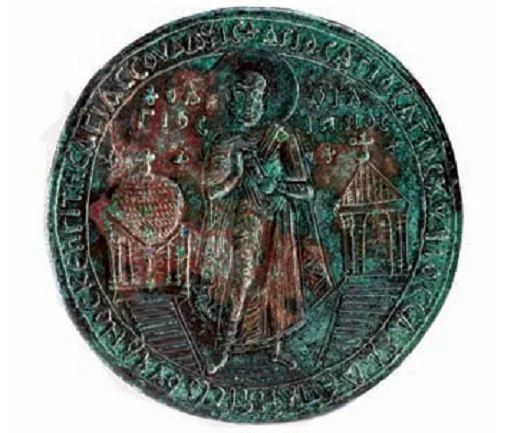
Bronze bread-stamp for the production of eulogiae, showing an image of *Philip (the Apostle, S00109), flanked by two buildings, topped by crosses and at the top of steps. Certainly from Hierapolis in south-west Phrygia (west central Asia Minor). Probably 6th-7th c. or later.
- Language
- Greek
- Date from
- 500
- Date to
- 700
- Evidence type
- Images and objects; Inscriptions
- Evidence subtype
- Inscribed objects; Lamps, ampullae and tokens; Narrative scenes; Other portable objects (metalwork, ivory, etc.)
- Evidence region
- Asia Minor
- Evidence location
- Hierapolis; Nicomedia, Νικομήδεια, Nikomēdeia, Izmit, Πραίνετος, Prainetos, Nicomedia
- Cult region
- Asia Minor
- Cult location
- Hierapolis; Nicomedia, Νικομήδεια, Nikomēdeia, Izmit, Πραίνετος, Prainetos, Nicomedia
- Cult date from
- 500
- Cult date to
- 700
Text
Round bronze disc. Diameter: 10.5 cm. Gripping ring on the back side. Reportedly found at Hierapolis, and, given the nature of the object, certainly from this site. Now in the Virginia Museum of Art, Richmond.
The central field of the disc is occupied by an elaborate engraved scene, showing a bearded man with nimbus, standing. He is holding a scroll with both his hands in front of his chest, and is wearing a long heavy cloak (resembling a pilgrim's outfit, according to Francesco D'Andria). To the man's right is shown an octagonal building at the top of a stairway, crowned by a dome with cross. To his left, is another building, likewise at the top of a stairway and with a cross on top of its gable.
Inscription 1 is engraved in mirror writing on both sides of the figure's head:
+ ὁ ἁ- Φιλ-
γιος ιππος
+ +
'+ Saint Philip + +.'
Inscription 2 runs on a band around the edge of the disc, in mirror writing:
+ ἅγιος, ἅγιος, ἅγιος Κύριος Σαβαώθ, πλήρις ὡ οὐρανὸς κὲ ἡ γῖ τῆς ἁγίας σου δώξις
'+ Holy, holy, holy Lord, God of hosts (Sabaoth)! Heaven and Earth are full of your holy glory!'
Text: D'Andria 2011-2012, 42.
Discussion
The object is certainly a bread-stamp for the production of eulogiae, small breads distributed to pilgrims, though it is an unusually elaborate version of the genre. Its reported provenance and the contents of the depicted scene strongly suggest that the object comes from the sanctuary of the Apostle Philip at Hierapolis (modern Pamukkale) in Phrygia, where early Christian tradition placed Philip's tomb.
The excavations conducted at the site by the Italian archaeological expedition, currently led by Francesco D'Andria, have revealed the remnants of a large octagonal shrine (the so-called martyrion) and of a three-aisled basilica close to it. There can be little doubt that D'Andria is correct in interpreting this image as depicting these two churches.
Inscriptions: Inscription 1 allows us to securely identify the figure as Philip the Apostle. He is holding a scroll as he was venerated in Hierapolis under the epithet Evangelist (see: E00890), probably as a result of a confusion with *Philip the Deacon, mentioned, for instance, in Acts 6,5 as one of the original seven deacons of the church in Jerusalem, and in Acts 21, 8-9 as an evangelist and father of four prophesising virgins, therefore a depository of divine knowledge. D'Andria notes that Inscription 2 is modelled on a passage from the Book of Isaiah (6,3), which was an element of the liturgy of the consecration of bread.
Bibliography
Edition:
Gonosovà, A., Kondoleon, Chr., Art of Late Rome and Byzantium in the Virginia Museum of Fine Arts (Baltimore: The Museum, 1994), 270-273, no. 94.
Further reading:
D'Andria, F., "Il santuario e la tomba dell'apostolo Filippo a Hierapolis di Frigia", Rendiconti della Pontificia Accademia Romana di Archeologia 84 (2011-2012), 42-45 and fig. 34.
D'Andria, F., "The sanctuary of St Philip in Hierapolis and the tombs of saints in Anatolian cities", in: J.R. Brandt, E. Hagelberg, G. Bjørnstad, and S. Ahrens, Life and Death in Asia Minor in Hellenistic, Roman, and Byzantine Times (Studies in Funerary Archaeology 10, Oxford - Philadelphia: Oxbow, 2017), 14.
Images
Associated saints
| Saint | Name in source | Certainty |
|---|---|---|
| Philip, the Apostle (S00109) | Φίλιππος | Certain |
| Philip the Deacon and Evangelist (S00604) | Φίλιππος | Certain |
Cult classifications
- Activities
- Production and selling of eulogiai, tokens
- Cult Places
- Burial site of a saint - tomb/grave; Cult building - independent (church); Place associated with saint's life
- Cult Related Objects
- Ampullae, flasks, etc.; Other
- Non Liturgical Activity
- Pilgrimage; Visiting graves and shrines
- Relics
- Ampullae, eulogiai, tokens; Contact relic - other; Making contact relics
- Use of Images
- Private ownership of an image
Record author
Paweł Nowakowski
Entry date
02/06/2017
Citation
Paweł Nowakowski, Cult of Saints, E02905 — https://csla.history.ox.ac.uk/record.php?recid=E02905