
E03081
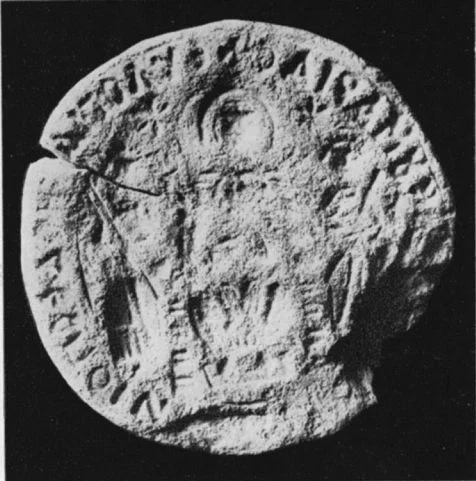
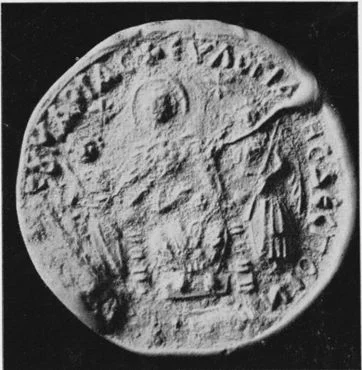
Clay stamp for making eulogiae with a Greek inscription referring to *Mary (Mother of Christ, S00033), and probably the Archangels *Michael (S00181) and *Gabriel (S00192). Found at Tel Mefalsim/Khirbet Deir Dusawi near Gaza (Roman province of Palaestina I). Probably 6th c.
- Language
- Greek
- Date from
- 500
- Date to
- 600
- Evidence type
- Images and objects; Inscriptions
- Evidence subtype
- Inscribed objects; Lamps, ampullae and tokens; Other portable objects (metalwork, ivory, etc.)
- Evidence region
- Palestine with Sinai
- Evidence location
- Gaza; Caesarea Maritima, Καισάρεια, Kaisareia, Caesarea, Kayseri, Turris Stratonis
- Cult region
- Palestine with Sinai
- Cult location
- Gaza; Caesarea Maritima, Καισάρεια, Kaisareia, Caesarea, Kayseri, Turris Stratonis
- Cult date from
- 500
- Cult date to
- 600
Text
Round clay stamp, broken and lost in the lower right-hand quarter. Diameter 0.1 m. Found in the 1960s by a member of Kibbutz Mefalsim at Tel Mefalsim/Khirbet Deir Dusawi, c. 9 km to the east of Gaza. Now in the Israel Museum, Jerusalem.
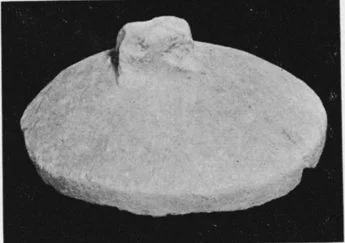
The stamp is made of greenish-yellow clay. The back is fitted with a handle. The central field on the front side is occupied by an image of the enthroned Virgin Mary, with her feet on a foot-stool, holding the Child Christ on her lap. Mary's head is flanked by two stars. Jesus is holding a codex, probably a Gospel, in his left hand and is performing a benediction with his right hand. To the left and to the right of Mary's throne, are two male figures: certainly an (arch)angel on one side; on the other, a male saint or an (arch)angel whose wings are worn away and so not visible; both carry sceptres. Rahmani identified them as the Archangels *Michael and *Gabriel. Ameling is less certain about their identity.
An inscription runs around the edge of the stamp (in mirror writing):
εὐλογία τῆς δεσποίν[ης ἡμῶν Θεοτό]κου Μαρίας
'Blessing (eulogia) of (our) Lady, the God-Bearer (Theotokos), Mary.'
Text: CIIP 3, no. 2526.
Source
First published with photographs and a drawing in 1970, by Levi Yizhaq Rahmani, Chief Curator of the Israel Antiquities Authority. Later mentioned by Yiannis Meimaris (with a fragmentary transcription and no reference to the editio princeps), and by Carol Glucker. A new edition is offered by Walter Ameling in the Corpus Inscriptionum Iudaeae Palaestinae.
Discussion
The stamp was certainly designed for making small breads (eulogiae) distributed to pilgrims and locals attending liturgy in a sanctuary of Mary. But the missing fragment made Rahmani, the first editor, think that the stamp was damaged during the firing, was discarded by the potter, and, therefore, actually never used.
Rahmani compares the image of Mary with those on ampullae at Monza (where Christ does not hold the Gospel, does not bless, and the angels are in flight), with an image of Mary in Santa Maria Antiqua in Rome, and with one in the cathedral of Porec.
Rahmani supposes that the stamp was possibly either brought to Gaza from one of the significant Holy Land sites of the cult of Mary (Jerusalem, Bethlehem, or Nazareth), or that it was made in a workshop at Gaza, for one of those shrines, or for a local sanctuary. The latter possibility is the most convincing, and Rahmani quotes a passage by Chorikios of Gaza, saying that the Church of St Sergios in Gaza housed in its apse a magnificent mosaic showing Mary with the Child Christ on her laps. Ameling notes that the formula of the inscription resembles somewhat those of clay lamps, labelled as originating from the workshop of one Ioannes (see E01657; E02830).
Dating: according to Rahmani the stamp can be safely dated to the 6th c., based on its archaeological context.
Bibliography
Edition:
Ameling, W., Ecker, A., Hoyland, R. (eds.), Corpus Inscriptionum Iudaeae/Palaestinae, vol. 3: South Coast, 2161-2648: A Multi-Lingual Corpus of the Inscriptions from Alexander to Muhammad ( Berlin - Boston, Massachusetts: De Gruyter, 2014), no. 2526.
Glucker, C., The City of Gaza in the Roman and Byzantine Periods (Oxford: B.A.R, 1987), 154-155, no. 44.
Rahmani, L.Y., "A "Eulogia" Stamp from the Gaza Region", Israel Exploration Journal 20 (1970), 105-108 and Pl. 28A-C.
Fuerther reading:
Meimaris, Y., Sacred names, saints, martyrs and church officials in the Greek inscriptions and papyri pertaining to the Christian Church of Palestine (Athens: National Hellenic Research Foundation, Center for Greek and Roman Antiquity, 1986), 84, no. 538 (fragmentary transcription).
Images
Associated saints
| Saint | Name in source | Certainty |
|---|---|---|
| Mary, Mother of Christ (S00033) | Μαρία | Certain |
| Michael, the Archangel (S00181) | Uncertain | |
| Gabriel, the Archangel (S00192) | Uncertain |
Cult classifications
- Activities
- Production and selling of eulogiai, tokens
- Cult Places
- Cult building - unspecified
- Cult Related Objects
- Ampullae, flasks, etc.; Other
- Non Liturgical Activity
- Pilgrimage; Visiting graves and shrines
- Relics
- Ampullae, eulogiai, tokens; Contact relic - other; Making contact relics
- Use of Images
- Private ownership of an image; Public display of an image
Record author
Paweł Nowakowski
Entry date
23/06/2017
Citation
Paweł Nowakowski, Cult of Saints, E03081 — https://csla.history.ox.ac.uk/record.php?recid=E03081