
E03496
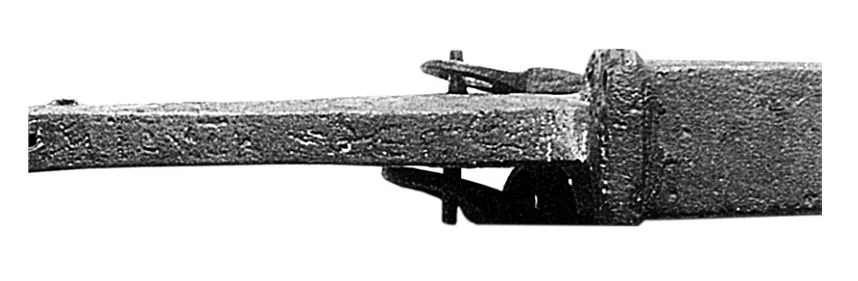
Greek inscription on a balance scale, possibly invoking the God of *George (soldier and martyr, S00259). Found at Dor (Tanturah) bay, to the north of Caesarea Maritima (Roman province of Palaestina I). Probably late antique.
- Language
- Greek
- Date from
- 400
- Date to
- 700
- Evidence type
- Images and objects; Inscriptions
- Evidence subtype
- Inscribed objects; Other portable objects (metalwork, ivory, etc.)
- Evidence region
- Palestine with Sinai
- Evidence location
- Caesarea Maritima; Caesarea Maritima, Καισάρεια, Kaisareia, Caesarea, Kayseri, Turris Stratonis; Dor; Caesarea Maritima, Καισάρεια, Kaisareia, Caesarea, Kayseri, Turris Stratonis
- Cult region
- Palestine with Sinai
- Cult location
- Caesarea Maritima; Caesarea Maritima, Καισάρεια, Kaisareia, Caesarea, Kayseri, Turris Stratonis; Dor; Caesarea Maritima, Καισάρεια, Kaisareia, Caesarea, Kayseri, Turris Stratonis
- Cult date from
- 400
- Cult date to
- 700
Text
The balance bears three inscriptions, punched on the short section of its lever:
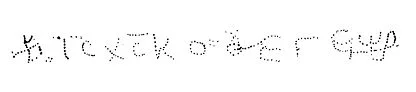
Inscription C was transcribed by de Presle as: ΙCΧC Ο ΘΕ Γ Ε ΨΡ and expanded as:
Ἰ(ησοῦ)ς Χ(ριστὸ)ς κ(αὶ) ὁ θε(ὸς) γ(εννηθεὶς), ἐ(λεήσον) Ψ(- - -) Ρ(- - -)
'Jesus Christ and begotten God, have mercy on Psates, of Rhion (or: Psates, son of Rhion)!'
Text: CIIP 2, no. 2143.
Translation: W. Ameling, lightly modified.
However, Jean Gascou in Bulletin épigraphique (2013), 463 suggests a different reading of the inscription, based on the drawing published in CIIP 2:
(christogram) ΙCΧCΚΟΘΕΓΕΙΩΡ/ which can be expanded for example as (christogram) Ἰ(ησοῦ)ς Χ(ριστὸ)ς, Κ(ύρι)ε, Θ(ε)ὲ Γειωρ(γίου)/'(christogram) Jesus Christ, Lord, God of George!'
Gatier points out that the name George/Georgios is spelt in the same way (Γειώργιος) in Inscription A from the same balance: Ἰ(ησοῦ)ς Χ(ριστὸ)ς βοήθισον | Γειωργίου ΩΙCΟΙΟΝΟC/'Jesus Christ, give help to Georgios (Geiorgios), son of ...'
Inscription B says the balance was the property of Sotirichos and Artemon.
Source
A large bronze balance, found during underwater surveys at the bay of Dor in the winter of 1990/1991, supervised by Kurt Raveh and Sean A. Kingsley. Now in the Center of Nautical and Regional Archaeology at Kibbutz Naḥsholim. First published by André de la Presle in 1993. Re-examined by Walter Ameling in March 2010 and re-published by him in the second volume of the Corpus Inscriptionum Iudaeae/Palaestinae.
Discussion
If Gascou's interpretation and expansion of the text is correct, it is possible that we have here an invocation of the God of Saint George, probably authored by an homonymous supplicant (from Inscription A). For two other cases where balances or weights were associated with saints or churches dedicated to saints, see: E01821 (Daphne (modern Harbiye) near Antioch on the Orontes; a balance scale inscribed with the name of *Sergios) and E02871 (Caesarea Maritima, weight of (a church) of *Mary).
We must, however, remember that Gascou's reading could be expanded in several different ways, as he himself underscores, and the one we discuss here need not be correct.
Bibliography
Edition:
Ameling, W., Cotton, H.M., Eck, W., and others, Corpus inscriptionum Iudaeae/Palaestinae: A Multi-Lingual Corpus of the Inscriptions from Alexander to Muhammad, vol. 2: Caesarea and the Middle Coast 1121-2160 (Berlin, Boston: De Gruyter, 2011), no. 2143.
de la Presle, A., "Inscriptions grecques sur deux balances romaines trouvées a Dor", La Revue biblique 100 (1993), 585-586, no. 1a-c.
Reference works:
Bulletin épigraphique (1994), 641; (2013), 463.
Supplementum Epigraphicum Graecum 43, 1050a-c.
Images
Associated saints
| Saint | Name in source | Certainty |
|---|---|---|
| George, soldier and martyr, and Companions (S00259) | Γειώργιος | Uncertain |
Cult classifications
- Non Liturgical Activity
- Prayer/supplication/invocation
- People
- Other lay individuals/ people
Record author
Paweł Nowakowski
Entry date
25/07/2017
Citation
Paweł Nowakowski, Cult of Saints, E03496 — https://csla.history.ox.ac.uk/record.php?recid=E03496