
E03502
Floor-mosaics with Greek inscriptions labelling a church dedicated to *Bakchos (probably the soldier and martyr of Barbalissos, S00079). Found at modern Horvat Tinshemet near Shoham (Roman province of Palaestina I). Probably 6th c.
- Language
- Greek
- Date from
- 500
- Date to
- 800
- Evidence type
- Archaeological and architectural; Inscriptions
- Evidence subtype
- Altars with relics; Cult buildings (churches, mausolea); Extant reliquaries and related fixtures; Formal inscriptions (stone, mosaic, etc.)
- Evidence region
- Palestine with Sinai
- Evidence location
- Horvat Tinshemet; Caesarea Maritima, Καισάρεια, Kaisareia, Caesarea, Kayseri, Turris Stratonis
- Cult region
- Palestine with Sinai
- Cult location
- Horvat Tinshemet; Caesarea Maritima, Καισάρεια, Kaisareia, Caesarea, Kayseri, Turris Stratonis
- Cult date from
- 500
- Cult date to
- 800
Text
Inscription 1:
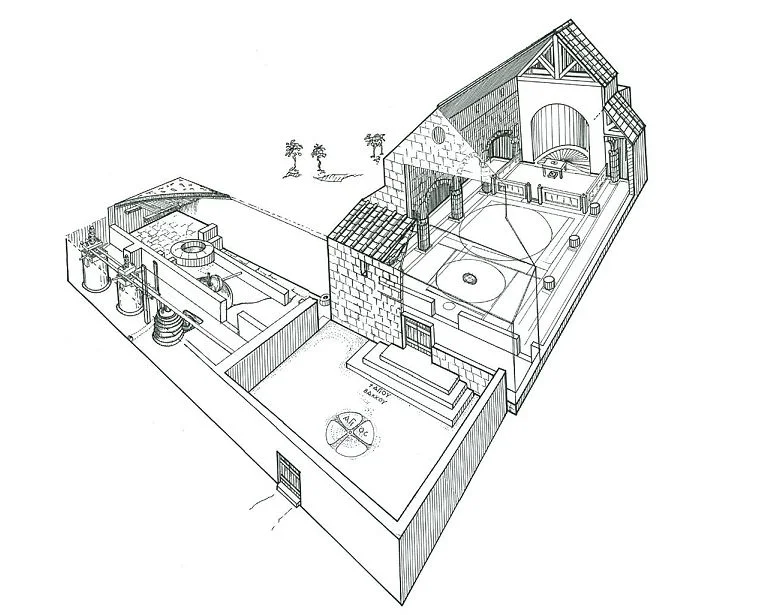
Mosaic inscription at the east end of the floor-mosaic of the atrium, in front of the steps leading to the narthex. There is no frame.
ἁγίου
Βάκχου
'Of Saint Bakchos.'
Inscription 2:
Framed by a mosaic medallion in the middle of the floor of the atrium. Diameter 1.26 m. The border and the cross within the medallion are made of red tesserae. Black letters on white background.
ἅγι- ος
[- - -]
'Holy [- - -].'
Inscription 3:
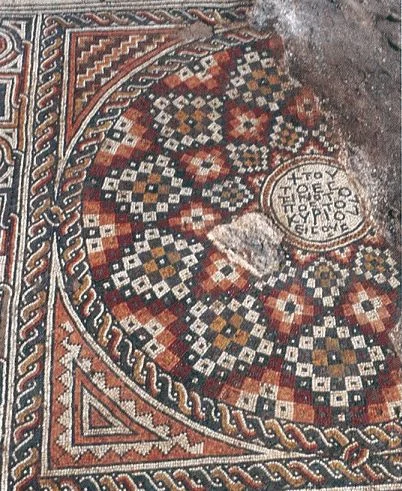
Framed by a medallion in the middle of the carpet mosaic of the nave. Black letters on white background. The border consists of several bands of black, white, and red tesserae.
+ τοῦ-
τό ἐσ-
τιν ὁ τό-
πος τοῦ
Κυρίου
Εἰσοῦς
'+ This is the place (i.e. church) of the Lord Jesus.'
Text: Dahari 2012, 105, 107.)
Source
The inscriptions come from a church first recorded in 1986 in the outskirts of Horvat Tinshemet (also known as Sheikh 'Ali Malikina; Khirbet esh-Shamiya) near Shoham. The site was excavated in 1995 by Uzi Dahari on behalf of the Israeli Antiquities Authority. Further conservation of the floor-mosaics took place in 2002/2003, and a new project aimed at the preservation of the site and dissemination of knowledge about it was launched in 2011 with the aid of the Jewish National Fund and a local school.
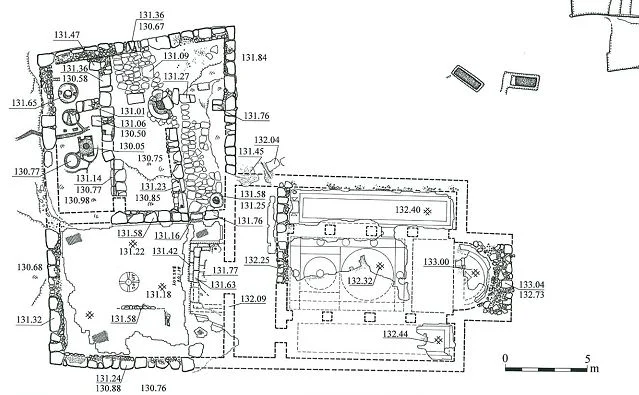
The building was a three-aisled basilica (27 m x 11.7 m) with an inscribed apse, and a narthex, preceded by an atrium at its west end. To the north of the atrium there was a compound with an oil press and a cistern.
The floors of the church were laid-out with mosaics decorated with rosettes, geometric motifs, crosses, and vine shoots sprouting out of vases. The carpet mosaic in the north aisle is completely preserved. Of the mosaic in the nave, only the north half survives. The mosaics of the apse and the south aisle are in very poor condition. The atrium was also paved with a mosaic which is very well preserved.
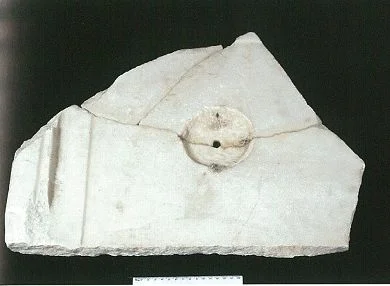
In the apse the excavators found a marble altar (shaped as a table: 0.60 m x 0.64 m), with a round cavity and a hole at its base. Four iron nails lay inside the cavity. Uzi Dahari says that the nails 'were probably meant to support a small ciborium that was intended to enhance the sanctity of the relics that were placed in the reliquary below the center of the altar' (2012, 106). As for the reliquary, only a fragment of its lid, made of marble, was recorded.
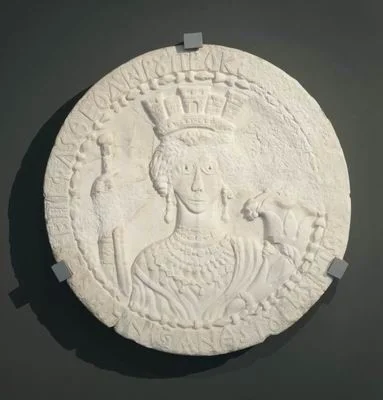
A remarkable marble token (diameter 0.67 m) with a sculpted portrait of Tyche was found in the church. This kind of marble is traced to west Asia Minor (Aphion, Aphrodisias, or Ephesos). The medallion was inscribed with a dedicatory inscription probably for a public building and a date in a Pompeian era, probably corresponding to AD 585. It is believed to have been brought from Gaza (where the Pompeian era of 61 BC was used) and donated to the church. In Madden's corpus of mosaic pavements (2014, 133) this object is probably by mistake referred to as a fragment of a broken chancel screen with a dated inscription. Now in the Israel Museum, Jerusalem (IAA 1996-3434).
Discussion
The inscriptions unquestionably label the church as a sanctuary of a Saint Bakchos. Dahari is not sure of the identity of the saint: whether this is the companion of the famous *Sergios, martyr of Rusafa (who was usually venerated alone), or a local martyr. If it is really Bakchos of Barbalissos, his independent occurrence would be of great importance. For another church dedicated to Bakchos, with no evidence for the simultaneous cult of Sergios, see E02085 (Qarfa near Bostra in Arabia, AD 589/590).
Dating: Uzi Dahari dates the construction of the church to the 6th c., based on the style of its mosaics and architecture, and on the fact that it must pre-date the presumed offering of the marble token, almost certainly produced in AD 585. The church was probably abandoned in the 8th c.
Bibliography
Dahari, U., "The church of St. Bacchus near Horvat Tinshemet", in: L.D. Chrupcała (ed.), Christ is here! Studies in Biblical and Christian Archaeology in Memory of Michele Piccirillo, ofm (SBF Collectio Maior 52, Milan: Edizioni Terra Santa, 2012), 105-124.
Madden A.M., Corpus of Byzantine Church Mosaic Pavements in Israel and the Palestinian Territories (Colloquia Antiqua 13, Leuven, Walpole, MA: Peeters, 2014), 132.
Dahari, U., Tinshemet, "Ḥorvat (Church of St. Bacchus)", in: New Encyclopedia of Archaeological Excavations in the Holy Land, vol. 5, 2054-2056.
Dahari, U., "Horbat Tinshemet, Church of St. Bacchus", Excavation and Surveys in Israel 18 (1996), 67-68.
Dahari, U., "Horbat Tinshemet: Church of St. Bacchus", Hadashot Arkheologiyot 106 (1996), [in Hebrew].
See also
http://www.iaa-conservation.org.il/Projects_Item_eng.asp?site_id=76&subject_id=8
Ashkenazi, J., "Family rural churches in late antique Palestine and the competition in the ‘field of religious goods’: A socio-historical view", Journal of Ecclesiastical History 68 (2018), 719.
Reference works:
Supplementum Epigraphicum Graecum 62, 1683.
Images
Associated saints
| Saint | Name in source | Certainty |
|---|---|---|
| Bakchos, soldier and martyr of Barbalissos (S00079) | Βάκχος | Uncertain |
Cult classifications
- Cult Places
- Altar; Cult building - independent (church)
- Relics
- Reliquary – institutionally owned
Record author
Paweł Nowakowski
Entry date
26/07/2017
Citation
Paweł Nowakowski, Cult of Saints, E03502 — https://csla.history.ox.ac.uk/record.php?recid=E03502