
E03538
Floor-mosaic with a Syriac inscription commemorating the paving of a martyr shrine (bet sahdē), and mentioning a Saint *John (probably the Baptist, S00020; possibly the Apostle and Evangelist, S00042). Found at al-Nabgha al-Kebira (to the north-east of Beroia/Aleppo, north Syria). Dated, probably 406/407.
- Language
- Syriac
- Date from
- 406
- Date to
- 407
- Evidence type
- Archaeological and architectural; Inscriptions
- Evidence subtype
- Cult buildings (churches, mausolea); Formal inscriptions (stone, mosaic, etc.)
- Evidence region
- Syria with Phoenicia
- Evidence location
- Beroia; Antioch on the Orontes, Ἀντιόχεια, Antiocheia, Antiochia ad Orontem, Ἀντιόχεια Μεγάλη, Ἀντιόχεια ἐπὶ Ὀρόντου, Antakya; al-Nabgha al-Kebira; Antioch on the Orontes, Ἀντιόχεια, Antiocheia, Antiochia ad Orontem, Ἀντιόχεια Μεγάλη, Ἀντιόχεια ἐπὶ Ὀρόντου, Antakya
- Cult region
- Syria with Phoenicia
- Cult location
- Beroia; Antioch on the Orontes, Ἀντιόχεια, Antiocheia, Antiochia ad Orontem, Ἀντιόχεια Μεγάλη, Ἀντιόχεια ἐπὶ Ὀρόντου, Antakya; al-Nabgha al-Kebira; Antioch on the Orontes, Ἀντιόχεια, Antiocheia, Antiochia ad Orontem, Ἀντιόχεια Μεγάλη, Ἀντιόχεια ἐπὶ Ὀρόντου, Antakya
- Cult date from
- 406
- Cult date to
- 407
Text
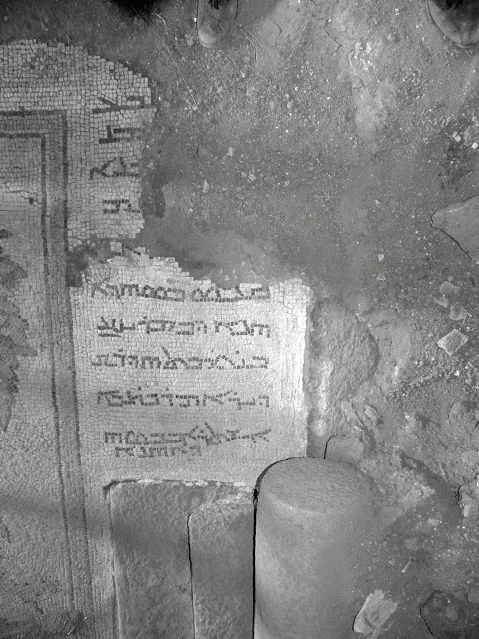
ܫܒܥ [...]
ܡܢ [...]
ܠܐ [...]
ܡ [...]
ܙ ܐܬ [...]
ܩܦܤ ܒܣܗܕܐ
ܗܢܐ ܕܒܡܪ ܝܚܢܢ
ܒܝܘ̈ܡܬܗ ܕܪܫ
ܕܝܪܐ ܡܪ ܒܪܢܒܐ
ܐܫܬܪܐ ܒܒܣܗ
ܕܐ ܗܢܐ
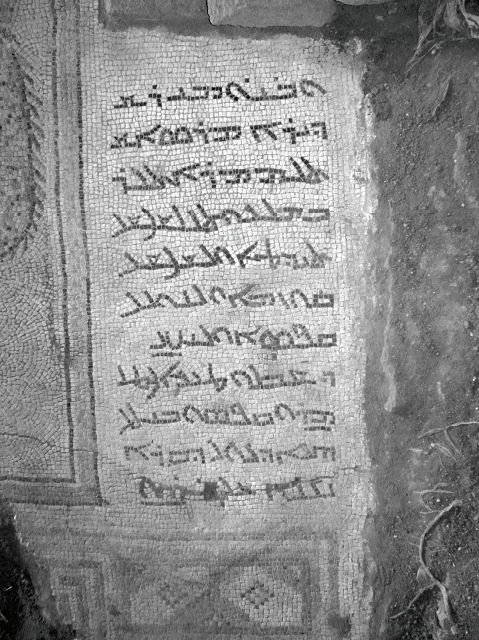
ܘܒܝܘ̈ܡܝ ܪܫ
ܕܝܪܐ ܡܪܤ ܐܫ
ܬܠܡ ܡܪܐ ܬܟܪ
ܒܡܠܟܘܬܐ ܠܫܡܫܐ
ܬܝܕܛܐ ܘܠܫܡܫܐ
ܩܘܙܡܐ ܘܠܢܘܚ
ܩܦܣܐ ܘܠܝܚܢܢ
ܕܫܩܠܘ ܛܥܢܐ ܡܛܠ
ܡܪܢ ܘܩܦܣܘ ܒܝܬܐ
ܗܢܐ ܕܟܘܠ ܕܩܪܐ
ܢܨܠܐ ܥܠܝܗ̈ܘܢ
'[- - -] eight-... [- - -] seven, this martyrion was mosaiced, which is in St. John. In the days of Father Superior Mar Barnaba the work was started in that martyrion, and in the days of Father superior Mares this work was completed. Lord, in the kingdom, remember deacons Theodotos and Kosma, and mosaicist Noah, and John, who all undertook the charge for Our Lord and have mosaiced this house so that whoever readeth shall pray for them.'
Text: Briquel Chatonnet & Desreumaux 2011, 48-49.
Translation: Fr. Briquel Chatonnet & A. Desreumaux.
Source
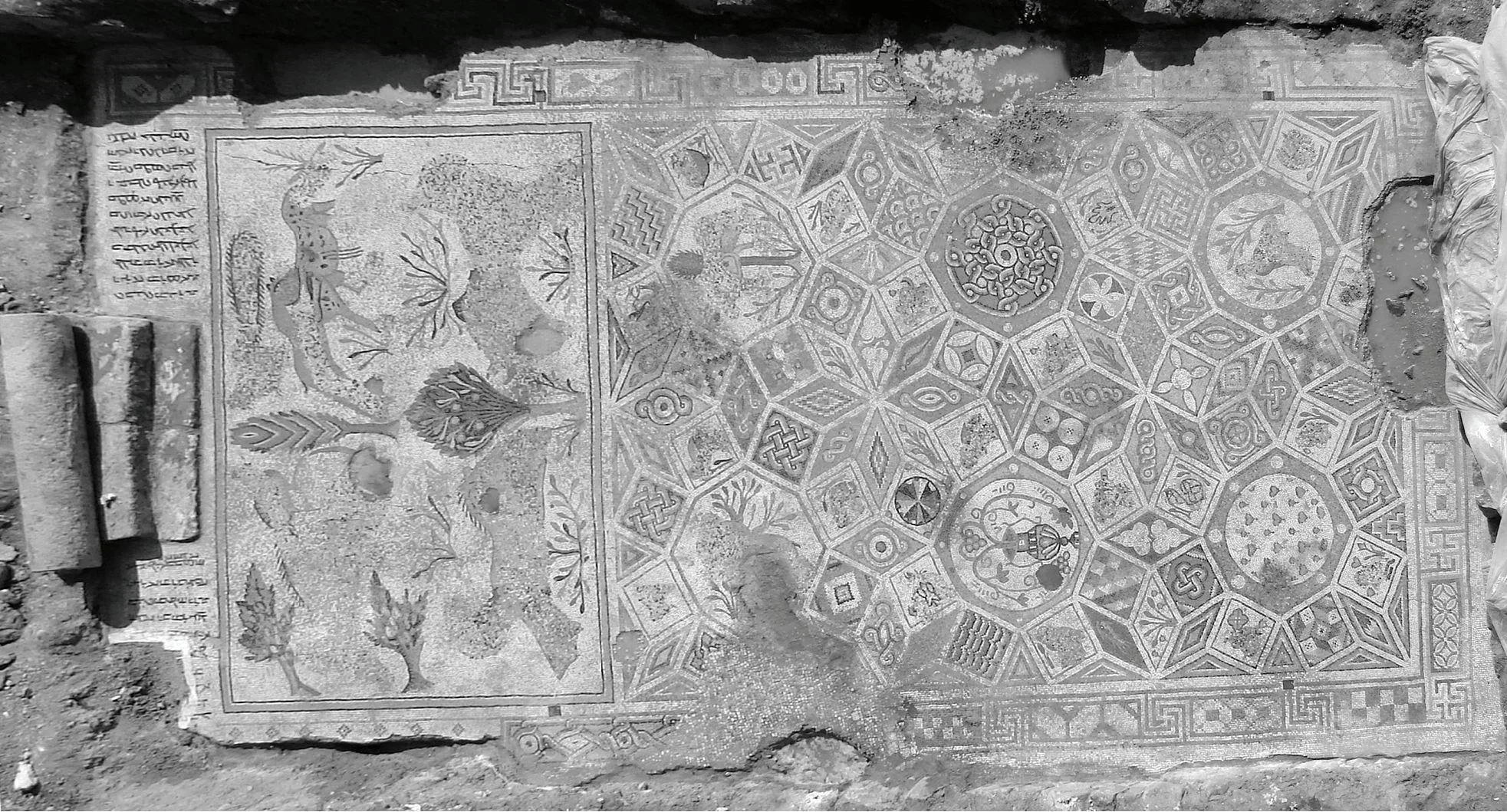
Mosaic inscription, laid-out in two superimposed columns, divided by a two-stepped stone threshold, on the east border of a mosaic pavement (9.59 m x 5.34-5.37 m), immediately to the north of a rectangular panel (2.60 m x 3.80 m) with hunting scenes, trees, and other plants. Dimensions of the north column: 1.05 m x 0.53 m, dimensions of the south column: 1.09 m x 0.57 m. Letter height 0.03-0.075 m (usually 0.045 m). Black letters on white background. The inscription is designed to be read by a person facing north.
The rest of the carpet mosaic is decorated with octagons and lozenges containing geometric motifs, images of plants, and animals, birds, and vine-sprouts growing out of a vase. The mosaic was stylistically identified as probably the work of an itinerant mosaic workshop from Antioch. The editors note that the palaeography of the two columns is different. Thus, it is probable that they were laid by two mosaicists, working simultaneously. The images of animals were removed during a period of iconoclasm.
Found in 2007 in the village of al-Nabgha al-Kebira, to the north-east of Beroia (modern Aleppo), the canton of Ghendura (the Jarablus area) during rescue excavations by the Syrian archaeological mission of Aleppo, supervised by Yusef Kanjo. The excavators had no time to investigate the rest of the building, so its exact plan is unknown. The inscription was examined in 2010 by members of the Syro-French mission with permission of the Syrian General Directorate of Antiquities and Museums. By that time the mosaic had been cleaned and restored, and ready to be transferred to the Aleppo Museum. Its present whereabouts are unknown to us. First published in 2008 by Françoise Briquel Chatonnet and Alain Desreumaux, and again in 2011, with extended commentary by the same editors.
Discussion
The inscription commemorates the paving with mosaics of the floor of a martyr shrine (termed:bet sahdē). We also learn that the martyr shrine 'is in St. John'/da-b-mār Yuḥannān, that it is probably in a church dedicated to St. John (as suggested by the editors) belonging to a monastery (as two monastic superiors are mentioned in column 1). Sadly, we do not know precisely if the mosaic lay in an aisle (for example in front of a chapel dedicated to the cult of the martyr) or the nave, but the width of the carpet mosaic (just 5.34 m) suggests that the inscription was sited in an aisle, in front of the entrance to a chamber flanking the apse, probably a martyr's chapel (bet sahdē). The inscription was designed to be read by a person facing north. Therefore, it is very probable that it was located in the north aisle.
The saint is probably John the Baptist whose cult was popular in the region and who was considered a (pre-Christian) martyr, with monastic connotations.
Dating: The editors identify our text as the earliest dated Christian Syriac inscription so far discovered in north Syria. The date was probably given in the initial lines of the south panel, now partially lost. The numeral 'seven', which is still preserved, is likely to be the number of hundreds in a date computed, according to the Seleucid era normally used in the region. Based on fragmentarily preserved other letters, the editors restore the date as 718 = AD 406/407. This is in accordance with their palaeographical analysis of the lettering, which shows some 'archaic' features of the estrangelo script of 2nd-3rd c. Edessene inscriptions. The phrasing is also 'archaic' and does not use the regular terms of 6th c. dedicatory inscriptions. For example, the editors say that 'the verb that is used here [to denote the paving], derives from the Greek kubos/"cube", hence "tessera". It is not a word that is commonly used in Syriac.' (cf. the comments on a similar word in E03603, dated AD 375/376). If the restoration is correct, the inscription would pre-date the Syriac inscription of Dar Qita in the territory of Antioch (AD 433/434), formerly the earliest known Christian Syriac epigraphic monument, and the Edessa manuscript BL Add. 12150 (AD 411). If the dating is correct, the church itself must have been even constructed earlier, probably in the 2nd half of the 4th c.
Bibliography
Edition:
Briquel Chatonnet, Fr., Desreumaux, A., "Oldest Syriac Christian inscription discovered in North-Syria", Hugoye: Journal of Syriac Studies 14/1 (2011), 45-61.
Briquel Chatonnet, Fr., Desreumaux, A., "L’inscription", in: F. Aysah (ed.), Le martyrion Saint-Jean dans la moyenne-vallée de l'Euphrate : fouilles de la direction générale des antiquités à Nabgha au NE de Jerablous (Documents d'archéologie syrienne 13, Damascus: Ministère de la Culture Direction Générale des Antiquités et des Musées, 2008), 23-28.
Images
Associated saints
| Saint | Name in source | Certainty |
|---|---|---|
| John, the Apostle and Evangelist (S00042) | ܡܪ ܝܚܢܢ | Uncertain |
| John the Baptist (S00020) | ܡܪ ܝܚܢܢ | Uncertain |
Cult classifications
- Cult Places
- Cult building - dependent (chapel, baptistery, etc.); Cult building - independent (church); Cult building - monastic; Martyr shrine (martyrion, bet sāhedwātā, etc.)
- Non Liturgical Activity
- Renovation and embellishment of cult buildings
- People
- Ecclesiastics - abbots; Ecclesiastics - lesser clergy; Merchants and artisans
- Places Names after Saint
- Monastery
Record author
Paweł Nowakowski, Sergey Minov
Entry date
07/08/2017
Citation
Paweł Nowakowski, Sergey Minov, Cult of Saints, E03538 — https://csla.history.ox.ac.uk/record.php?recid=E03538