
E03555
Three Greek inscriptions from Khirbet el-Jiljil and Beit Jimal (close to Eleutheropolis, Roman province of Palaestina I) once implausibly identified as referring to a shrine built at the site of the tomb of *Stephen (the First Martyr, S00030) at Caphargamala, but actually connected to a wine press and a regular dining room. Probably 5th-6th c.
- Language
- Greek
- Date from
- 400
- Date to
- 600
- Evidence type
- Archaeological and architectural; Inscriptions
- Evidence subtype
- Cult buildings (churches, mausolea); Formal inscriptions (stone, mosaic, etc.)
- Evidence region
- Palestine with Sinai
- Evidence location
- Beit Jimal; Caesarea Maritima, Καισάρεια, Kaisareia, Caesarea, Kayseri, Turris Stratonis; Cafargamala; Caesarea Maritima, Καισάρεια, Kaisareia, Caesarea, Kayseri, Turris Stratonis; Eleutheropolis; Caesarea Maritima, Καισάρεια, Kaisareia, Caesarea, Kayseri, Turris Stratonis; Khirbet el-Jiljil; Caesarea Maritima, Καισάρεια, Kaisareia, Caesarea, Kayseri, Turris Stratonis
- Cult region
- Palestine with Sinai
- Cult location
- Beit Jimal; Caesarea Maritima, Καισάρεια, Kaisareia, Caesarea, Kayseri, Turris Stratonis; Cafargamala; Caesarea Maritima, Καισάρεια, Kaisareia, Caesarea, Kayseri, Turris Stratonis; Eleutheropolis; Caesarea Maritima, Καισάρεια, Kaisareia, Caesarea, Kayseri, Turris Stratonis; Khirbet el-Jiljil; Caesarea Maritima, Καισάρεια, Kaisareia, Caesarea, Kayseri, Turris Stratonis
- Cult date from
- 400
- Cult date to
- 600
Text
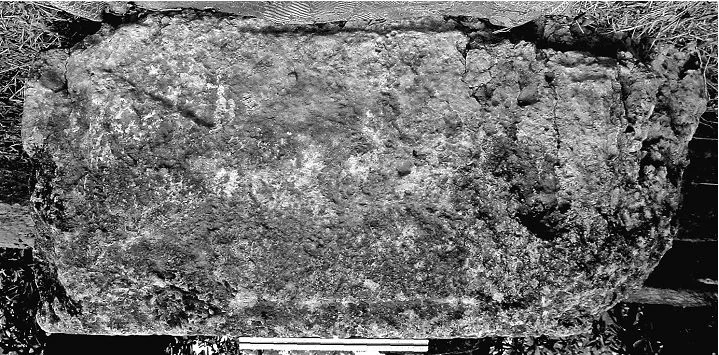
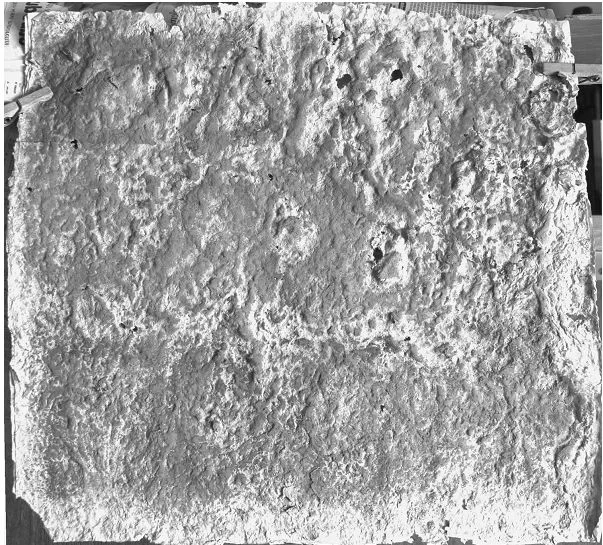
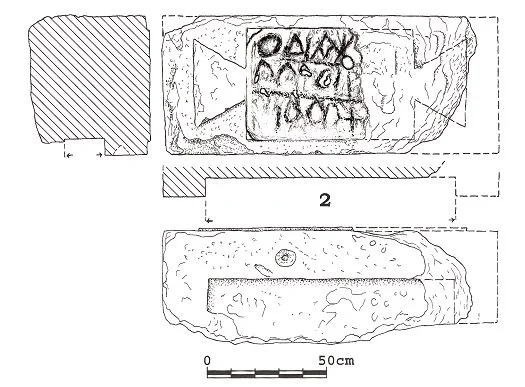
A survey of the village of Khirbet el-Jiljil near Beit Jimal (close to Eleutheropolis and to the south-west of Jerusalem), conducted in 2003 by Andrzej Strus and Shimon Gibson, revealed a stone lintel lying loose among ancient buildings, and bearing a carved tabula ansata (0.70 m x 0.46 m). The face with the tabula was so badly weathered that the surveyors could not say if it was inscribed.
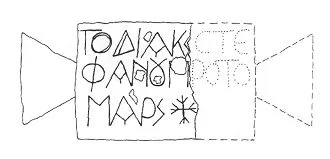
The examination of the stone was commissioned to Émile Puech who, based on a squeeze, read the inscription as follows:
τὸ διακ(ονικὸν) [Στε]-
φάνου π[ροτο]- (sic!)
μάρ(τυρος) +
'The diakonikon of Stephen the First Martyr. +'
Text: Puech 2006, 110.
Puech used this tentative reading to argue that modern Beit Jimal/Bet Gemal was the site of ancient Caphar Gamala where the relics of Stephen were found by the presbyter Loukianos in 415. The story is known from a number of contemporary sources which describe the circumstances of the discovery and the division of the relics.
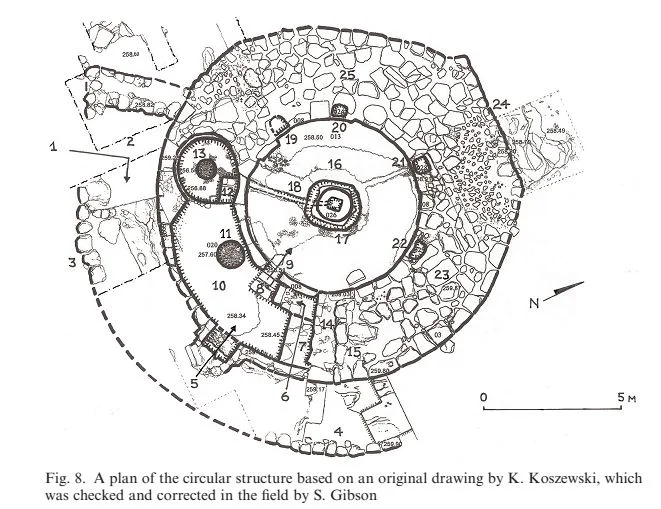
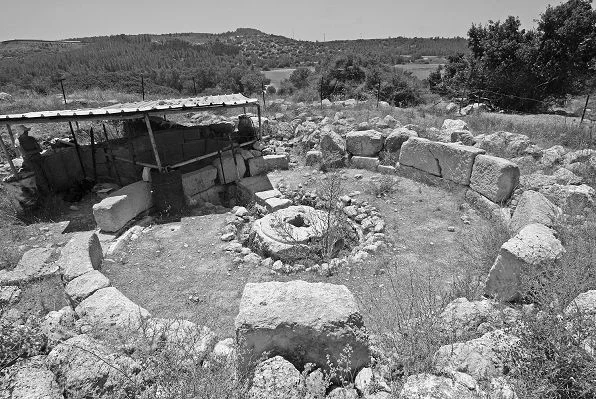
The site where the inscription was found features ruins of a round structure (diameter 13 m), first surveyed by Strus in 1993 and excavated in 1999. Strus, even before the discovery of our inscription, supposed that it was a 4th c. memorial shrine of an important religious figure, probably built over his or her tomb, possibly with a basin for ritual bath, which was later abandoned (purportedly as a result of the Decretum Gelasianum of 494, condemning apocryphal stories on inventions of relics, see E03336, E03338), and converted to a wine press. Following this reasoning Puech suggested that it was the diakonikon allegedly mentioned in the inscription, and therefore a shrine dedicated to Stephen, one of the first seven deacons.
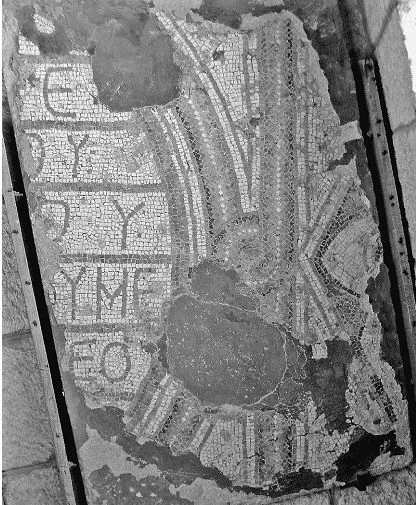
Furthermore, Puech used these suppositions to offer a new reading of a very fragmentarily preserved mosaic panel from the 'Byzantine church' at Beit Jimal, first published by Françoise-Marie Abel in 1919. No more than single letters are preserved in each line, but Puech gives an extensive restoration:
[+]
[Κ(ύρι)ε Ἰ(ησο)ῦ βωή]θε-
[σον Λουκιαν]οῦ
[εὐσεβεστά]του
[πρεσβ(υτέρου) καὶ ἡγ]ουμέ-
[νου Μεγεθίου θ]εο-
[σεβεστάτου]
[+]
'+ Lord, Jesus, help Loukianos, the most pious priest, and Megethios, the most God-fearing abbot (higoumenos)! +'
Text: Puech 2006, 102-103.
Both Loukianos and Megethios are protagonists of the story of the invention of relics of Stephen, and the insertion of their names in this almost entirely lost text was dictated only by the supposed association of the site with ancient Caphar Gamala.
Finally, Puech mentioned one more text, from a floor-mosaic found in a corridor annexed to the dining room (triclinium) of a building at Khirbet el-Jiljil (see Di Segni 2005, SEG 56, 1893, Di Segni & Gibson 2007, 140-141). The text is very short: εἴσιθι χαίρων/'Enter rejoicing!', and according to Puech, is a paraphrase of a passage from the Book of Tobias, placed in a hall designed for cultic feasts in honour of Stephen the First Martyr.
Puech's ideas were rightly refuted by Denis Feissel (in Bulletin épigraphique) and by Leah Di Segni and Shimon Gibson in a special paper published as a direct response of the excavators to his interpretation of the results of their field work.
Di Segni and Gibson re-examined the lintel, and made a new squeeze, a drawing, and a high quality photograph 'using special angled lighting'. Based on this new documentation, they read the lintel inscription as:
ΟΔΙΑ̣Κ[- - -]
̣Μ[- - -]
̣Π[- - -]
which, they say, may just possibly mean ὁ διακ(ὼν) [ὁ δεῑνα ἐ]π[οιησε]/'The deacon so-and-so built it.' Therefore, there is no basis to suppose that the lintel comes from a sanctuary of the First Martyr (for a detailed analysis of the inscription, see Di Segni & Gibson 2007). Similarly, a close re-examination of the round building, shows that it 'was intentionally designed as a wine press and not for any other purpose', although an admittedly large one (of an 'industrial size', 'for large-scale wine production, presumably as an installation belonging to the villa rustica building complex at Khirbet el-Jiljil', see Di Segni & Gibson 2007, 126, 132).
As for the mosaic with the greeting at the alleged cultic dining hall, they rightly say that this kind of welcoming inscription was ubiquitous in the Mediterranean, and there is no reason to consider the room as anything more than a common triclinium.
Di Segni and Gibson (2007, 136) rightly note that the identification of Beit Jimal with Caphar Gamala was considered implausible already in the early 20th c. by Françoise-Marie Abel and Louis H. Vincent, who pointed to the village of Jemmala sited to the north-west of Jerusalem as a far better candidate. An important argument is that the invention of the relics of Stephen involved a bishop of Jerusalem, while Beit Jimal was almost certainly within the bishopric of Eleutheropolis.
We have included these inscriptions in our database in case anyone has encountered Puech's hypotheses and wishes to know whether they are remotely plausible - and also as an object lesson of how epigraphists can get carried away when interpreting fragmentary inscriptions!
Bibliography
Edition:
Di Segni, L., Gibson, S., "Greek inscriptions from Khirbet el-Jiljil and Beit Jimal and the identification of Caphar Gamala", Bulletin of the Anglo-Israel Archaeological Society 25 (2007), 117-145 (with further bibliography).
Puech, É., "Un mausolée de Saint Étienne à Khirbet Jiljil - Beit Gimal", La Revue biblique 113, 100-126.
Di Segni, L., "An inscription from Khirbet el-Jiljil", Bulletin of the Anglo-Israel Archaeological Society 23 (2005), 101-106.
Abel, F.M., "Une chapelle byzantine à Beit el-Jimal", La Revue biblique 16 (1919), 244-248.
Further reading:
Gisler, M., "Das Grab des heiligen Stefan", Das heilige Land 61 (1917), 15-21.
Madden A.M., Corpus of Byzantine Church Mosaic Pavements in Israel and the Palestinian Territories (Leuven - Walpole, MA: Peeters, 2014), 25-26, no. 23 (with further bibliography).
Mallon, A., "Le sanctuaire byzantin de Beit Djemal", Biblica 3 (1922), 505.
Strus, A., Gibson, S., "New excavations at Khirbet el-Jiljil (Bet Gemal) Near Beth Shemesh", Bulletin of the Anglo-Israel Archaeological Society 23 (2005), 29–89.
Reference works:
Bulletin épigraphique (2007), 519.
Supplementum Epigraphicum Graecum 56, 1892-1894.
Images
Associated saints
| Saint | Name in source | Certainty |
|---|---|---|
| Stephen, the First Martyr (S00030) | Uncertain |
Cult classifications
- Cult Places
- Burial site of a saint - tomb/grave; Cult building - independent (church)
- People
- Ecclesiastics - abbots; Ecclesiastics - bishops; Ecclesiastics - lesser clergy; Ecclesiastics - monks/nuns/hermits
- Relics
- Bodily relic - entire body; Construction of cult building to contain relics; Discovering, finding, invention and gathering of relics; Transfer, translation and deposition of relics
Record author
Paweł Nowakowski
Entry date
09/08/2017
Citation
Paweł Nowakowski, Cult of Saints, E03555 — https://csla.history.ox.ac.uk/record.php?recid=E03555