
E03571
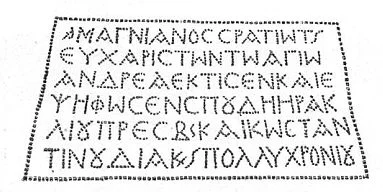
Floor-mosaic with a Greek inscription recording the construction and paving with mosaics of a church, in thanks to *Andrew (probably the Apostle, S00288; or Andreas 'Stratelates', soldier and martyr of Cilicia, S00763) by a soldier. Found at Jericho (Roman province of Palaestina I). Probably 6th-7th c.
- Language
- Greek
- Date from
- 500
- Date to
- 700
- Evidence type
- Archaeological and architectural; Inscriptions
- Evidence subtype
- Cult buildings (churches, mausolea); Formal inscriptions (stone, mosaic, etc.)
- Evidence region
- Palestine with Sinai
- Evidence location
- Jericho; Caesarea Maritima, Καισάρεια, Kaisareia, Caesarea, Kayseri, Turris Stratonis
- Cult region
- Palestine with Sinai
- Cult location
- Jericho; Caesarea Maritima, Καισάρεια, Kaisareia, Caesarea, Kayseri, Turris Stratonis
- Cult date from
- 500
- Cult date to
- 700
Text
Μαγνιανὸς σ<τ>ρατιώτ(ης)
εὐχαριστῶν τῷ ἁγίῳ
Ἀνδρέᾳ ἔκτισεν καὶ ἐ-
ψήφωσεν σπουδῇ Ἡρακ-
λίου πρεσβ(υτέρου) καὶ Κω<ν>σταν-
τίνου διακ(όνου) (καὶ) Πολλυχρονίου
'Magnianos, the soldier, giving thanks to Saint Andrew, built (it) and paved with mosaics, by the zeal of the presbyter Heraklios and the deacon Konstantinos, and Pollychronios.'
Text: SEG 37, 1492.
Source
Rectangular mosaic panel framed by a tabula ansata (not recorded in the drawing). H. 1.00 m; W. 1.70 m. Letter height c. 0.10 m. Set in the floor, at the west end of the modern 'chapel', built over ancient foundations, at the modern Coptic monastery in the south-western sector of the city, in Wadi el-Qilt.
Due to damage done to the ancient foundations and floors, the actual plan of the building originally housing the mosaic is not known, but it is supposed that it was a small three-aisled basilica with an apse. Its floors were decorated with mosaics with geometric patterns. Another inscribed panel, an epitaph, was set in the floor between the nave and the south aisle. As it is important to the dating of the site, we discuss it below.
The site had been known to western scholars since at least the early 20th c. (see the references in Avi-Yonah 1932, no. 99). The inscribed mosaics were reportedly unearthed by Coptic monks before 1933, but the floors of the church were partially destroyed during the construction of the modern 'chapel'. The inscriptions were first published in 1951 by Agostino Augustinović, with drawings (based on photographs by Stefano Paparelli). Further comments on their dating were offered in the Supplementum Epigraphicum Graecum by Jean Bingen and in Tyche by Klaas Worp. Subsequent survey of the site was conducted in the 1960s by Otto Meinardus who also re-edited the mosaic inscriptions. Their text was reprinted in the corpus of mosaic pavements of Israel by the Ovadiahs (1987) and by Andrew Madden (2014).
Discussion
The inscription commemorates the construction and paving of a building, presumably the ancient church where it was found, by a soldier, Magnianos, as an act of thanksgiving to a certain Saint Andrew. Augustinović, the first editor, does not comment on the identity of the saint. Neither do the Ovadiahs (1987) and Madden (2014). Meimaris hesitated between Andrew the Apostle and Andreas 'Stratelates' (the General), martyr of Cilicia (south-east Asia Minor) under the emperor Maximianus. Solely based on the fact that the dedication is made by a soldier, Meimaris opts for Andreas Stratelates. This is, of course, hypothetical, but we do have other epigraphic evidence which could refer to that saint (see: E01061: Korykos in Cilicia; E01696: Kfar 'Aruq near Antioch on the Orontes (north Syria); E01269: Aigiale on the island of Amorgos (Aegean Islands)). Furthermore, Cilicia had stronger links with the rest of the Diocese of Oriens (which included Palestine) than with the rest of Anatolia, so the spread of the cult of a Cilician saint to our region is not impossible. The formula bears some resemblance to a dedicatory inscription to Saint Theodore in Hypaipa in west Anatolia (E00792).
Dating: It is supposed that the inscription must pre-date the epitaph for one Tryphon, also found in the church, which contains a dating formula: μηνὶ Φεβρουαρίῳ κ΄, ἡμέρᾳ ε΄ ἰ[ν]δ(ικτιῶνο)ς ι΄/'on the 20th day of the month of February, the 5th day of the week (= Thursday), 10th indiction' (see SEG 37, 1492; 41, 1557). Augustinović misunderstood the date, reading it as 20 February, 5th indiction, 10th regnal year of an emperor. According to his calculations, the 5th indiction corresponded to the 10th year of the reigns of Justin II (= AD 575) and Heraclius (= AD 620). In his comments in SEG 37, 1492 Jean Bingen rightly pointed out that, firstly, the 5th indiction did not fall on the dates calculated by Augustinović, secondly, that the dating formula was misread, and that we must look for a coincidence of three variables: 20 February, Thursday, and 10th indiction. Leah Di Segni, in a letter sent to the editors of SEG suggested AD 637. The issue was again raised in 1991 by Klaas Worp who pointed out that in the 6th c. there was no 20 February that would fall on Thursday in the 10th indictional year, but there were such days in AD 637 (as mentioned above) and in AD 682. Worp, however, notes that authors of ancient inscriptions not infrequently confused indiction years, and the fact that we have two acceptable options does not necessarily mean that Tryphon was buried on one of those days. He argues that a closer examination of the archaeological context of the site will be decisive.
Bibliography
Edition:
Ovadiah, R. & A., Hellenistic, Roman and Early Byzantine Mosaic Pavements in Israel (Rome: "L'Erma" di Bretschneider, 1987), no. 2 (addendum).
Meinardus, O., "The Byzantine church of St. Andrew in Jericho", Bulletin de la société d'archéologie copte 18 (1965-1966), 181-196.
Augustinović, A., Gerico e Dintorni: Guida (Jerusalem: Tipografia Dei PP. Francescani, 1951), 77-83.
Further reading:
Avi-Yonah, M., "Mosaic pavements in Palestine", Quarterly of the Department of Antiquities in Palestine 2 (1932), no. 99 (with further bibliography on eraly surveys of the site).
Madden A.M., Corpus of Byzantine Church Mosaic Pavements in Israel and the Palestinian Territories (Leuven - Walpole, MA: Peeters, 2014), 82, no. 105.
Meimaris, Y., Sacred names, saints, martyrs and church officials in the Greek inscriptions and papyri pertaining to the Christian Church of Palestine (Athens: National Hellenic Research Foundation, Center for Greek and Roman Antiquity, 1986), 116, no. 625.
Schick, R., The Christian Communities of Palestine from Byzantine to Islamic Rule: A Historical and Archaeological Study (Studies in late antiquity and early Islam 2, Princeton, N.J: Darwin Press, 1995), 322.
Worp, K.A., "Remarks on weekdays in Late Antiquity occurring in documentary sources", Tyche 6 (1991), 229-230.
For the site, see also: http://www.lasapienzatojericho.it/padis/component/content/article/38-sites/64-012-abu-hindi-tell-area-st-andrews-church
Reference works:
Supplementum Epigraphicum Graecum 37, 1492; 41, 1557.
Images
Associated saints
| Saint | Name in source | Certainty |
|---|---|---|
| Andreas Stratelates, martyr under Maximian (S00763) | Ἀνδρέας | Uncertain |
| Andrew, the Apostle (S00288) | Ἀνδρέας | Uncertain |
Cult classifications
- Cult Places
- Cult building - independent (church)
- Non Liturgical Activity
- Bequests, donations, gifts and offerings; Construction of cult buildings; Prayer/supplication/invocation; Renovation and embellishment of cult buildings
- People
- Ecclesiastics - lesser clergy; Other lay individuals/ people; Soldiers
Record author
Paweł Nowakowski
Entry date
16/08/2017
Citation
Paweł Nowakowski, Cult of Saints, E03571 — https://csla.history.ox.ac.uk/record.php?recid=E03571