
E03850
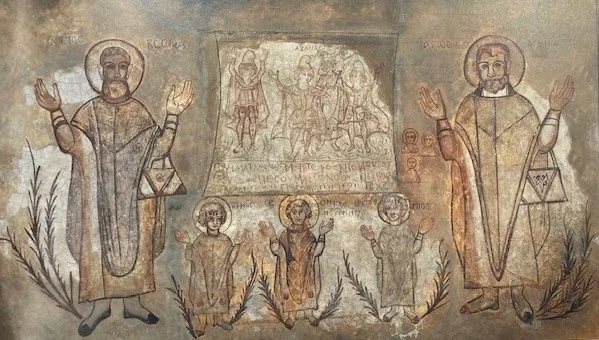
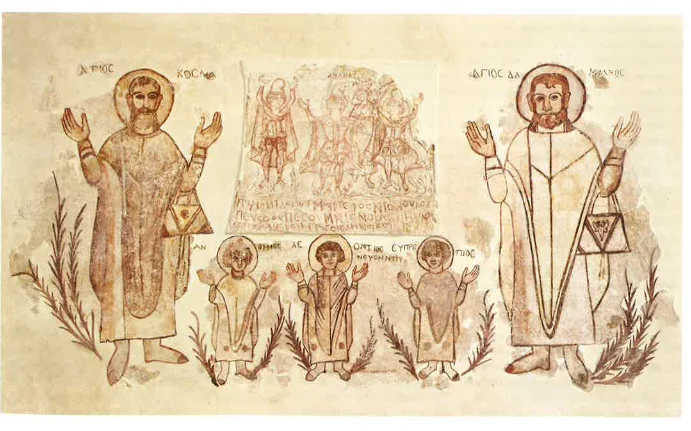
Wall painting from a site 2 km north of Wadi Sarga (Upper Egypt), of the *Three Hebrew Youths (of the Old Testament Book of Daniel, S01198), with a Coptic inscription below it mentioning the *Sixty Martyrs of Samalut (Middle Egypt) (S01515), and, to either side and below it, paintings of *Kosmas and Damianos (brothers, physicians martyrs of Syria, S00385) and their three brothers, and fellow martyrs, *Anthimos, Leontios and Euprepios (S01544) on a smaller scale. Now in the British Museum; datable to the 6th/7th c.
- Language
- Coptic
- Date from
- 500
- Date to
- 699
- Evidence type
- Images and objects; Inscriptions
- Evidence subtype
- Formal inscriptions (stone, mosaic, etc.); Wall paintings and mosaics
- Evidence region
- Egypt and Cyrenaica; Palestine with Sinai
- Evidence location
- Lykopolis; Caesarea Maritima, Καισάρεια, Kaisareia, Caesarea, Kayseri, Turris Stratonis; Wadi Sarga; Hermopolis, ϣⲙⲟⲩⲛ, Ashmunein, Hermopolis
- Cult region
- Egypt and Cyrenaica
- Cult location
- Lykopolis; Hermopolis, ϣⲙⲟⲩⲛ, Ashmunein, Hermopolis; Samalut; Hermopolis, ϣⲙⲟⲩⲛ, Ashmunein, Hermopolis; Wadi Sarga; Hermopolis, ϣⲙⲟⲩⲛ, Ashmunein, Hermopolis
- Cult date from
- 500
- Cult date to
- 699
Text
KSB 1 321:
At the centre of the painting is a rectangular panel with a representation in red outline of the Three Hebrew Youths in the 'fiery furnace' (as described in the Book of Daniel), with an angel standing behind them. The youths are shown in Persian dress, with elaborate leggings and Persian hats.
All three were presumably originally labelled, but only the label of the central figure survives:
PLEASE ADD ORIGINAL HERE
'Azarias'
The angel is also labelled:
PLEASE ADD ORIGINAL HERE Is this Coptic or Greek; or are they the same??
'Angel'
Below this painted scene, in the same red paint, is a three-line Coptic inscription:
ⲡϣⲙⲛⲧϫⲟⲩⲱⲧ ⟨ⲛ⟩ⲙⲁⲣⲧⲉⲣⲟⲥ ⲛⲧⲥⲛⲟⲩⲗⲟⲧ
ⲡⲉⲩϩⲟⲟⲩ ⲡⲉ ⲥⲟⲩ ⲙⲛⲧⲥⲛⲟⲟⲩⲥ ⲛⲏⲙϣⲩⲣ
ⲉⲥⲩⲣⲕⲉⲛⲉ ⲕⲟⲩⲓ ⲡⲁⲥⲟⲛ ⲙⲏⲛⲁ ⲕⲟⲩⲓ ⲓⲥ ⲭⲥ
‘The Sixty martyrs of Samalut.
Their [commemoration] day is day 12 of Mecheir [6 February].
Young Esurkene, Pason, [and] young Mena. Jesus Christ’
Three small busts are depicted to the right of the inscription (between it and the figure of Damianos), perhaps images of the Esurkene, Pason and Mena mentioned here.
EA73139:
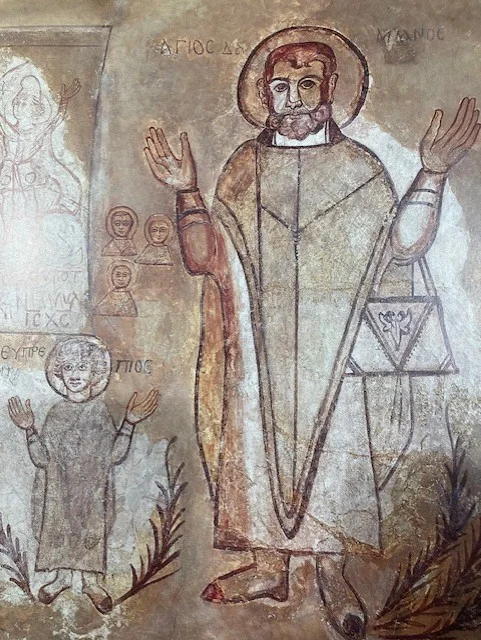
To either side of the central panel, in full colour and in a different style, are paintings of the physicians Kosmas and Damianos, both bearded, and both wearing a tunic under a paenula cloak and both carrying a medical bag.
Both are labelled:
ⲁⲅⲓⲟⲥ ⲕⲟⲥⲙⲁ and ⲁⲅⲓⲟⲥ ⲇⲁⲙⲓⲁⲛⲟⲥ
'Saint Kosmas' and 'Saint Damianos'
Standing between them, below the central panel, are their three younger brothers Anthimos, Leontios and Euprepios, also labelled:
ⲁⲛⲑⲏⲙⲟⲥ ⲗⲉⲟⲛⲧⲓⲟⲥ ⲉⲩⲡⲣⲉⲡⲓⲟⲥ
ⲛⲉⲩⲥⲛⲏⲩ
'Anthimos, Leontios, Euprepios,
their brothers.'
Translations: G. Schenke
Source
The wall painting measures 86 x 144.5 cm and is now in the British Museum, London.
Discussion
In the Coptic Martyrdom of Kosmas and Damianos (E03560) it is mentioned that the two of them stood trial in Antioch, together with their three younger brothers Anthimos, Leontios and Euprepios, accompanied by their mother Theodote.
Note that the wall-painting is not from Wadi Sarga (as in Papaconstantinou 2001, 225, etc), but from a site 2 km north, called by the excavator ‘the Daniel villa’ (information provided by Elisabeth O'Connell). The name of the site most likely derived from the image of the Three Youths in the Furnace (Daniel 3:19–30), but in view of the saints depicted and the inscription, it might well have been a healing sanctuary or martyr shrine dedicated to martyr groups. These groups included protomartyrs, famous healing saints, and local Egyptian martyrs, possibly all connected by their youth.
The very different style of the Kosmas and Damianos painting from that of the Youths raises the possibility that the former was added to the latter at a later date.
The 'Sixty Martyrs of Samalut' are otherwise unknown. Whether the three names, Esurkene, Pason, and Mena, occuring at the end of the inscription are the names of the donors visualised by the three busts, or whether they are to be seen as three representatives of these martyrs, remains unclear. If the latter, their explicit youth might indicate a young age for most, if not all the martyrs of Samalut. In this case, their names could have been intended as an invocation. For images of donors in floor mosaics, see e.g. E03137 and E02367.
The paintings in their present form in the British Museum have clearly been heavily 'restored' (with evident over-painting), but we can probably assume that their iconography, and the wording of their inscriptions, are original.
Bibliography
Badawy, A., Coptic Art and Archaeology (Cambridge MA: MIT Press, 1978), 4.46, p.268 (detail).
Fluck, C., Helmecke, G., and O'Connell, E.R. (eds.), Egypt: Faith after the Pharaohs (London: BMP, 2015), 172–173.
Strudwick, N., Masterpieces of Ancient Egypt (London: BMP, 2006), 324–325.
Images
Associated saints
| Saint | Name in source | Certainty |
|---|---|---|
| Kosmas and Damianos, brothers, physician martyrs of Syria (S00385) | Κοσμα | Certain |
| Sixty martyrs of Samalut (Middle Egypt) (S01515) | ⲡϣⲙⲛⲧϫⲟⲩⲱⲧ ⟨ⲛ⟩ⲙⲁⲣⲧⲉⲣⲟⲥ ⲛⲧⲥⲛⲟⲩⲗⲟⲧ | Certain |
| Theodote, and Anthimos, Leontios and Euprepios (mother and brothers of Kosmas and Damianos) (S01544) | ⲗⲉⲟⲛⲧⲓⲟⲥ | Certain |
| Three Hebrew Youths of the Old Testament Book of Daniel (S01198) | Certain |
Cult classifications
- Cult Places
- Cult building - unspecified
- Use of Images
- Public display of an image
Record author
Gesa Schenke
Entry date
4/9/2017, revised 23/8/2024
Citation
Gesa Schenke, Cult of Saints, E03850 — https://csla.history.ox.ac.uk/record.php?recid=E03850