
E03946
Three fragmentary Greek inscriptions (two carved, and one painted), mentioning *John the Baptist (S00020), and possibly *Aaron (first High Priest, brother of Moses, S01427), and *George (soldier and martyr, S00259). Found in the church and chapel in the monastic complex of Aaron on Jabal Hārūn near Petra (Roman province of Palaestina III). Probably late antique.
- Language
- Greek
- Date from
- 400
- Date to
- 800
- Evidence type
- Inscriptions
- Evidence subtype
- Formal inscriptions (stone, mosaic, etc.); Graffiti
- Evidence region
- Palestine with Sinai
- Evidence location
- Jabal an-Nabī Hārūn; Caesarea Maritima, Καισάρεια, Kaisareia, Caesarea, Kayseri, Turris Stratonis; Petra; Caesarea Maritima, Καισάρεια, Kaisareia, Caesarea, Kayseri, Turris Stratonis
- Cult region
- Palestine with Sinai
- Cult location
- Jabal an-Nabī Hārūn; Caesarea Maritima, Καισάρεια, Kaisareia, Caesarea, Kayseri, Turris Stratonis; Petra; Caesarea Maritima, Καισάρεια, Kaisareia, Caesarea, Kayseri, Turris Stratonis
- Cult date from
- 400
- Cult date to
- 800
Text
The Finnish Jabal Hārūn project was launched after a preliminary analysis of the papyrus P.Petra inv. 6: the will of Obodianos, son of Obodianos, which revealed the existence of a monastery named after *Aaron (the first High Priest, and brother of Moses): 'the House of our Lord the Saint High Priest Aaron', presumed to be in the area of Jabal an-Nabī Hārūn (see E03944; E03976). Several excavation campaigns conducted between 1998 and 2001, and centred around a church and another apsed building, identified as a chapel, brought to light more than a dozen very fragmentary carved and painted inscriptions. Among them three may refer to the cult of saints:
Inscription 1:
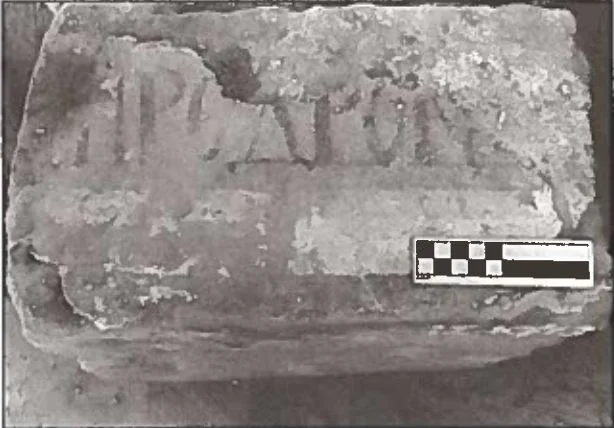
Fragment of painted plaster, found in Trench I. Letter height, c. 0.06 m.
Πρόδρομο[ς]/'Forerunner'
Prodromos/Forerunner is an epithet of *John the Baptist. The editors note that this is clearly the beginning of a line. Traces of red paint on the upper edge of the fragment suggest that the text was laid-out in at least two lines.
Text: SEG 51, 2076 (4).
Inscription 2:
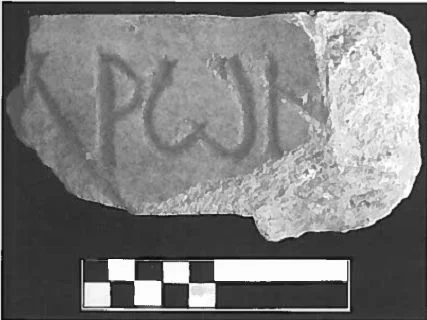
Fragment, probably of a chancel screen, from its right-hand corner. Dimensions: 0.14 x 0.08 x 0.08 m. Letter height 0.035-0.04 m. Found in the chapel, in front of the altar.
[- - -]̣ΑΡω̣Ν
The editors, Frösén and Lindblom, published the fragment as a possible mention of Aaron (Ἀαρών), brother of Moses, venerated at the site. Tybout in his comments in the SEG was sceptical about this interpretation, pointing out that actually only Ρ and Ω are clear in the photograph.
Text: SEG 49, 2012.
Inscription 3:
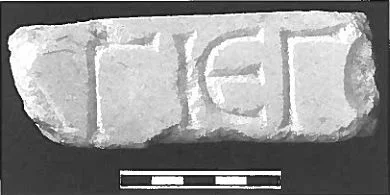
Fragment of a chancel screen or table of white marble. Dimensions 0.12 x 0.105 x 0.043 m. Letter height 0.035 m. High quality lettering. The editors consider it a fragment of a table with moulding, rather than of a chancel screen. Found in the church.
[- - -]̣ΑΓΙΕΓ̣Ε[- - -]
The editors, probably rightly, identify the inscription as part of an invocation of *George, soldier and martyr of Diospolis/Lydda. They restore the text as ̣ἅγιε Γ̣ε[ώργιε, βοήθει or ἐλέησον - - -]/'O Saint George [help (or: have mercy) - - -]!'
Text: SEG 52, 1733 (3).
Bibliography
Edition:
Inscription 1:
Frösén, J., Sironen, E., Fiema, Z.T., "Greek inscriptions from the Church and the Chapel", in: Z.T. Fiema, J. Frösén (eds.), Petra. The Mountain of Aaron. The Church and the Chapel (Helsinki: Societas Scientiarum Fennica, 2008), 279.
Supplementum Epigraphicum Graecum 52, 1733 (9).
Frösén, J., "", in: J. Frösén, Z.T. Fiema (eds.), Petra. A City Forgotten and Rediscovered (Helsinki: Amos Anderson Art Museum, 2002), 184.
Frösén, J., Sironen, E., Fiema, Z.T., "Greek inscriptions from the Church and the Chapel", in: Z.T. Fiema, J. Frösén (eds.), Petra. The Mountain of Aaron. The Church and the Chapel (Helsinki: Societas Scientiarum Fennica, 2008), 273-274, no. 2.
Supplementum Epigraphicum Graecum 51, 2076 (4)
Frösén, J., Fiema, Z.T., Danielli, Ch., and others, "The 1998-2000 Finnish Hārūn project: specialised reports", Annual of the Department of Antiquities of Jordan 45 (2001), 377-378, no. 4 ("Inscriptions", ed. J. Frösén).
Inscription 2:
Frösén, J., Sironen, E., Fiema, Z.T., "Greek inscriptions from the Church and the Chapel", in: Z.T. Fiema, J. Frösén (eds.), Petra. The Mountain of Aaron. The Church and the Chapel (Helsinki: Societas Scientiarum Fennica, 2008), 273, no. 1.
Supplementum Epigraphicum Graecum 52, 1733 (1)
Frösén, J., "", in: J. Frösén, Z.T. Fiema (eds.), Petra. A City Forgotten and Rediscovered (Helsinki: Amos Anderson Art Museum, 2002), 181-182.
Supplementum Epigraphicum Graecum 49, 2012.
Frösén, J., Lindblom, J., "", Annual of the Department of Antiquities of Jordan 43 (1999), 400.
Inscription 3:
Frösén, J., Sironen, E., Fiema, Z.T., "Greek inscriptions from the Church and the Chapel", in: Z.T. Fiema, J. Frösén (eds.), Petra. The Mountain of Aaron. The Church and the Chapel (Helsinki: Societas Scientiarum Fennica, 2008), 274, no. 3.
Supplementum Epigraphicum Graecum 52, 1733 (3)
Frösén, J., "", in: J. Frösén, Z.T. Fiema (eds.), Petra. A City Forgotten and Rediscovered (Helsinki: Amos Anderson Art Museum, 2002), 182.
"", Annual of the Department of Antiquities of Jordan 44 (2000), 411.
Reference works:
Bulletin épigraphique (2009), 531.
Supplementum Epigraphicum Graecum 49, 2012; 51, 2076; 52, 1733; 58, 1775.
Images
Associated saints
| Saint | Name in source | Certainty |
|---|---|---|
| George, soldier and martyr, and Companions (S00259) | Certain | |
| John the Baptist (S00020) | Πρόδρομος | Certain |
| Aaron, first High Priest, brother of Moses (S01427) | Ἀαρών | Uncertain |
Cult classifications
- Cult Places
- Cult building - dependent (chapel, baptistery, etc.); Cult building - independent (church); Cult building - monastic
- Non Liturgical Activity
- Prayer/supplication/invocation
- Places Names after Saint
- Monastery
Record author
Paweł Nowakowski
Entry date
05/09/2017
Citation
Paweł Nowakowski, Cult of Saints, E03946 — https://csla.history.ox.ac.uk/record.php?recid=E03946