
E04157
Greek inscription with an invocation of *Stephen (the First Martyr, S00030), probably from a church dedicated to the saint. Found at Beersheva in the Negev desert (Roman province of Palaestina III). One of its fragments was displaced and found in Jerusalem, and, therefore, incorrectly ascribed to that city in early editions. Probably 5th-6th c.
- Language
- Greek
- Date from
- 400
- Date to
- 600
- Evidence type
- Inscriptions
- Evidence subtype
- Formal inscriptions (stone, mosaic, etc.)
- Evidence region
- Palestine with Sinai
- Evidence location
- Berosaba/Beersheva; Caesarea Maritima, Καισάρεια, Kaisareia, Caesarea, Kayseri, Turris Stratonis; Jerusalem; Caesarea Maritima, Καισάρεια, Kaisareia, Caesarea, Kayseri, Turris Stratonis
- Cult region
- Palestine with Sinai
- Cult location
- Berosaba/Beersheva; Caesarea Maritima, Καισάρεια, Kaisareia, Caesarea, Kayseri, Turris Stratonis
- Cult date from
- 400
- Cult date to
- 600
Text
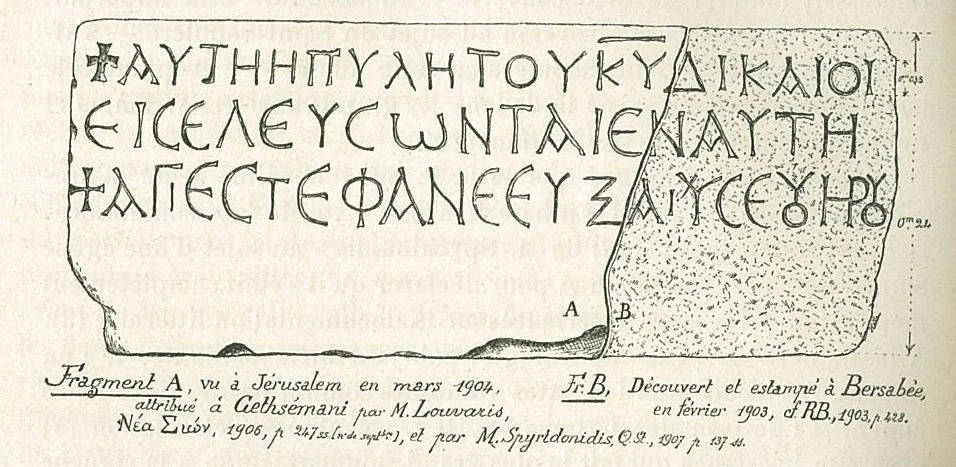
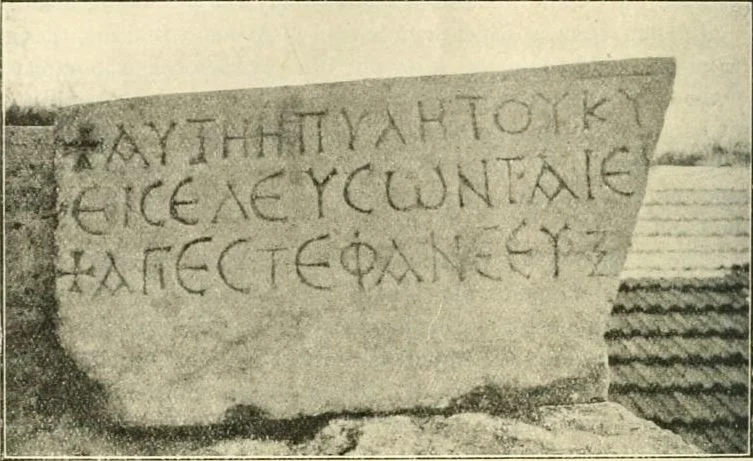
+ αὕτη ἡ πύλη τοῦ Κ(υρίο)υ, δίκαιοι
εἰσελεύσωνται ἐν αὐτῇ
+ ἅγιε Στέφανε, εὔξαι ὑ(πὲρ) Σεουήρου
'This gate of the Lord, into which the righteous shall enter. O Saint Stephen, pray for Severos!'
Text: Vincent 1907, 607. We do not reproduce the restorations suggested by editors unaware of the complete text.
Source
Large marble slab, certainly a lintel, broken into two conjoining fragments. H. 0.24 m; W. 0.61 m; Th. 0.05 m. Letter height 0.035 m.
Fragment A (c. H. 0.24 m; W. 0.45 m), the large left-hand fragment of the slab, comes from Jerusalem, from a field close to the St. Stephen's Gate [= The Lions' Gate], in the immediate area of the Mount of Olives. It was seen there by Polykrates Louvaris in March 1904, and was published by him in 1906. In 1907 it was independently published by C.K. Spyridonidis (with a photograph). The stone was reportedly unearthed during 'some building excavations', after the field had been acquired by the treasurer of the Church of the Holy Sepulchre. During these 'excavations', ruins of an unidentified structure were also recorded. Spyridonidis supposed that the stone came from an ancient church built at the find-spot, which, he argued, commemorated the place of the stoning of Stephen the First Martyr, and which he identified with the ruins mentioned. Also in 1907, Fragment A was reprinted by Robert Alexander Stewart Macalister, in his collection of new epigraphic finds in Jerusalem. The editor offered a transcription in capital letters, skipping the restorations by Spyridonidis, and noted that the fragment was stored in the St. Abraham Monastery.
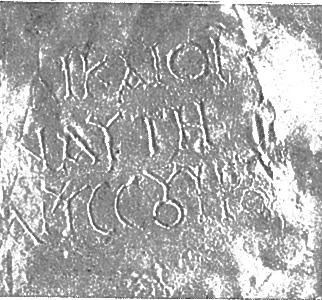
Fragment B, which constitutes the right-hand end of the slab, was first published by Félix-Marie Abel in 1903, after a squeeze made by him earlier that year at Beersheva in the Negev desert (Roman province of Palaestina III).
In 1906 Louis-Hugues Vincent came up with the idea that both fragments match each other, and, since Fragment B mentions one Severos, probably the same man attested by other inscriptions from Beersheva (see below), that Fragment A was a pierre errante, i.e. had been brought to Jerusalem in obscure circumstances. Given the shape of the blocks and the wording and letter-forms of their inscriptions, this hypothesis is certainly correct, even though moving such a large block to Jerusalem from distant Beersheva must have been a serious undertaking. Furthermore, Vincent pointed out that the remains of the structure found in the field at the Mount of Olives, were never properly examined. Hence, the existence of an ancient church at that site is very doubtful, not to say implausible. Vincent offered a transcription of the two fragments combined, and a drawing.
In 1921 Albrecht Alt, unaware of Vincent's brilliant suggestion, republished Fragment B after Abel's edition, with no reference to Fragment A. In 1983 Bellarmino Bagatto, and in 1986 Yiannis Meimaris correctly referred to both fragments as the elements of one inscription. Both fragments were also correctly published in a drawing with English and Hebrew translation, albeit with no Greek transcription, by Pau Figueras (in 1985, in a catalogue of an epigraphic exhibition of the Negev Museum).
Discussion
Louvaris and Spyridonidis rightly identified the beginning of the inscription as a quotation of Psalm 117(118):20, often carved over doorways in near eastern churches. This is followed by an invocation of Saint Stephen, certainly the First Martyr, asked to pray on behalf of one Severos. From another inscription from Beersheva, we know that a certain Severos, perhaps together with his wife, built a 'holy place' (topos) dedicated to Saint Stephen and to the Patriarch *Abraham (see E04156). It is, therefore, very probable that he is identical with the Severos mentioned in our inscription, and that both stones come from the same sanctuary.
Bibliography
Edition:
Fragments A and B:
Figueras P., Ketovot bizanṭiyot mi-Beʼer-Sheva' ṿeha-Negev [Byzantine Inscriptions from Beersheva and the Negev] (Negev Museum Publications 2, Beersheva: Muzeʼon ha-Negev, 1985), 14, no. 6 (drawing, English and Hebrew translations).
Bagatti, B., Ancient Christian Villages of Judaea and the Negev (Jerusalem: Franciscan Printing Press, 2002), 100, fig. 16 [= Antichi villaggi cristiani della Giudea e del Neghev (Jerusalem: Franciscan Printing Press, 1983)].
Vincent, L.-H., "Encore l'inscription de Saint Étienne à Gethsémani", La revue biblique (1907), 607-611.
Fragment A:
Stewart Macalister, R.A., "Some new inscriptions from Jerusalem and its neighbourhood", Palestine Exploration Fund Quarterly Statement (1907), 235, no. II.
Spyridonidis, C.K., "The church of St. Stephen", Palestine Exploration Fund Quarterly Statement (1907), 137-139 (with a photograph).
Louvaris, P., "", Νέα Σιών 3 (1906), 247-249.
Fragment B:
Alt, A., Die griechischen Inschriften der Palaestina Tertia westlich der 'Araba (Berlin – Leipzig: Vereinigung wissenschaftlicher Verleger, 1921), 14, no. 9.
Abel, F.-M., "Inscriptions grecques de Besarabée", La Revue biblique 12 (1903), 428, no. 7b.
Further reading:
Meimaris, Y., Sacred names, saints, martyrs and church officials in the Greek inscriptions and papyri pertaining to the Christian Church of Palestine (Athens: National Hellenic Research Foundation, Center for Greek and Roman Antiquity, 1986), 135, no. 715.
Images
Associated saints
| Saint | Name in source | Certainty |
|---|---|---|
| Stephen, the First Martyr (S00030) | Στέφανος | Certain |
Cult classifications
- Cult Places
- Cult building - independent (church); Cult building - unspecified
- Non Liturgical Activity
- Prayer/supplication/invocation
- People
- Other lay individuals/ people
Record author
Paweł Nowakowski
Entry date
15/10/2017
Citation
Paweł Nowakowski, Cult of Saints, E04157 — https://csla.history.ox.ac.uk/record.php?recid=E04157