
E04160
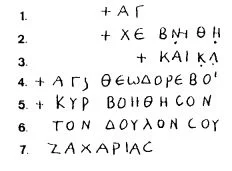
Greek painted inscriptions (dipinti) from a hermit cell in the Ein Avdat ravine near Avdat/Oboda in the central Negev desert (Roman province of Palaestina III), one of which invokes the help of *Theodore (probably the soldier and martyr of Amaseia and Euchaita, S00480). Probably 6th-7th c.
- Language
- Greek
- Date from
- 500
- Date to
- 800
- Evidence type
- Inscriptions
- Evidence subtype
- Graffiti
- Evidence region
- Palestine with Sinai
- Evidence location
- Avdat/Oboda; Caesarea Maritima, Καισάρεια, Kaisareia, Caesarea, Kayseri, Turris Stratonis
- Cult region
- Palestine with Sinai
- Cult location
- Avdat/Oboda; Caesarea Maritima, Καισάρεια, Kaisareia, Caesarea, Kayseri, Turris Stratonis
- Cult date from
- 500
- Cult date to
- 800
Text
Graffito 1:
+ ἅγ(ιε)
+ Χ(ριστ)έ, β̣οήθη
+ καὶ ̣Κ̣Λ[- - -]
[2. βοήθη(σον) SEG 41, 1542 || 3. Κ̣Α[- - -] SEG 41, 1542]
'O Holy Christ, help and [- - -]!'
Graffito 2:
+ ἅγ(ιε) Θεώδορε, βο(ήθει)
βο(ήθησον) SEG 41, 1542
'O Saint Theodore, help! Saint (?).'
Graffito 3:
Κύρ(ιε), βοήθησον
τὸν δοῦλόν σου
Ζαχαρίας
'O Lord, help your servant Zacharias!'
Text: SEG 45, 1974.
Source
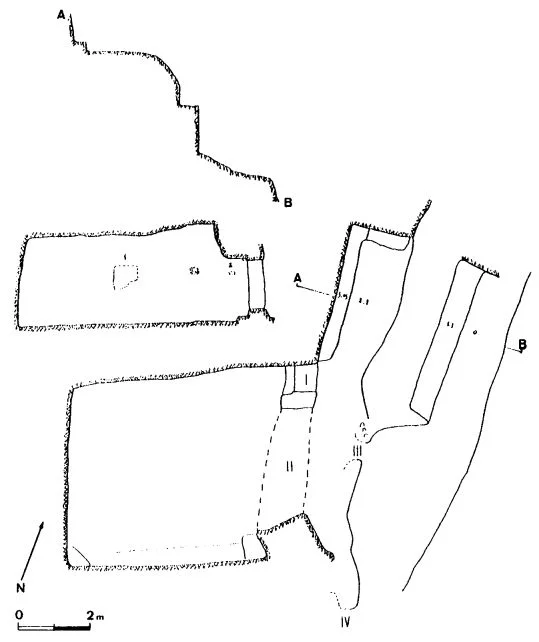
The inscriptions are painted in red. They were found in Cave no. 2 in the Ein Avdat ravine, located to the north of the city of Avdat/Oboda, one of very few hermitages recorded in the Negev desert. Cave no. 2 was certainly a hermit cell (one of four examined in the ravine). Its internal dimensions are: c. 5.30 m x 5.60 m. A bench was carved in the rock-face on the outer wall of the cave, close to the entrance.
The inscriptions were first published by Yoram Tsafrir and Ze'ev Meshel in 1977 in a hardly accessible volume. Their existence was communicated to the editors of the Supplementum Epigraphicum Graecum by Leah Di Segni, and the text was reprinted in the SEG 41, 1542. In 1995 Pau Figueras published a drawing, based on which the editors of the SEG offered an improved edition in the SEG 45, 1974.
Discussion
Only Graffito 2 contains an invocation of Saint Theodore. Graffito 3 invokes God as the Lord, and Graffito 1, if it was read correctly, probably Christ (although its phrasing is unusual).
Tsafrir, one of the first editors, suggested, on the basis of the invocation of Theodore, that the cells of 'Ein 'Avdat could be associated with a monastery (coenobium) in Oboda, where Theodore was venerated. He also argued that the Zacharias, mentioned in our Graffito 3, might be the person buried in the South Church in Oboda, dedicated to Theodore (see E04162). This supposition is, however, implausible.
Theodore certainly was venerated in nearby Oboda (E04162; E04163; E04164), further to the south, at 'Aila (E02617), and possibly at Abasan el-Kabir in the north-west Negev (E03170).
Bibliography
Edition:
Figueras, P., "Monks and monasteries in the Negev desert", Liber Annuus 45 (1995), 412-413.
Meshel, Z., Tsafrir, Y., Seqer archeologi be - 'En Ἀvdat (Midrashat Sede Boquer, 1977), 11-13.
Further reading:
Supplementum Epigraphicum Graecum 41, 1542; 45, 1974.
Images
Associated saints
| Saint | Name in source | Certainty |
|---|---|---|
| Theodore, soldier and martyr of Amaseia and Euchaita (S00480) | Θεώδορος | Uncertain |
Cult classifications
- Non Liturgical Activity
- Prayer/supplication/invocation
- People
- Ecclesiastics - monks/nuns/hermits
Record author
Paweł Nowakowski
Entry date
16/10/2017
Citation
Paweł Nowakowski, Cult of Saints, E04160 — https://csla.history.ox.ac.uk/record.php?recid=E04160