
E04284
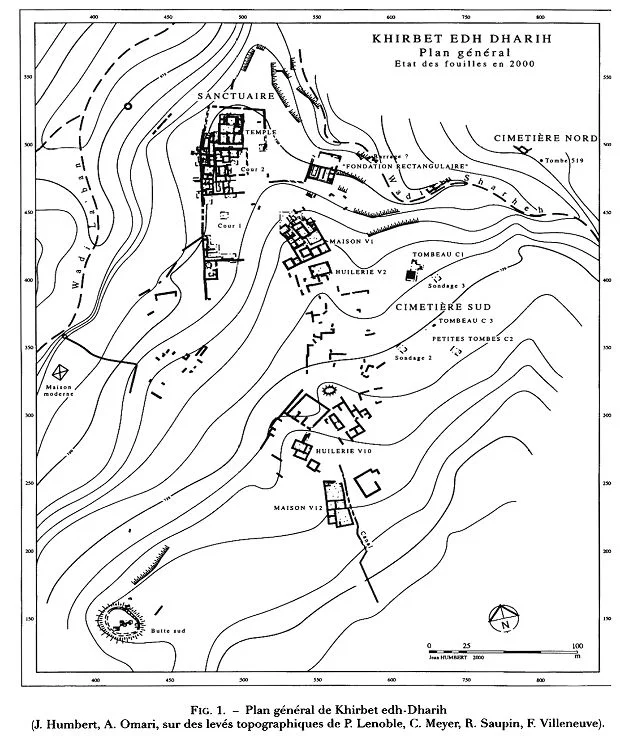
Fragmentary painted inscription in Greek, invoking the intercession of *Mary (Mother of Christ, S00033), and of unnamed saints. Found in the late antique church at Khirbat edh-Dharih to the north-west of Petra and Arindela (Roman province of Palaestina III/south Jordan). Probably 6th c.
- Language
- Greek
- Date from
- 500
- Date to
- 600
- Evidence type
- Inscriptions
- Evidence subtype
- Graffiti; Inscribed architectural elements
- Evidence region
- Palestine with Sinai
- Evidence location
- Arindela; Caesarea Maritima, Καισάρεια, Kaisareia, Caesarea, Kayseri, Turris Stratonis; Khirbat edh-Dharih; Caesarea Maritima, Καισάρεια, Kaisareia, Caesarea, Kayseri, Turris Stratonis; Petra; Caesarea Maritima, Καισάρεια, Kaisareia, Caesarea, Kayseri, Turris Stratonis
- Cult region
- Palestine with Sinai
- Cult location
- Arindela; Caesarea Maritima, Καισάρεια, Kaisareia, Caesarea, Kayseri, Turris Stratonis; Khirbat edh-Dharih; Caesarea Maritima, Καισάρεια, Kaisareia, Caesarea, Kayseri, Turris Stratonis; Petra; Caesarea Maritima, Καισάρεια, Kaisareia, Caesarea, Kayseri, Turris Stratonis
- Cult date from
- 500
- Cult date to
- 600
Text
The inscription is painted in red on the arch of the apse, next to a painted cross:
πρεσβίαις τῆς ὑπερενδόξου Θεοτόκου Μαρίας καὶ ἱκεσίαις τῶν ἁγίων
'Through the intercessions of the exceedingly glorious God-Bearer (Theotokos) Mary and through the supplications of the saints.'
Text: Villeneuve & Al-Muheisen 2000, 1560, based on a preliminary reading by F. Alpi.
Source
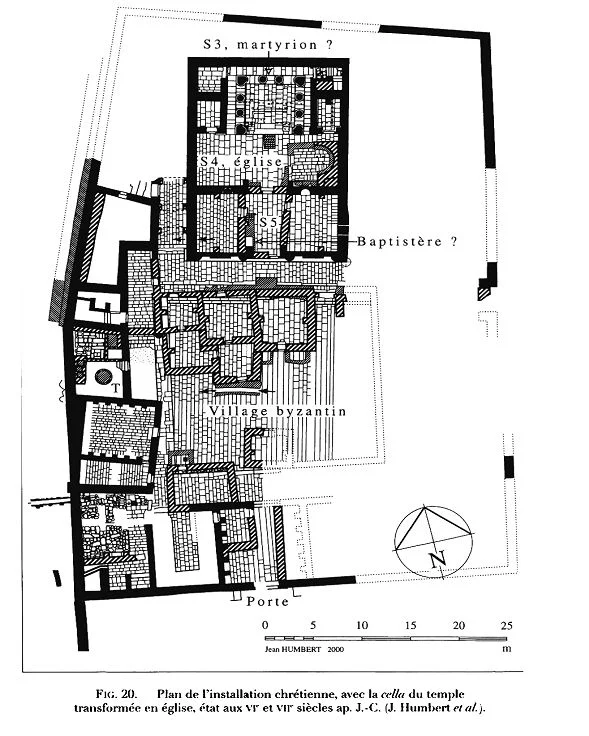
The inscription was found in a church complex built at the site of a former pagan sanctuary, located in the north-west sector of the ancient village. In the mid 4th c. the pagan sacred precinct with its temple were apparently abandoned, as well as the rest of the settlement. The sacred precinct was resettled probably in the 6th c., and the temple was converted into a church with a single apse, and a baptistery. The excavators argue for the existence of a martyr shrine in the building, in the area delimited by a square colonnade (probably former motab) in the north wing of the complex, as it was protected by a chancel screen.
The sacred precinct was excavated by a French-Jordanian mission during three campaigns between 1996 and 1999. The inscription was first published by François Villeneuve and Zeidoun Al-Muheisen in 2000, from a preliminary transcription made by Frédéric Alpi.
Discussion
The find is interesting for the epithet of Mary, ὑπερένδοξος/'exceedingly glorious', and the term ἱκεσία denoting the intercession of saints, both very rare in inscriptions.
The editors argue that the use of the epithet Theotokos points to the Chalcedonian character of the local Christian community. They add that the church could have been dedicated to Mary, whose cult may have replaced that of Aphrodite/al-Uzza, although any links between the two figures are not clear due to the circa 200-year long chronological gap between the abandonment of the village and the establishment of the Christian settlement.
Dating: the editors date the inscription to the 6th c. based on the shape of its letters.
Bibliography
Edition:
Chambon, A., Al-Muheisen, Z., Janif, M.M., and others, Khirbet edh-Dharih. Des Nabatéens au premier Islam (Amman: Mairie d'Amman, 2002), no. 25.
Villeneuve, F., Al-Muheisen, Z., "Nouvelles recherches à Khirbet edh-Dharih (Jordanie du Sud, 1996-1999)", Comptes rendus des séances de l'Académie des Inscriptions et Belles-Lettres (2000), 1560.
Further reading:
Villeneuve, Fr., "Dharih (Jordanie méridionale): village chrétien puis musulman (VIe-IXe siècles) dans les ruines d'un sanctuaire nabatéen [with an excursus by B. Pitarakis: Un médaillon-amulette retoruvé à Khirbet Dharih en Jordanie]", in: Borrut, A., Debié, M., Papaconstantinou, A., Pieri, D., Sodini, J.-P. (eds.), Le Proche-Orient de Justinien aux Abbassides: Peuplement et dynamiques spatiales. Actes du colloque «Continuités de l’occupation entre les périodes byzantine et abbasside au Proche-Orient, VIIe-IXe siècles», Paris, 18-20 octobre 2007 (Bibliothèque de lʼAntiquité tardive 19, Turnhout: Brepols, 2011), 323.
Villeneuve, F., Al-Muheisen, Z., "Le sanctuaire nabatéo-romain de Dharih (Jordanie) : nouvelles découvertes, 2001-2008", Comptes rendus des séances de l'Académie des Inscriptions et Belles-Lettres (2008), 1495-1520.
Reference works:
Chroniques d'épigraphie byzantine, 813
Supplementum Epigraphicum Graecum 50, 1536.
Images
Associated saints
| Saint | Name in source | Certainty |
|---|---|---|
| Mary, Mother of Christ (S00033) | Μαρία | Certain |
| Saints, unnamed (S00518) | οἱ ἅγιοι | Certain |
Cult classifications
- Cult Places
- Cult building - independent (church)
- Non Liturgical Activity
- Prayer/supplication/invocation
Record author
Paweł Nowakowski
Entry date
06/11/2017
Citation
Paweł Nowakowski, Cult of Saints, E04284 — https://csla.history.ox.ac.uk/record.php?recid=E04284