
E04468
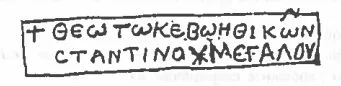
Fragmentary Greek inscription carved on a lintel, invoking the help of *Mary (Mother of Christ, S00033) for an emperor Constantine, probably Constantine IV (AD 668-685). Found at the gateway of Hisar Kapısı at Bursa/ancient Prusa ad Olympum (Bithynia, north-west Asia Minor).
- Language
- Greek
- Date from
- 668
- Date to
- 685
- Evidence type
- Inscriptions
- Evidence subtype
- Formal inscriptions (stone, mosaic, etc.)
- Evidence region
- Asia Minor
- Evidence location
- Prusa ad Olympum; Nicomedia, Νικομήδεια, Nikomēdeia, Izmit, Πραίνετος, Prainetos, Nicomedia
- Cult region
- Asia Minor
- Cult location
- Prusa ad Olympum; Nicomedia, Νικομήδεια, Nikomēdeia, Izmit, Πραίνετος, Prainetos, Nicomedia
- Cult date from
- 668
- Cult date to
- 685
Text
+ Θεωτώκε βωήθι Κων-
σταντίνου μεγάλου [- - -]
2. possibly: μεγάλου [βασιλ]έως καὶ Θεοδώρου κ|όμιτος καὶ ̣Σ̣τεφάνου Grélois
'+ O God-Bearer (Theotokos), help Constantine, the great [- - -]!'
Text: SEG 49, 1799.
Source
The inscription is on a stone lintel, reused in the gateway of Hisar Kapısı at Bursa/ancient Prusa ad Olympum. No dimensions given.
Recorded by John Covel, an English clergyman travelling in western Turkey between 1670 and 1677. A journal of his travel, now in the British Museum, was published in 1998 by Jean-Pierre Grélois. Our inscription is one of 80 epigraphic monuments copied by Covel.
Discussion
The inscription is incomplete, and Grélois notes that the missing part could be restored based on another fragmentary text found in the same area, which reads βασιλ]έως καὶ Θεοδώρου κ|όμιτος καὶ ̣Σ̣τεφάνου (I. Prousa ad Olympum, no. 222).
Grélois identifies the emperor mentioned as Constantine IV (AD 668-685), as he uses the epithet μέγας in the Acts of the Third Council of Constantinople (680-681). The same Acts also mention a patrician Theodoros, comes of the Opsikion theme and hypostrategos of Thrace, probably identical with the Thedoros mentioned above. Given this timeframe, it is possible that our inscription refers to the fortification of Prusa after the Arab capture of Kyzikos in 670 and the siege of Constantinople in 674-678.
Bibliography
Edition:
Grélois, J.-P. (ed.) with a preface by Cyril Mango, Dr. John Covel Voyages en Turquie, 1675-1677 (Réalités Byzantines 6, Paris: P. Lethielleux, 1998), 373-374, no. 32.
Reference works:
Supplementum Epigraphicum Graecum 49, 1799.
Images
Associated saints
| Saint | Name in source | Certainty |
|---|---|---|
| Mary, Mother of Christ (S00033) | Θεωτώκος | Certain |
Cult classifications
- Non Liturgical Activity
- Prayer/supplication/invocation
- People
- Aristocrats; Monarchs and their family; Officials
Record author
Paweł Nowakowski
Entry date
16/12/2017
Citation
Paweł Nowakowski, Cult of Saints, E04468 — https://csla.history.ox.ac.uk/record.php?recid=E04468