
E04469
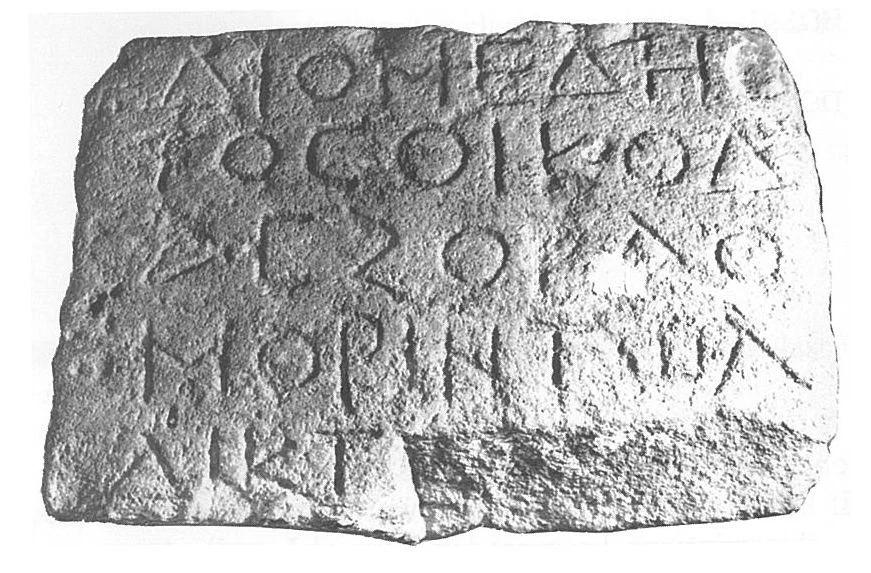
Greek inscription commemorating the construction of a memorion, probably a martyr shrine. Found at Quneitra near Paneas/Caesarea Philippi, in the Golan Heights, to the north-east of the Sea of Galilee (Roman province of Phoenicia Paralias). Probably 5th or 6th c.
- Language
- Greek
- Date from
- 400
- Date to
- 600
- Evidence type
- Inscriptions
- Evidence subtype
- Formal inscriptions (stone, mosaic, etc.)
- Evidence region
- Palestine with Sinai; Syria with Phoenicia
- Evidence location
- Caesarea Philippi; Caesarea Maritima, Καισάρεια, Kaisareia, Caesarea, Kayseri, Turris Stratonis; Paneas; Caesarea Maritima, Καισάρεια, Kaisareia, Caesarea, Kayseri, Turris Stratonis; Quneitra; Antioch on the Orontes, Ἀντιόχεια, Antiocheia, Antiochia ad Orontem, Ἀντιόχεια Μεγάλη, Ἀντιόχεια ἐπὶ Ὀρόντου, Antakya
- Cult region
- Palestine with Sinai; Syria with Phoenicia
- Cult location
- Caesarea Philippi; Caesarea Maritima, Καισάρεια, Kaisareia, Caesarea, Kayseri, Turris Stratonis; Paneas; Caesarea Maritima, Καισάρεια, Kaisareia, Caesarea, Kayseri, Turris Stratonis; Quneitra; Antioch on the Orontes, Ἀντιόχεια, Antiocheia, Antiochia ad Orontem, Ἀντιόχεια Μεγάλη, Ἀντιόχεια ἐπὶ Ὀρόντου, Antakya
- Cult date from
- 400
- Cult date to
- 600
Text
Διομέδη̣ς [- - -]
τος οἰκοδ[όμος - - - μητροκωμί]-
ας Ζοραο[υηνῶν τὸ με]-
μόριν ΤωΛ[- - - ἰν]-
δικτ̣ι[ῶνος - -]
[3-4. με]|μόριν Feissel]
'Diomedes [- - -] builder [- - - of the mother-village (metrokomia)] of the Zoraouenoi (built) the memorion [- - -] indiction [- - -].'
Text: SEG 46, 1978.
Source
Stone block. Broken and lost at the right-hand end. Dimensions not specified.
Found during surveys organised by the Israel Antiquities Authority after 1967 at Quneitra. First published by Robert Gregg and Dan Urman in 1996. When recorded, the stone was reused in a modern building.
Discussion
Gregg and Urmann were unsure about the religious affiliation of Diomedes mentioned in line 1. Denis Feissel, however, argues that lines 3-4 almost certainly mention a memorion, here understood as a martyr shrine (= martyrion, cf. E02082; E02144), which would suggest that the inscription came from a Christian religious building.
Line 3 apparently contains a reference to the community of Izra/Zorava, a town famous for its high quality Christian inscriptions (see, e.g.: E01754; E02065; E02116; E02117, and others).
Dating: There is no way to precisely date the inscription. If it really mentions a Christian martyr shrine, the building must have been erected in the 5th or 6th c., as suggested by other, dated inscriptions from the region.
Bibliography
Edition:
Gregg, R., Urman, D., Jews, Pagans, and Christians in the Golan Heights: Greek and Other Inscriptions of the Roman and Byzantine Eras (Atlanta, Ga.: Scholars Press, 1996), no. 219.
Further reading:
For memorion, see also: Feissel, D. (ed.), Recueil des inscriptions chrétiennes de Macédoine, du IIIe au VIe siècle (Athens: Ecole française d'Athènes, Paris Dépositaire, Diffusion de Boccard, 1983), 23-24.
Reference works:
Bulletin épigraphique (1997), 648.
Chroniques d'épigraphie byzantine, 771.
Supplementum Epigraphicum Graecum 46, 1978.
Images
Associated saints
| Saint | Name in source | Certainty |
|---|---|---|
| Martyrs, unnamed or name lost (S00060) | Uncertain |
Cult classifications
- Cult Places
- Cult building - independent (church)
- Non Liturgical Activity
- Construction of cult buildings; Renovation and embellishment of cult buildings
- People
- Merchants and artisans
Record author
Paweł Nowakowski
Entry date
18/12/2017
Citation
Paweł Nowakowski, Cult of Saints, E04469 — https://csla.history.ox.ac.uk/record.php?recid=E04469