
E04470
Greek inscriptions commemorating the construction of a martyr shrine (martyrion) by Flavios Balbion, probably a former soldier. Found at Jueîzeh, near Quneitra and Paneas/Caesarea Philippi, in the Golan Heights, to the north-east of the Sea of Galilee (Roman province of Phoenicia Paralias). Probably 6th c., once wrongly dated 472/473.
- Language
- Greek
- Date from
- 500
- Date to
- 600
- Evidence type
- Inscriptions
- Evidence subtype
- Formal inscriptions (stone, mosaic, etc.)
- Evidence region
- Palestine with Sinai; Syria with Phoenicia
- Evidence location
- Caesarea Philippi; Caesarea Maritima, Καισάρεια, Kaisareia, Caesarea, Kayseri, Turris Stratonis; Jueîzeh; Caesarea Maritima, Καισάρεια, Kaisareia, Caesarea, Kayseri, Turris Stratonis; Paneas; Caesarea Maritima, Καισάρεια, Kaisareia, Caesarea, Kayseri, Turris Stratonis; Quneitra; Antioch on the Orontes, Ἀντιόχεια, Antiocheia, Antiochia ad Orontem, Ἀντιόχεια Μεγάλη, Ἀντιόχεια ἐπὶ Ὀρόντου, Antakya
- Cult region
- Palestine with Sinai; Syria with Phoenicia
- Cult location
- Caesarea Philippi; Caesarea Maritima, Καισάρεια, Kaisareia, Caesarea, Kayseri, Turris Stratonis; Jueîzeh; Caesarea Maritima, Καισάρεια, Kaisareia, Caesarea, Kayseri, Turris Stratonis; Paneas; Caesarea Maritima, Καισάρεια, Kaisareia, Caesarea, Kayseri, Turris Stratonis; Quneitra; Antioch on the Orontes, Ἀντιόχεια, Antiocheia, Antiochia ad Orontem, Ἀντιόχεια Μεγάλη, Ἀντιόχεια ἐπὶ Ὀρόντου, Antakya
- Cult date from
- 500
- Cult date to
- 600
Text
Inscription 1:
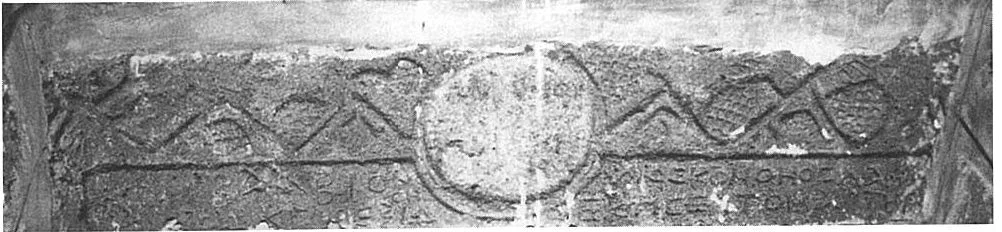
Stone lintel. Dimensions not specified. The inscription is carved below a decorated band, on both sides of a circle in relief. The right-hand end is lightly damaged.
+ Φλ(άβιος) Βαλβίον υἱὸς Κόνονος λαμ̣π(ρότατος)
καὶ τη̣λικ(οῦτος) γινό(μενος) ἐξ ἰδίον ἔκτισεν τὸ μα̣ρτύ(ριον)
[1. Φλ(άβιος) Feissel, φλγ΄ = the year 533 of a Pompeian era = AD 471/472 Gregg & Urman]
'+ Flavios Balbion, son of Konon, (who was) of clarissimus rank and came to such great age, built (this) martyr shrine (martyrion) at his own expense.'
Inscription 2:
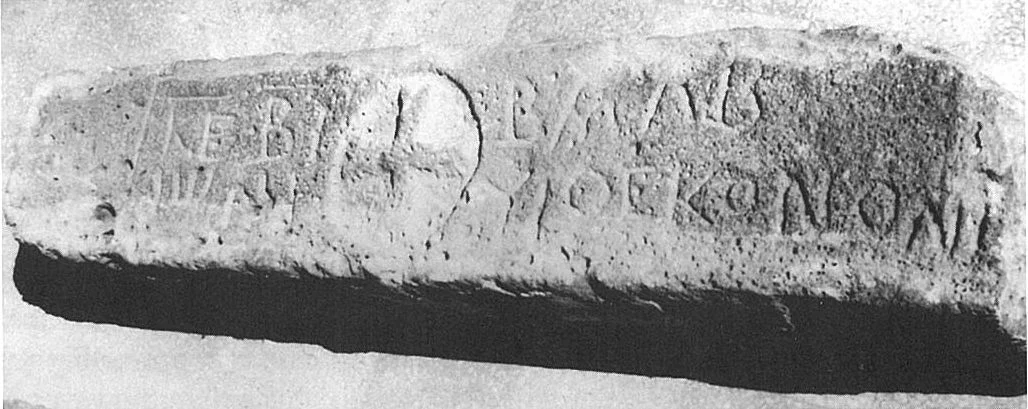
Complete stone lintel. Dimensions not specified. The inscription is carved on both sides of a sunk circle with a cross in relief.
Κ(ύρι)ε, β(οήθ)ι Βα̣λβ-
ίω̣νι υἱὸς Κόνον
'O Lord, help Balbion, son of Konon!'
Text: SEG 46, 1959 (3-4).
Translation R. Gregg, D. Urman, modified.
Source
Both inscriptions were recorded at Jueîzeh, a Circassian village sited 10 km to the south of Quneiṭra, during surveys organised by the Israel Antiquities Authority after 1967. They were first published with photographs by Robert Gregg and Dan Urman in 1996.
As the inscriptions were found reused in modern buildings, we cannot be sure that they come from the same ancient structure. This is, however, very likely.
Discussion
Inscription 1 refers to the foundation of a martyr shrine (martyrion) to an unspecified saint, probably as an act of thanksgiving of the founder, Flavios Balbion, son of Konon, for his long life. The same Flavios Balbion was probably also the builder of another martyrion, located in nearby Ramsâniyye (E04523), where the structure is termed a 'holy place'/hagios topos. Balbion could have been a former soldier bestowed with the honorific title of clarissimus /lamprotatos (see the comments in E04474).
Inscription 2 contains an invocation of God on behalf of Flavios Balbion.
Dating: Gregg and Urman interpreted the first signs in Inscription 1 as a date computed according to a Pompeian era (the year 533 = AD 471/472). However, Denis Feissel rightly observed that this was an abbreviated gentile name of the founder, Flavios. Therefore, we cannot precisely date either of the two texts. An early 6th c. date is, however, possible. The building could have been constructed under the influence of, or even by, Ghassanid/Jafnid Arabs, as in the 6th c. this region was the heartland of their settlement.
Bibliography
Edition:
Gregg, R., Urman, D., Jews, Pagans, and Christians in the Golan Heights: Greek and Other Inscriptions of the Roman and Byzantine Eras (Atlanta, Ga.: Scholars Press, 1996), nos. 163-164.
Further reading:
Urman, D., Dar, S., Hartal, M., Ayalon, E., Rafid on the Golan. A Profile of a Late Roman and Byzantine Village (Oxford: Archaeopress, 2006), 288.
Reference works:
Bulletin épigraphique (1997), 648.
Chroniques d'épigraphie byzantine, 771.
Supplementum Epigraphicum Graecum 46, 1959.
Images
Associated saints
| Saint | Name in source | Certainty |
|---|---|---|
| Martyrs, unnamed or name lost (S00060) | Certain |
Cult classifications
- Cult Places
- Cult building - independent (church); Martyr shrine (martyrion, bet sāhedwātā, etc.)
- Non Liturgical Activity
- Bequests, donations, gifts and offerings; Construction of cult buildings
- People
- Soldiers
Record author
Paweł Nowakowski
Entry date
18/12/2017
Citation
Paweł Nowakowski, Cult of Saints, E04470 — https://csla.history.ox.ac.uk/record.php?recid=E04470