
E04527
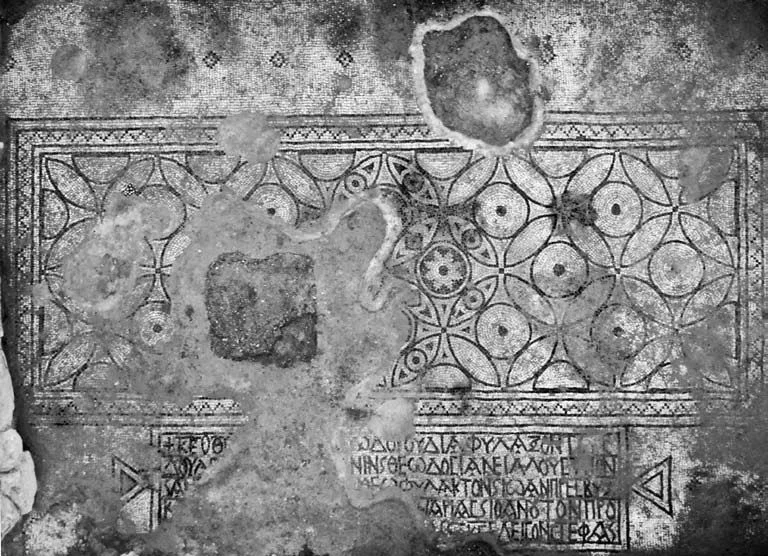
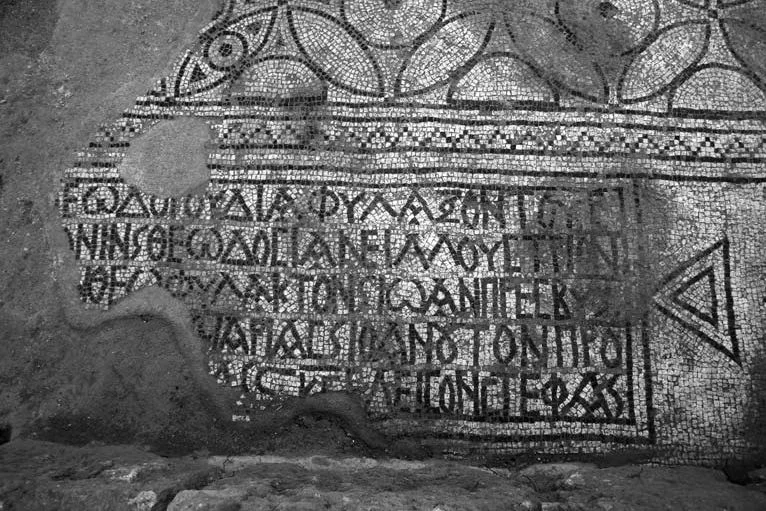
Floor-mosaic with a Greek inscription invoking the God of *Theodore (soldier and martyr of Amaseia and Euchaita in Pontus, S00480) on behalf of a group of benefactors. Found at Khirbet Deiry/Nes Harim near Jerusalem (Roman province of Palaestina I). Probably early 7th c.
- Language
- Greek
- Date from
- 580
- Date to
- 620
- Evidence type
- Archaeological and architectural; Inscriptions
- Evidence subtype
- Cult buildings (churches, mausolea); Formal inscriptions (stone, mosaic, etc.)
- Evidence region
- Palestine with Sinai
- Evidence location
- Jerusalem; Caesarea Maritima, Καισάρεια, Kaisareia, Caesarea, Kayseri, Turris Stratonis; Khirbet Deiry; Caesarea Maritima, Καισάρεια, Kaisareia, Caesarea, Kayseri, Turris Stratonis
- Cult region
- Palestine with Sinai
- Cult location
- Jerusalem; Caesarea Maritima, Καισάρεια, Kaisareia, Caesarea, Kayseri, Turris Stratonis; Khirbet Deiry; Caesarea Maritima, Καισάρεια, Kaisareia, Caesarea, Kayseri, Turris Stratonis
- Cult date from
- 580
- Cult date to
- 620
Text
+ Κ(ύρι)ε ὁ θ(εὸ)ς [τοῦ ἁγίου Θ]εωδόρου, διαφύλαξον τοὺς
δούλο[υς σου Ἀντ]ώνι(ο)ν (καὶ) Θεωδοσίαν εἰλλούστριον
(καὶ) ἀν[άπαυσον - - -]Ν Θεωφύλακτον (καὶ) Ἰωάν(νην) πρεσβύ(τερον)
Κ(ύρι)ε [μνήσθητι - - - καὶ] Μαρίας (καὶ) Ἰοάνου τõν προ-
[σενεγκότων μηνὶ - - -, ἰν]δ(ικτιῶνος) ϛ΄· Κ(ύρι)ε ἐλέϊσον Στέφα(νον)
'O Lord, God [of Saint] Theodore, protect [your] servant, Antonios, and Theodosia, of illustris rank, and give repose to [- - -] Theophylaktos, and Ioannes the presbyter! O Lord, [remember - - - and] Maria, and Ioannes, who [made the offering in the month of - - -], 6th indiction. O Lord, have mercy upon Stephanos!'
Text: SEG 60, 1722.
Source
Floor-mosaic framed by a tabula ansata.
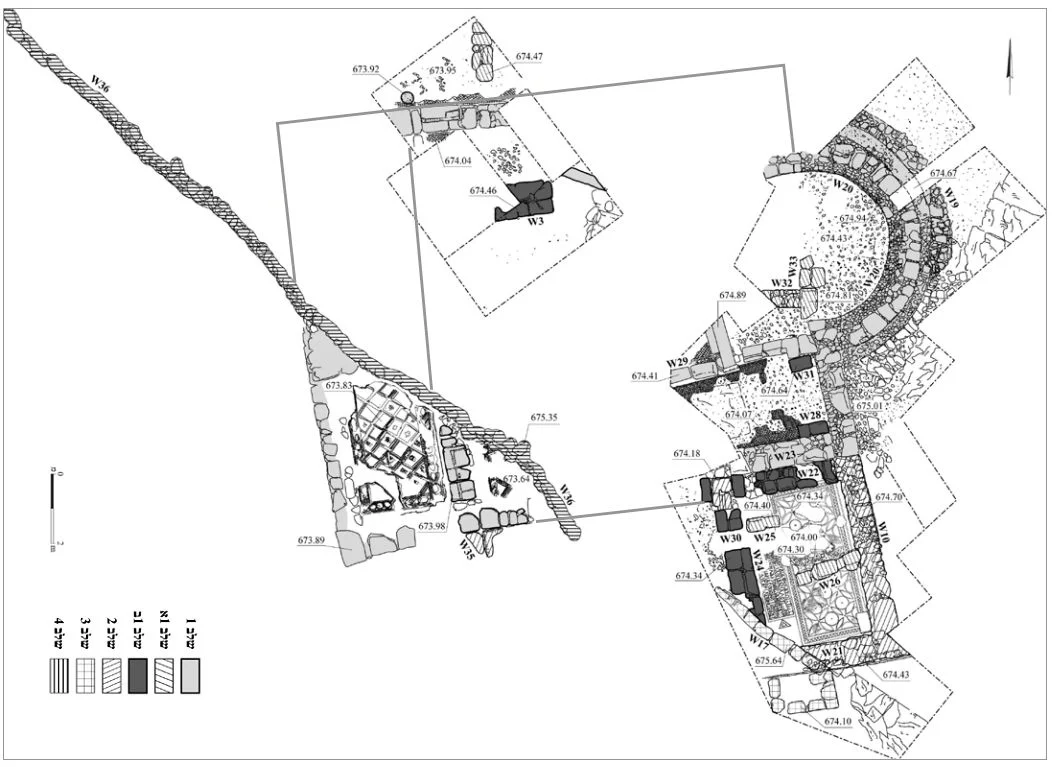
Found in a south room (a side chalpel?) annexed to a church excavated at Khirbet Deiry/Nes Harim, sited 8 km to the east of Jerusalem. As far as we know, the inscription still lacks a proper edition. In 2009 a photograph and a Hebrew translation were offered by Daniel Ein-Mor in New Studies in the Archaeology of Jerusalem. There followed a note with a Greek transcription by Leah Di Segni in the sixtieth volume of the Supplementum Epigraphicum Graecum (which is the basis for the present record).
Discussion
The inscription records a donation, probably a restoration or paving of a church of Theodore, or its extension (perhaps the construction of the room where the inscription was found). There is extensive evidence across the near eastern provinces of the cult of Theodore of Amaseia and Euchaita, so we can be confident that he is the saint referred to here.
Di Segni suggests that the principal benefactors were Antonios and Theodosia. At least one of them is described by a relatively rare epithet illustris. The epithet is given in the singular masculine form, but is placed immediately after the name of Theodosia, which makes it uncertain which person it describes. It may actually refer to both Antonios and Theodosia. Di Segni points out that they could have been benefactors to a monastery if our church was a part of a monastic establishment, or owners of the estate where they built the church.
Line 3 mentions the deceased for whose repose the offering was made. There follow more, possibly lesser, benefactors. The final, isolated invocation of God's mercy may refer to the artisan who laid the mosaic (cf. SEG 62, 1661, line 6).
Dating: Line 5 contains a dating formula, the majority of which is lost. As the mention of the 6th indiction year is very plausible, and the shape of letters suggests a late 6th or early 7th c. date, Di Segni points to three consecutive years in that period, which fall on the 6th indiction, and may be the date of laying of the floor-mosaic: AD 587/588, AD 602/603, and AD 617/618.
Bibliography
Edition:
Supplementum Epigraphicum Graecum 60, 1722 [Greek transcription by Leah Di Segni].
Ein-Mor, D., "The Church at Khûrbat Deiry (Nes Harim) and its Surrounding", in: Amit, D., Stiebel, G.D., Peleg-Barkat, O. (eds.), New Studies in the Archaeology of Jerusalem and its Region, vol. 3 (Jerusalem: , 2009), 140-150 [in Hebrew; no transcription].
Images
Associated saints
| Saint | Name in source | Certainty |
|---|---|---|
| Theodore, soldier and martyr of Amaseia and Euchaita (S00480) | Θεώδορος | Certain |
Cult classifications
- Cult Places
- Cult building - dependent (chapel, baptistery, etc.); Cult building - independent (church)
- Non Liturgical Activity
- Bequests, donations, gifts and offerings; Construction of cult buildings; Prayer/supplication/invocation; Renovation and embellishment of cult buildings
- People
- Aristocrats; Merchants and artisans; Other lay individuals/ people; Women
Record author
Paweł Nowakowski
Entry date
25/12/2017
Citation
Paweł Nowakowski, Cult of Saints, E04527 — https://csla.history.ox.ac.uk/record.php?recid=E04527