
E04556
Greek, Arabic, and Christian-Palestinian Aramaic inscriptions and visitors' graffiti from a cave chapel dedicated to *Salome (probably the apocryphal Salome who assisted Mary at the birth of Christ, S02982; or perhaps *Salome the follower of Jesus, S01819) at Ḥorvat Qaṣra near ancient Eleutheropolis, in the Judean Hills (Roman province of Palaestina I). Probably of the late antique and early Arab periods.
- Language
- Greek; Other
- Date from
- 500
- Date to
- 800
- Evidence type
- Archaeological and architectural; Inscriptions
- Evidence subtype
- Cult buildings (churches, mausolea); Formal inscriptions (stone, mosaic, etc.); Graffiti; Inscribed architectural elements
- Evidence region
- Palestine with Sinai
- Evidence location
- Eleutheropolis; Caesarea Maritima, Καισάρεια, Kaisareia, Caesarea, Kayseri, Turris Stratonis; Ḥorvat Qaṣra; Caesarea Maritima, Καισάρεια, Kaisareia, Caesarea, Kayseri, Turris Stratonis
- Cult region
- Palestine with Sinai
- Cult location
- Eleutheropolis; Caesarea Maritima, Καισάρεια, Kaisareia, Caesarea, Kayseri, Turris Stratonis; Ḥorvat Qaṣra; Caesarea Maritima, Καισάρεια, Kaisareia, Caesarea, Kayseri, Turris Stratonis
- Cult date from
- 500
- Cult date to
- 800
Text
A subterranean chapel, located at the 1st/2nd c. Ḥorvat Qaṣra tomb complex, has graffiti and inscriptions in Greek, Arabic, and Christian-Palestinian Aramaic (termed 'Syriac' by the first editors), invoking God as the Lord, Christ, and Salome, probably a female saint believed to have been the woman who, together with a midwife, assisted Mary after Jesus' birth (as described by the apocryphal Protoevangelium of James), or Salome, a follower of Jesus mentioned in the canonical Gospels. A report from the exploration of the complex, with epigraphic appendices, was published in 1990 by Amos Kloner, Y. Drori, Jospeh Naveh, Leah Di Segni, and Joseph Patrich. Kloner says that the tomb was converted into a Christian place of cult in the 'Byzantine period' (that is Late Antiquity). The editors suppose that the chapel was built after the discovery of a tomb of an ordinary women named Salome, identified with the biblical/apocryphal figure.
1) Greek inscriptions and graffiti
Twelve Greek inscriptions and graffiti were published by Leah Di Segni and Joseph Patrich. The editors say that many of the carved inscriptions are well executed, but that the graffiti are usually careless and in cursive script. The texts commemorate offerings, name the chapel, invoke God as the Lord, Christ, and Saint Salome. Di Segni and Patrich date them to the 'Byzantine' = (late antique) and early Arab periods. The following texts openly refer to the cult of saints.
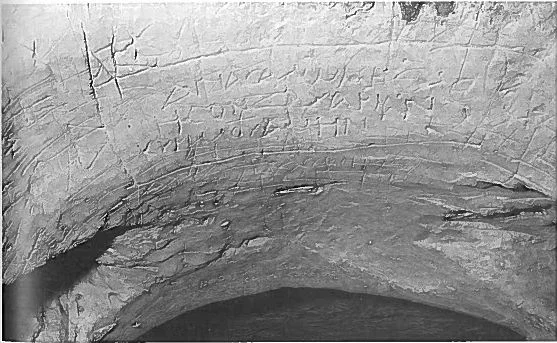
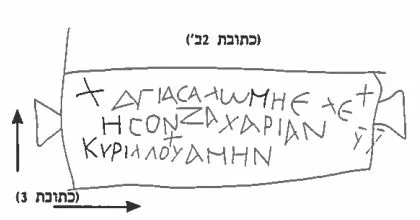
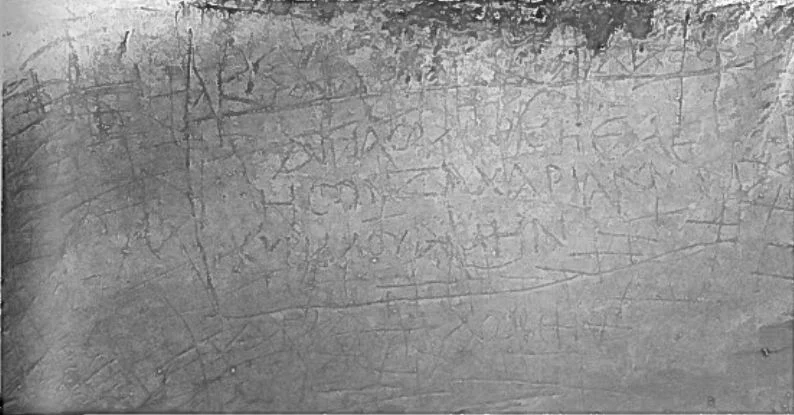
Inscription 2 (fig. 2): = SEG 40, 1451.
a) ἁγία Σαλώμη, ἐλέ-
ησον Ζαχαρίαν ̣υ<ἱο>̣ῦ
Κυρίλλου· ἀμήν
'O Saint Salome, have mercy upon Zacharias, son of Kyrillos! Amen.'
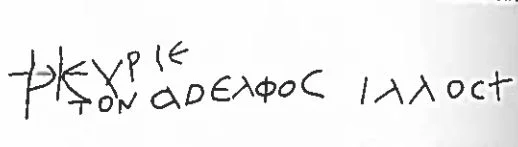
b) + Κύριε, [ἐλέησον]
τὸν ἀδελφὸς [Κύρ]ιλλος +
'+ O Lord, [have mercy upon] the brother Kyrillos!'
Inscription a) is within a tabula ansata, located above the arched doorway between the entrance hall (I) and chapel (IV), and surrounded by carvings of crosses. The editors praise its careful script (but they doubt that this is the work of a professional stonecutter) and consider it a dedicatory text. They suppose that Zacharias was 'the principal benefactor of the church'. Inscription b) probably belongs to the same text, although it is carved above the tabula. Kyrillos may be an elder brother of Zacharias.
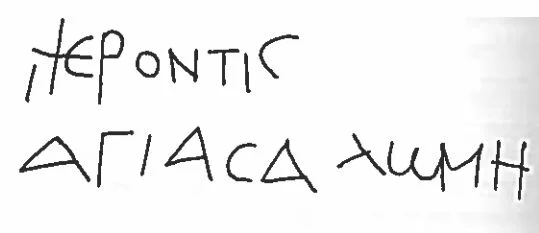
Inscription 3 (fig. 3) = SEG 40, 1452.
ἱερὸν τῖς
ἁγία<ς> Σαλώμη<ς>
'Temple (hieron) of Saint Salome.'
Line 2 is carved to the left of Inscription 2a, perpendicularly. Line 2 is below the tabula ansata. The editors suggest that this inscription names our chapel. However, based on the drawing we suggest that line 1 may contain the name of a supplicant, Geronti(o)s.
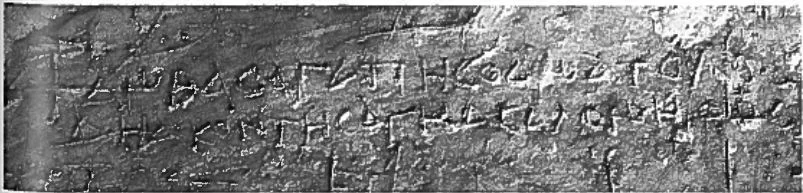
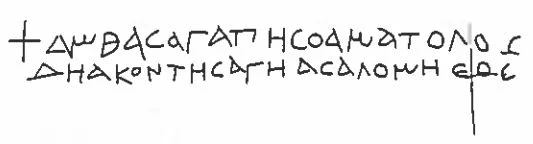
Inscription 4 (fig. 4) = SEG 40, 1453.
+ Ἄμβας Ἁγάπης ὁ ἁμα<ρ>τολὸς
δηακὸν τῆς ἁγήα<ς> Σαλόμη<ς> ̣ἔ̣θ<ηκ>ε
'+ Abbas Agapios, the sinner, deacon of Saint Salome, set [this] up.'
Carved on the soffit in the passageway between between the hall (I) and the chapel (IV). The editors suppose that this dedication refers to an offering of an object, or to the carving of the inscription itself.
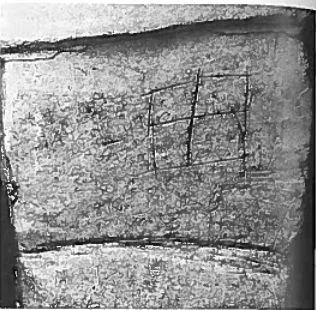
Inscription 5 (fig. 5) = SEG 40, 1454.
ἁ(γ)ί(α) Σα(λώμη)
Ἰ(ησοῦ)ς Χ(ριστό)ς
Carved on the capital of a column in the chancel screen in Room IV, below a carving of a square divided into four sectors. Abbreviations in line 1 are, however, unusual, and, based on the drawing, one can wonder if the inscription reads νι- κᾷ Ἰ(ησοῦ)ς Χ(ριστό)ς/'Jesus Christ conquers!', which is a popular acclamation, often laid out in four sectors.
2) Arabic graffiti.
Five Arabic graffiti were published by Y. Drori. Kloner and Drori suppose that they were 'carved by Arabic-speaking Christians of the Early Islamic period, rather than Christian Arabs of Byzantine times'. The inscriptions invoke God as the Lord, 'the Lord Messiah and Saviour' (apparently Christ), and Saint Salome. They also invoke the intercession of anonymous saints. Below we present English translations, as published by Y. Drori, of three texts which are interesting for our project.
no. 2 (fig. 19):
'Have mercy, O merciful one, upon Thy erring servant Musa b. Daoud an-Nasrani [by virtue of] the prayers of the saints! Amen.'
no. 4 (fig. 20):
'O Lord, have mercy on Thy erring servant Hajaj b. Samir and have mercy on he who sought refuge in Thy shadow and said Amen [- - -] of all the Christians (?) [- - -] virtue of the saint [- - -]
no. 5 (fig. 21):
'[- - -] Saint Salome. O Lord, have mercy on Thy erring servant Malek b. Namir from [- - -] Duwweir.'
3) Christian-Palestinian Aramaic ('Syriac') inscriptions:
In Appendix B Joseph Naveh comments on two inscriptions in Aramaic. The first of them is illegible. The other begins with an invocation 'Remember, Lord God...'.
Discussion
In their comments, Di Segni and Patrich discuss literary sources referring to Salome and her alleged presence at the birth of Jesus, stating that her cult was never accepted by the mainstream church, but that she sometimes appears in iconography, and was venerated in Egypt and Palestine (see Di Segni & Patrich 1990, 32*-33*).
Bibliography
Edition:
Kloner, A., Drori, Y., Naveh, J., "The cave chapel of Ḥorvat Qaṣra", ‘Atiqot. Hebrew Series 10 (1990), 29*-30* [summary in English].
Di Segni, L., Patrich, J., "The Greek inscriptions in the cave chapel of Ḥorvat Qaṣra", ‘Atiqot. Hebrew Series 10 (1990), 141-154 [in Hebrew], 31*-35* [summary in English]. With photographs, drawings.
Further reading:
Supplementum Epigraphicum Graecum 40, 1450-1461.
Images

Associated saints
| Saint | Name in source | Certainty |
|---|---|---|
| Salome, follower of Jesus (S01819) | Σαλώμη, Σαλόμη | Uncertain |
| Salome, apocryphal figure who aided Mary at the birth of Jesus (S02982) | Σαλώμη, Σαλόμη | Uncertain |
Cult classifications
- Cult Places
- Burial site of a saint - tomb/grave; Cult building - dependent (chapel, baptistery, etc.); Holy cave; Place associated with saint's life
- Non Liturgical Activity
- Bequests, donations, gifts and offerings; Pilgrimage; Prayer/supplication/invocation; Visiting graves and shrines
- People
- Ecclesiastics - lesser clergy; Other lay individuals/ people
Record author
Paweł Nowakowski
Entry date
04/01/2018
Citation
Paweł Nowakowski, Cult of Saints, E04556 — https://csla.history.ox.ac.uk/record.php?recid=E04556