
E04646
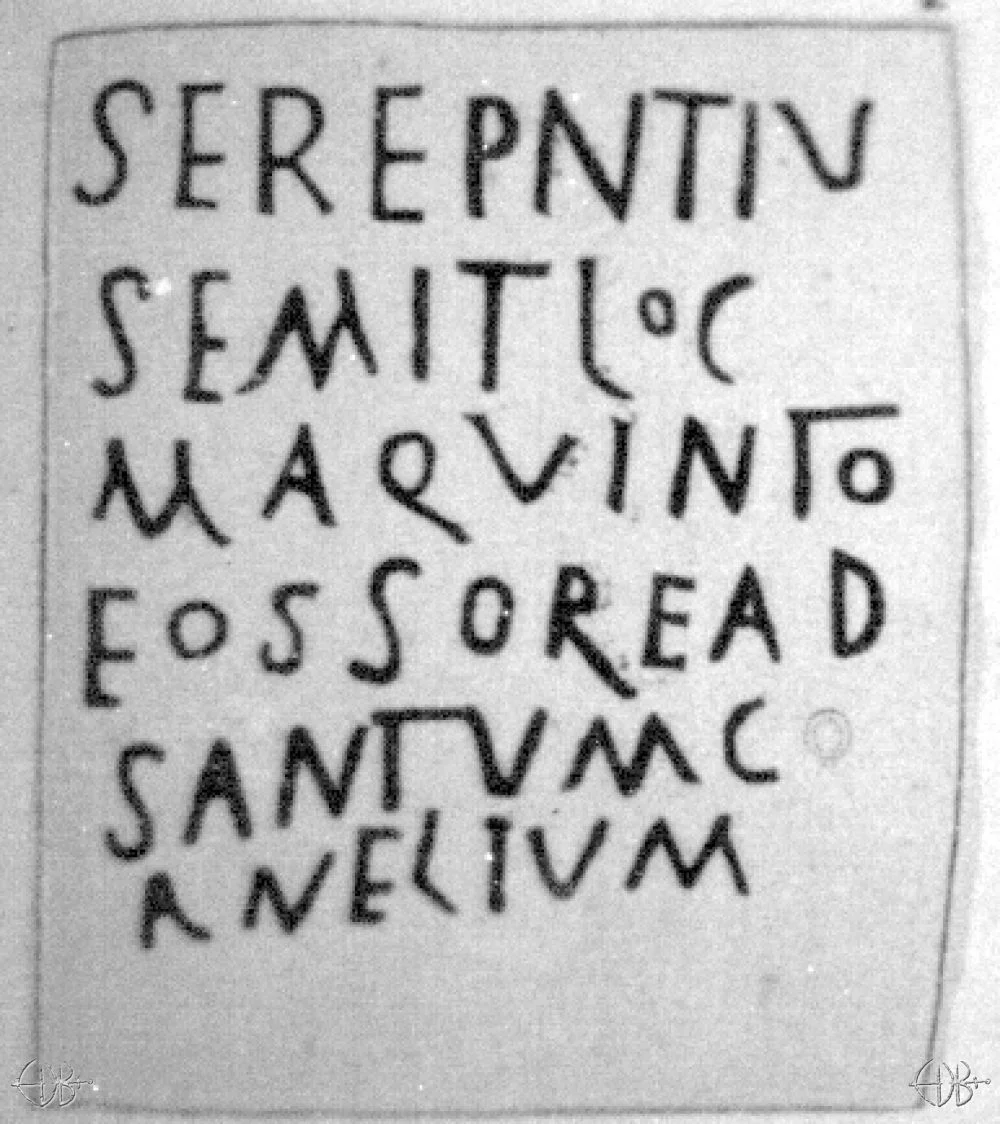
Latin inscription recording the purchase of a tomb (locus) in a burial complex called after *Cornelius (bishop and martyr of Rome, S00172). Found probably in the 'crypt of Saint Cornelius,' at the Cemetery of Callixtus, via Appia (Rome). Probably 5th c.
- Language
- Latin
- Date from
- 400
- Date to
- 500
- Evidence type
- Inscriptions
- Evidence subtype
- Funerary inscriptions
- Evidence region
- Rome and region
- Evidence location
- Suburban catacombs and cemeteries; Rome, Rome, Roma, Ῥώμη, Rhōmē
- Cult region
- Rome and region
- Cult location
- Suburban catacombs and cemeteries; Rome, Rome, Roma, Ῥώμη, Rhōmē
- Cult date from
- 400
- Cult date to
- 500
Text
Serepntiu-
s emit loc-
m a Quinto
fossore ad
santum Cor-
nelium
1-2. read Serpentium || 2-3 read locum
'Serpentius bought this burial place (locus) from Quintus, gravedigger. (In the crypt called) "near Saint Cornelius".'
Text: ICVR, n.s., IV, no. 9441.
Source
Marble plaque. H. 0.25 m; W. 0.20 m. Letter height 0,02-0.025 m.
First recorded by Carlo Fea in the late 18th or early 19th c., who offered a transcription in one of his manuscripts (Vat. lat. 10591 f. 115). Published by Giovanni Battista de Rossi in 1864 from Fea's copy, and by Orazio Marucchi, and Ernst Diehl, after de Rossi's edition. In 1964 republished by Antonio Ferrua.
Fea did not describe the findspot. De Rossi ascribed the stone to the crypt of Cornelius. Now in the church of San Rocco in the village of Cesinali in the province of Avellino (Campania).
Discussion
The inscription marks the tomb as the property of one Serpentius, legally purchased from a licensed gravedigger. The property, and therefore inviolability, of burial places concerned both Christians and pagans. It was often proclaimed by means of inscriptions to prevent the seizure of tombs by other people.
The present tomb is named as 'at saint Cornelius / ad sanctum Cornelium’. This is a reference to the tomb of Cornelius, a 3rd c. bishop of Rome (pope), and probably a martyr. He was buried in the Catacombs of Callixtus, and became the eponym for an entire burial sector.
The editors considered the inscription testimony to a burial ad sanctos, but the formula can also be interpreted as containing a mere name of the place rather than a statement that the tomb’s owner wanted to be buried near Cornelius
Dating: Antonio Felle in the EDB dates the inscription to the 5th c.
Bibliography
Edition:
Epigraphic Database Bari, no. EDB19777, see http://www.edb.uniba.it/epigraph/19777
De Rossi, G.B., Ferrua, A. (eds.) Inscriptiones Christianae Urbis Romae Septimo Saeculo Antiquiores, n.s., vol. 4: Coemeteria inter Vias Appiam et Ardeatinam (Vatican: Pont. Institutum Archaeologiae Christianae, 1964), no. 9441.
Diehl, E., Inscriptiones Latinae Christianae Veteres (Berlin: Apud Weidmannos, 1925-1927), vol. 1, no. 2131, and vol. 2, comments on no. 3756B.
Marucchi, O., Epigrafia cristiana. Trattato elementare con una silloge di antiche iscrizioni cristiane principalmente di Roma (Milan: U. Hoepli, 1910), 169, no. 153.
de Rossi, G.B., La Roma sotterranea cristiana, vol. 1 (Rome: Cromo-litografia pontificia, 1864), 304, 327 and Tav. XXVIII 2.
Further reading:
Bond, S.E., "Mortuary workers, the Church, and the funeral trade in Late Antiquity", Journal of Late Antiquity 6 (2013), 143.
Images
Associated saints
| Saint | Name in source | Certainty |
|---|---|---|
| Cornelius, bishop and martyr of Rome, and companion martyrs (S00172) | Cornelius | Certain |
Cult classifications
- Cult Places
- Burial site of a saint - cemetery/catacomb; Burial site of a saint - crypt/ crypt with relics; Burial site of a saint - tomb/grave
- Non Liturgical Activity
- Burial ad sanctos
- People
- Merchants and artisans; Other lay individuals/ people
- Places Names after Saint
- Other
Record author
Paweł Nowakowski
Entry date
19/01/2018
Citation
Paweł Nowakowski, Cult of Saints, E04646 — https://csla.history.ox.ac.uk/record.php?recid=E04646