
E04743
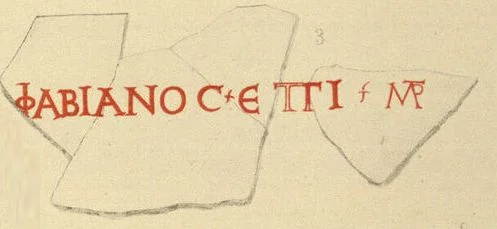
Greek epitaph for *Fabianus (bishop and martyr of Rome, S00147), naming him a bishop and martyr (with the second epithet probably added by a different hand). Found in the lower part of the cemetery of Callixtus, on the via Appia, outside Rome. Probably 250.
- Language
- Greek
- Date from
- 250
- Date to
- 250
- Evidence type
- Archaeological and architectural; Inscriptions
- Evidence subtype
- Formal inscriptions (stone, mosaic, etc.); Funerary inscriptions; Internal cult fixtures (crypts, ciboria, etc.)
- Evidence region
- Rome and region
- Evidence location
- Suburban catacombs and cemeteries; Rome, Rome, Roma, Ῥώμη, Rhōmē
- Cult region
- Rome and region
- Cult location
- Suburban catacombs and cemeteries; Rome, Rome, Roma, Ῥώμη, Rhōmē
- Cult date from
- 250
- Cult date to
- 250
Text
Φαβιανὸς ἐπί(σκοπος) μ(ά)ρτ(υς)
'Fabianos, bishop, martyr.'
Text: ICVR, n.s., IV, no. 10694 = EDB1781.
Source
Five conjoining fragments of a marble plaque. Preserved dimensions: H. 0.58 m; W. 0.82 m. Letter height 0.05 m. Four fragments were recorded by Giovanni Battista de Rossi in cubiculum Aa, in the area of the Crypt of the Popes, in 1854. The fifth fragment was found in 1922 by Enrico Josi. Now in cubiculum Aa.
The fragments have been re-edited and discussed by many scholars, notably Antonio Ferrua in 1964. High quality photographs are published in the Epigraphic Database Bari.
Discussion
The epitaph was composed for pope Fabianus (236-250). His numerous deeds, including his peculiar interest in the monumentalisation of papal tombs in the catacombs, are recounted by the Liber pontificalis (E00343), a work from the 530s. Fabianus was, notably, also known to the eastern Greek-speaking church historian, Eusebius (E00343).
The Liber pontificalis says that Fabianus died a martyr's death, and 'was buried in the cemetery of Callixtus on the via Appia on 20 January.' The same day is attested by the Martyrologium Hieronymianum (E04616). The epitaph does not record the year of the deposition. Epitaphs for 3rd c. popes, however, rarely record those dates. For a remarkable exception, see the epitaph for pope *Gaius (E04739).
Importantly, it has been suggested that the term martyr, clearly visible in the epitaph of Fabianus, was added later, by a different hand. Having carefully examined the stone, Antonio Ferrua confirmed the different lettering, and shallower carving of this word.
Dating: The inscription, if this is the original epitaph for the pope, erected during or shortly after this burial, must date to 250.
Bibliography
Edition:
Epigraphic Database Bari, no. EDB1781, see http://www.edb.uniba.it/epigraph/1781
De Rossi, G.B., Ferrua, A. (eds.) Inscriptiones Christianae Urbis Romae Septimo Saeculo Antiquiores, n.s., vol. 4: Coemeteria inter Vias Appiam et Ardeatinam (Vatican: Pont. Institutum Archaeologiae Christianae, 1964), no. 10694 (with further bibliography).
Josi, E., Il Cimitero di Callisto (Roma: Pontificio Istituto di archeologia cristiana, 1933), 23.
Josi, E., "Conferenze di Archeologia Cristiana", Nuovo bullettino di archeologia cristiana (1922), 97 (communication of the discovery of the fifth fragment).
Marucchi, O., Epigrafia cristiana. Trattato elementare con una silloge di antiche iscrizioni cristiane principalmente di Roma (Milan: U. Hoepli, 1910), 190, no. 192.
Wilpert, J., La Cripta dei Papi e la cappella di Sainta Cecilia ne cimetero di Callisto (Rome: Desclée & C., 1910), 19, 28, and Fig. 12.
de Rossi, G.B., La Roma sotterranea cristiana, vol. 2 (Rome: Cromo-litografia pontificia, 1867), 58-62, and Tav. III.
Corpus Inscriptionum Graecarum IV, no. 9674.
Civiltà cattolica, vol. 3 (1854), 127 (four fragments).
Further reading:
Carletti, C., Epigrafia dei cristiani in Occidente dal III al VII secolo. Ideologia e prassi (Bari: Edipuglia, 2008), 36.
Images
Associated saints
| Saint | Name in source | Certainty |
|---|---|---|
| Fabianus, bishop and martyr of Rome (S00147) | Φαβιανός | Certain |
Cult classifications
- Cult Places
- Burial site of a saint - cemetery/catacomb; Burial site of a saint - crypt/ crypt with relics; Burial site of a saint - tomb/grave
- Cult Related Objects
- Inscription
- Non Liturgical Activity
- Ceremonies at burial of a saint
- People
- Ecclesiastics - bishops
Record author
Paweł Nowakowski
Entry date
29/10/2018
Citation
Paweł Nowakowski, Cult of Saints, E04743 — https://csla.history.ox.ac.uk/record.php?recid=E04743