
E05037
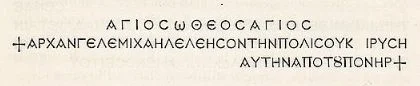
Greek inscription invoking the Archangel *Michael (S00181) to protect a city. Found at Afyonkarahisar near ancient Akroinos and Prymnessos (Phrygia, west central Asia Minor). No certain dating: possibly late antique or middle Byzantine.
- Language
- Greek
- Date from
- 500
- Date to
- 1300
- Evidence type
- Inscriptions
- Evidence subtype
- Formal inscriptions (stone, mosaic, etc.); Inscribed architectural elements
- Evidence region
- Asia Minor
- Evidence location
- Akroinos; Nicomedia, Νικομήδεια, Nikomēdeia, Izmit, Πραίνετος, Prainetos, Nicomedia; Prymnessos; Nicomedia, Νικομήδεια, Nikomēdeia, Izmit, Πραίνετος, Prainetos, Nicomedia
- Cult region
- Asia Minor
- Cult location
- Akroinos; Nicomedia, Νικομήδεια, Nikomēdeia, Izmit, Πραίνετος, Prainetos, Nicomedia; Prymnessos; Nicomedia, Νικομήδεια, Nikomēdeia, Izmit, Πραίνετος, Prainetos, Nicomedia
- Cult date from
- 500
- Cult date to
- 1300
Text
ἅγιος ὦ θεός, ἅγιος [ὦ θεός, ἅγιος ὦ θεός]
+ ἀρχάνγελε Μιχαήλ, ἐλέησον τὴν πόλι<ν> σου κ[α]ὶ ῥύση αὐτὴν ἀπὸ τοῦ πονηρ(οῦ) +
1. ἅγιος ὦ θεός, ἅγιος [ὦ θεός, ἅγιος ὦ θεός] Ramsay, but possibly ἅγιος ὡ θεός, ἅγιος [ἰσχυρός, ἅγιος ἀθάνατος, ἐλέησον ἡμᾶς]
'Holy God, Holy [God, Holy God!] + O Archangel Michael, have mercy upon your city, and deliver her from evil!'
Text: Felle 2006, no. 495.
Source
The inscription is on a small marble pillar. There is no published description. Line 2 runs around the pillar. Found at Afyonkarahisar near ancient Akroinos and Prymnessos by William Ramsay. When recorded, the pillar was in an Armenian church, said to have been 'an old building,' constructed by the Greeks.
First published by Ramsay with a majuscule copy in 1882. Republished by Ramsay in 1897. In 2006 the inscription was included by Antonio Felle in his collection of epigraphs containing biblical quotations.
Discussion
The inscription records a very interesting invocation of the Archangel Michael. He is asked to protect an unnamed city (polis) with the words borrowed from the Lord's prayer ('and deliver us from evil!'). Ramsay suggested that the city was nearby Akroinos. For a similar invocation based on the Lord's prayer, see E00743.
Line 1 may contain a triple invocation of God, as suggested by Ramsay, or the Trisagion prayer.
Dating: Sadly, there is no reliable way to date the inscription. We cannot say if it comes from the late antique or middle Byzantine period.
Bibliography
Edition:
Inscriptiones Christianae Graecae database, no. 1552, see
http://www.epigraph.topoi.org/ica/icamainapp/inscription/show/1552
Felle, A.E., Biblia epigraphica. La sacra scrittura nella documentazione epigrafica dell'«Orbis christianus antiquus» (III-VIII secolo) (Bari: Edipuglia, 2006), no. 495.
Ramsay, W.M., Cities and Bishoprics of Phrygia, vol. 1, part 2: West and West-Central Phrygia (Oxford: Clarendon Press, 1897), 741-742, no. 678.
Ramsay, W.M., "Prymnessos and Metropolis", Mittheilungen des Deutschen archaeologischen Institutes in Athen 7 (1882), 144.
Further reading:
Cumont, F., "Les inscriptions chrétiennes de l'Asie Mineure", Mélanges d'archéologie et d'histoire 15 (1895), no. 189.
Images
Associated saints
| Saint | Name in source | Certainty |
|---|---|---|
| Michael, the Archangel (S00181) | Μιχαήλ | Certain |
Cult classifications
- Non Liturgical Activity
- Prayer/supplication/invocation; Saint as patron - of a community
- Recorded Miracles
- Miraculous protection - of communities, towns, armies
Record author
Paweł Nowakowski
Entry date
09/02/2018
Citation
Paweł Nowakowski, Cult of Saints, E05037 — https://csla.history.ox.ac.uk/record.php?recid=E05037