
E05088
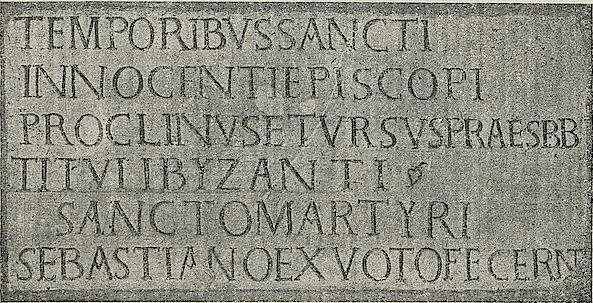
Latin inscription recording the fulfilment of a vow to *Sebastianus, martyr of Rome (S00400). Found in the church of S. Sebastiano/Basilica Apostolorum at the Cemetery ad Catacumbas, via Appia, Rome. Probably 401/417 or slightly later.
- Language
- Latin
- Date from
- 401
- Date to
- 417
- Evidence type
- Inscriptions
- Evidence subtype
- Formal inscriptions (stone, mosaic, etc.)
- Evidence region
- Rome and region
- Evidence location
- Suburban catacombs and cemeteries; Rome, Rome, Roma, Ῥώμη, Rhōmē
- Cult region
- Rome and region
- Cult location
- Caelian Hill; Rome, Rome, Roma, Ῥώμη, Rhōmē; Suburban catacombs and cemeteries; Rome, Rome, Roma, Ῥώμη, Rhōmē
- Cult date from
- 401
- Cult date to
- 417
Text
temporibus sancti
Innocenti episcopi
Proclinus et Ursus praesbb(yteres)
titu<l>i Byzanti (ivy leaf)
sancto martyri
Sebastiano ex voto fecer<u>nt
4. TITVI stone || 6. FECERNT stone
'Proclinus and Ursus, presbyters of the titulus Byzantis made it as en ex-voto offering to the holy martyr Sebastian. In the times of the the holy Innocentius, bishop.'
Text: ICVR, n.s., V, no. 13122 = EDB1476.
Source
Marble plaque broken into two conjoining pieces. H. 0.63 m; W. 1.30 m. Letter height 0.07 m.
The earliest records (14th c.) say that the plaque was displayed in the left sector of the church of San Sebastiano, at the Cemetery ad Catacumbas, on the Via Appia. Antonio Bosio (early 17th c.) says that it was reportedly brought there from the staircase leading to the crypt of San Sebastiano Pope Pius VII had it relocated to the Vatican Museums. On the suggestion of Giovanni Battista de Rossi it was added to the epigraphic collection of the Lateran. Now in the Vatican Museums, Lapidario Cristiano ex Lateranense.
Beginning in the 14th c., the inscription appears in manuscript syllogae of Latin inscriptions. It was known to a number of early modern scholars including, for example, Cyriacus of Ancona and Konrad Peutinger. It first appeared in print in 1570, in Onofrio Panvinio's De septem urbis ecclesiis. For a list of manuscripts, and printed editions up to 1971, see the lemma in Antonio Ferrua's ICVR, n.s., V, no. 13122. A high-quality photograph is published in the Epigraphic Database Bari.
Discussion
The inscription commemorates the completion of an unspecified vow to the martyr Sebastianus by two presbyters of the titulus Byzantis, that is the Roman church of *Iohannes and Paulus (SS. Giovanni e Paolo) on the Caelian Hill. Antonio Ferrua notes that presbyters of this church were in charge of the church of Sebastianus/Basilica Apostolorum and its cemetery.
It is not clear what the object of the vow made by the two presbyters was. Ferrua suspends judgement. Earlier scholars speculated that it could have been the entire church, the crypt of the saint, or just the marble revetment of the altar. Therefore, the inscription is sometimes unjustly presented as the building inscription for the church of Sebastianus. See also the comments by Anna Maria Nieddu (2006, 369, note 1695) on a theory by Orazio Marucchi who, based on the present and other inscriptions marking the presence of the clergy of Iohannes and Paulus in the Church of Sebastianus/Basilica Apostolorum, implausibly argued that it was not built by the emperor Constantine, but rather by the presumed founders of the church of Iohannes and Paulus: a certain Byzantius and his son Pammachius.
Dating: the dating formula says that the vow was fulfilled during the episcopacy of Innocentius I (401-417). However, as the pope is termed sanctus / 'holy', or possibly 'saint', Antonio Zaccaria (1781), and Giovanni Battista de Rossi supposed that the inscription was carved after Innocentius' death. Antonio Ferrua was not convinced by their reasoning, and placed the inscription within the pontificate of Innocentius.
Bibliography
Edition:
Epigraphic Database Bari, no. EDB1476, see http://www.edb.uniba.it/epigraph/1476
Lega, C., Le iscrizioni cristiane di Roma conservate nei Musei Vaticani. Indice dei vocaboli (Città del Vaticano: , 2000), XY.
Di Stefano Manzella, I., Le iscrizioni dei cristiani in Vaticano (Città del Vaticano: Monumenti, Musei e gallerie pontificie; Rome: Distribuzione esclusiva, Edizioni Quasar, 1997), 289-291, no. 3.7.1.
De Rossi, G.B., Ferrua, A. (eds.) Inscriptiones Christianae Urbis Romae Septimo Saeculo Antiquiores, n.s., vol. 5: Coemeteria reliqua Viae Appiae (Vatican: Pont. Institutum Archaeologiae Christianae, 1971), no. 13122.
Hendrichs, F., La voce delle chiese antichissime di Roma (Rome: Desclée & C. Editori Pontifici, 1933), Tav. 34, fig. 138.
Diehl, E., Inscriptiones Latinae Christianae Veteres, vol. 1 (Berlin: Apud Weidmannos, 1925), no. 1776.
Marucchi, O., "Marucchi, Orazio: Di una iscrizione storica che puň attribuirsi alla basilica Apostolorum sulla via Appia", Nuovo Bulletino di Archeologia Cristiana (1921), 65.
Marucchi, O., Epigrafia cristiana. Trattato elementare con una silloge di antiche iscrizioni cristiane principalmente di Roma (Milan: U. Hoepli, 1910), no. 177.
Duchesne, L., Le Liber pontificalis, vol. 1 (Paris: E. Thorin, 1886), 236.
De Rossi, G.B., Inscriptiones christianae urbis Romae septimo saeculo antiquiores, part 1, vol. 2 (Rome: Ex Officina Libraria Pontificia, Officina libraria Philippi Cuggiani, 1888), 322.
Panvinio, O., De septem urbis ecclesiis (Rome, 1570), 93.
Further reading:
Ferrua, A., 'I lavor di Proclinus e Ursus a S. Sebastiano', La civiltà cattolica 40 (1964), 287-293.
Lapidge, M., The Roman Martyrs: Introduction, Translations, and Commentary (Oxford: OUP, 2018), 93, no. 12.
Nieddu, A.M., La Basilica Apostolorum sulla via Appia e l'area cimiteriale circostante (Città del Vaticano: Pontificio istituto di archeologia cristiana, 2009), 369 note 1695.
Pesci, B., 'Il culto di S. Sebastiano a Roma nell’antichità e nel medioevo', Antonianum 20 (1945), 187-188.
Images
Associated saints
| Saint | Name in source | Certainty |
|---|---|---|
| Sebastianus, martyr of Rome (S00400) | Sebastianus | Certain |
| Innocentius, bishop of Rome, ob. 417, buried on the via Portuensis (S00575) | Innocentius | Certain |
Cult classifications
- Cult Places
- Burial site of a saint - cemetery/catacomb; Burial site of a saint - crypt/ crypt with relics; Burial site of a saint - tomb/grave; Cult building - independent (church)
- Non Liturgical Activity
- Bequests, donations, gifts and offerings; Construction of cult buildings; Renovation and embellishment of cult buildings; Vow
- People
- Ecclesiastics - lesser clergy
Record author
Paweł Nowakowski
Entry date
16/02/2018
Citation
Paweł Nowakowski, Cult of Saints, E05088 — https://csla.history.ox.ac.uk/record.php?recid=E05088