
E05125
Latin epitaph recording a burial next to a certain Hippolytus, not termed a saint, possibly *Hippolytus, monk and ascetic, one of the Greek Martyrs of Rome (S01873). Found on the via Appia, Rome. Probably 4th or 5th c.
- Language
- Latin
- Date from
- 350
- Date to
- 500
- Evidence type
- Archaeological and architectural; Inscriptions
- Evidence subtype
- Funerary inscriptions; Internal cult fixtures (crypts, ciboria, etc.)
- Evidence region
- Rome and region
- Evidence location
- Suburban catacombs and cemeteries; Rome, Rome, Roma, Ῥώμη, Rhōmē
- Cult region
- Rome and region
- Cult location
- Suburban catacombs and cemeteries; Rome, Rome, Roma, Ῥώμη, Rhōmē
- Cult date from
- 350
- Cult date to
- 500
Text
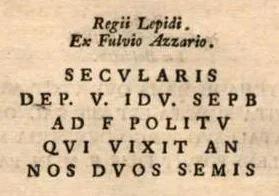
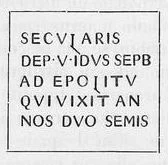
Secularis
dep(ositus) V idu(s) Sep(tem)b(ris)
ad Epolitu
qui vixit an-
nos duo semis
3. F POLITV Muratori || 5. DVOS SEMIS Muratori
'Secularis was buried on the 5th day before the ides of September near Hippolytus. He lived two years and a half.'
Text: ICVR, n.s., IV, no. 12748.
Source
Marble plaque. There is no published description. The stone first appears in 1647, in the manuscript Antiquarium Regii Lepidi by Giulio Borzani (Parisinus Ital. 260, p. 238bis), and in his other manuscripts with revised versions of his work (the last of which is dated 1655). According to Borziani, it was found in an unspecified location in the cemetery of San Sebastiano/'ad Catacumbas', and brought to Reggio in 1646 by count Francesco Calcagni together with bodies of saints buried there. The stone and the relics were deposited in an oratory of San Girolamo, probably demolished in 1797. The stone is now lost.
The inscription first appeared in print in 1742, in Lodovico Muratori's Novus Thesaurus Veterum Inscriptionum (probably with a wrongly indicated source for the edition). In 1877 it was discussed by Giovanni Battista de Rossi, and mentioned in the eleventh volume of the Corpus Inscriptionum Latinarum. Newer editions were offered by Ernst Diehl in 1925, Antonio Ferrua in 1964, and Paola De Santis in 2010.
De Rossi argued that the name of the cemetery where the stone was reportedly found was confused, or that, when retrieved by Calcagni, it had already been displaced. In his opinion, which is based on the identity of the saint mentioned, it came from the cemetery housing the tomb of the Greek Martyrs, sited close to the Cemetery of Callixtus. Therefore, Antonio Ferrua published the inscription in the ICVR series in the volume on the Cemetery of Callistus and adjacent burial complexes. It is reprinted by Paola De Santis in 2010, as a find of unknown provenance.
Discussion
The inscription is the epitaph for a boy, Secularis. It says that he was buried near a certain Hippolytus, which probably is a reference to a saint. Giovanni Battista de Rossi rejected the possibility that this Hippolytus was the martyr buried on the Via Tiburtina, whose tomb is mentioned by the Chronography of 354 (E01052), and the Notitia ecclesiarum urbis Romae (E00678), and who is the protagonist of Latin Martyrdoms and poems (see the list of records in S00509). Instead, he argued that this was Hippolytus, a monk, ascetic, and martyr, whose martyrdom and burial on the Via Appia are described in the Martyrdom of the Greek Martyrs (E03254). De Rossi also points out that a very similar epitaph, with the formula AT IPPOLITV is kept in the Vatican Museums, and is usually ascribed to the cemetery on the Via Tiburtina (E05354).
Dating: Paola De Santis dates the epitaph to the 4th or 5th c. The day mentioned is 9 September.
Bibliography
Edition:
The inscription is not included in the Epigraphic Database Bari.
De Santis, P., Sanctorum Monumenta: "Aree sacre" del suburbio di Roma nella documentazione epigrafica (IV-VII secolo) (Bari: Edipuglia, 2010), 216, no. 72.
De Rossi, G.B., Ferrua, A. (eds.) Inscriptiones Christianae Urbis Romae Septimo Saeculo Antiquiores, n.s., vol. 4: Coemeteria inter Vias Appiam et Ardeatinam (Vatican: Pont. Institutum Archaeologiae Christianae, 1964), no. 12748.
Diehl, E., Inscriptiones Latinae Christianae Veteres, vol. 1 (Berlin: Apud Weidmannos, 1925), no. 2136.
Corpus Inscriptionum Latinarum XI, no. 134* b2.
de Rossi, G.B., La Roma sotterranea cristiana, vol. 3 (Rome: Cromo-litografia pontificia, 1877), 214.
Muratori, L.A., Novus Thesaurus Veterum Inscriptionum in Praecipuis Earumdem Collectionibus Hactenus Praetermissarum, vol. 4 (Milan, Ex Aedibus Palatinis, 1742), 1939, no. 2.
Further reading:
De Santis, P., Sanctorum Monumenta: "Aree sacre" del suburbio di Roma nella documentazione epigrafica (IV-VII secolo) (Bari: Edipuglia, 2010), 74, note 322.
Lapidge, M., The Roman Martyrs. Introduction, Translations, and Commentary (Oxford: OUP, 2018), Chapter XXVIII (The Greek Martyrs).
Spera, L., Il paesaggio suburbano di Roma dall'antichità al Medioevo : il comprensorio tra le vie Latina e Ardeatina dalle Mura Aureliane al III miglio (Roma: "L'Erma" di Bretschneider, 1999), 129-131.
Images
Associated saints
| Saint | Name in source | Certainty |
|---|---|---|
| Greek martyrs of Rome (Hippolytus, Hadrias, Paulina, Neon, Maria, and their companions Eusebius, Marcellus, Maximus, Martana and Valeria) (S01873) | Epolitus | Certain |
Cult classifications
- Cult Places
- Burial site of a saint - cemetery/catacomb; Burial site of a saint - crypt/ crypt with relics; Burial site of a saint - tomb/grave
- Non Liturgical Activity
- Burial ad sanctos
- People
- Children
Record author
Paweł Nowakowski
Entry date
22/02/2018
Citation
Paweł Nowakowski, Cult of Saints, E05125 — https://csla.history.ox.ac.uk/record.php?recid=E05125