
E05281
Fragmentary Latin epitaph for a priest of the titulus-church of Eusebius (not termed 'saint'/sanctus), considered, probably at a later date, to be *Eusebius (priest and martyr of Rome under Constantius II, ob. 356/361, S01413). Found in the cemetery Ad Sanctos Marcellinum et Petrum /inter duas lauras, via Labicana, Rome. Dated 474.
- Language
- Latin
- Date from
- 474
- Date to
- 474
- Evidence type
- Archaeological and architectural; Inscriptions
- Evidence subtype
- Funerary inscriptions; Internal cult fixtures (crypts, ciboria, etc.)
- Evidence region
- Rome and region
- Evidence location
- Suburban catacombs and cemeteries; Rome, Rome, Roma, Ῥώμη, Rhōmē
- Cult region
- Rome and region
- Cult location
- Esquiline area; Rome, Rome, Roma, Ῥώμη, Rhōmē
- Cult date from
- 474
- Cult date to
- 474
Text
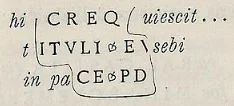
[h]ic requiescit [- - -]
[t]ituli Eusebi q[ui v]ixit ann(is) [- - -]
[- - -] in pace p(ri)d(ie) kal(endas) febr(uarias) [Le]one iun(iore) aug(usto) pr[imum cons(ule)]
'Here rests [- - -] of the titulus of Eusebius, who lived [- - -] years [- - -] in peace on the day before the calends of February, during the first consulate of Leo the Younger Augustus (= the emperor Leo II).'
Text: ICVR, n.s., VI, no. 16002 = EDB304.
Source
Fragmentary marble plaque. Two conjoining fragments? Dimensions: .
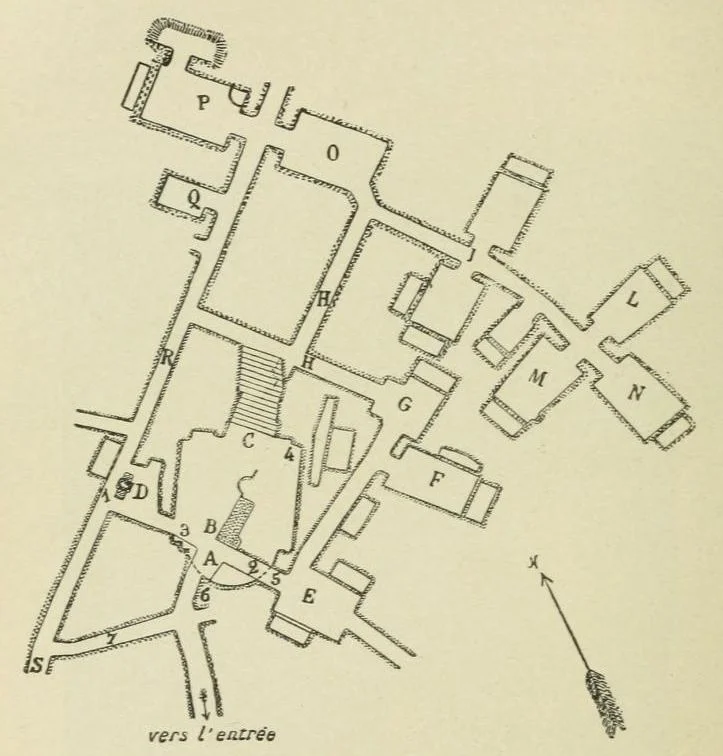
Found in the cubiculum located immediately to the south of the apsed crypt in the cemetery of Marcellinus and Petrus, marked E on the plan.
Fragment 1, with the name of the church was first published by Orazio Marucchi in 1898. Fragment 2, with the dating formula was…
Discussion
The titulus-church of Eusebius mentioned in this epitaph is normally considered to be the Roman church of Saint Eusebius, Sant' Eusebio all' Esquilino, located on the Piazza Vittorio Emmanuele. Thanks to the consular date in Fragment 2 we can date the inscription to 474. Therefore, this is the earliest testimony to the existence of a titulus-church of Eusebius in Rome. The same church probably also appears in the acts of the council of 499 ($EXXXX). The Martyrologium Hieronymianum says that the founder of the titulus-church of Eusebius was venerated on 14 August (E04918). Based on this inscription, Orazio Marucchi suggested that the cemetery depended on the titulus-church of Eusebius. This is, however, disputable.
At some point the founder of this titulus-church was identified with Eusebius, a priest and martyr of Rome under Constantius II, during the schism between Liberius and Felix II in the 350s and 360s. For his Martyrdom, see E02492 and Lapidge 2018, chapter XIII. During this conflict, the Arian emperor Constantius II supported Felix, an archdeacon of the exiled pope Liberius (opposing the Arian creed and refusing to condemn Athanasius, bishop of Alexandria), and created him a new bishop of Rome. As we learn from the Martyrdom, Eusebius was a supporter of Felix, and, subsequently, when Liberius was recalled from the exile by Constanius II, opposed Liberius for reaching agreement with the emperor. The Martyrdom says that 'then in his rage Constantius, at the request of Liberius, confined Eusebius to a cupboard in his house, which was only four feet across. And being kept there for many days, he persevered constantly in prayer, and yet after seven months he passed away on 14 August.' (trans. Lapidge 2018, 301). The Martyrdom records the burial of this Eusebius on the Via Appia, but this is probably because of the confusion with an earlier Pope Eusebius buried there (see Lapidge 2018, 299).
Notably, Eusebius, the eponym of the titulus-church, in our inscription is not named sanctus/'saint', which may suggest that in 474 he had not yet been identified with the Roman martyr. It may be that the identification was made during or after the Laurentian schism (498–506) during which the opposing parties drew heavily upon the stories of the schism between Liberius and Felix II, and during which the Martyrdom of Eusebius was possibly written. The fact that the Eusebius of the Martyrdom died on 14 August and the founder of the church was commemorated on the same day according to the Martyrologium Hieronymianum does not help much in proving that they were the same person, as the feast could have been established after the two figures had been already confused and identified with each other.
Bibliography
Edition:
Epigraphic Database Bari, nos. EDB304. See http://www.edb.uniba.it/epigraph/304
De Rossi, G.B., Ferrua, A. (eds.), Inscriptiones Christianae Urbis Romae Septimo Saeculo Antiquiores, n.s., vol. 6: Coemeteria viis Latina, Labicana et Praenestina (Vatican: Pont. Institutum Archaeologiae Christianae, 1975), no. 16002.
Marucchi, O., Le catacombe romane (Rome: Desclée, Lefebvre E.C., 1905, 2nd ed.), 269.
Marucchi, O., "La cripta storica dei SS. Pietro e Marcellino recentemente scoperta sulla via labicana", Nuovo bullettino di archeologia cristiana 4 (1898), 175.
Further reading:
Lapidge, M., The Roman Martyrs. Introduction, Translations, and Commentary (Oxford, 2018), chapter XIII.
Images
Associated saints
| Saint | Name in source | Certainty |
|---|---|---|
| Eusebius, priest and martyr of Rome under Constantius II, ob. 356/361 (S01413) | Eusebius | Uncertain |
Cult classifications
- Cult Places
- Cult building - independent (church)
- People
- Ecclesiastics - lesser clergy
Record author
Paweł Nowakowski
Entry date
30/03/2018
Citation
Paweł Nowakowski, Cult of Saints, E05281 — https://csla.history.ox.ac.uk/record.php?recid=E05281