
E05310
Latin graffito with an invocation, probably of unnamed saints or martyrs, on behalf of a deceased man. Found in the cemetery of Cyriaca ad Sanctum Laurentium, via Tiburtina, Rome. Probably second half of the 4th c.
- Language
- Latin
- Date from
- 350
- Date to
- 400
- Evidence type
- Archaeological and architectural; Inscriptions
- Evidence subtype
- Graffiti; Internal cult fixtures (crypts, ciboria, etc.)
- Evidence region
- Rome and region
- Evidence location
- Suburban catacombs and cemeteries; Rome, Rome, Roma, Ῥώμη, Rhōmē
- Cult region
- Rome and region
- Cult location
- Suburban catacombs and cemeteries; Rome, Rome, Roma, Ῥώμη, Rhōmē
- Cult date from
- 350
- Cult date to
- 400
Text
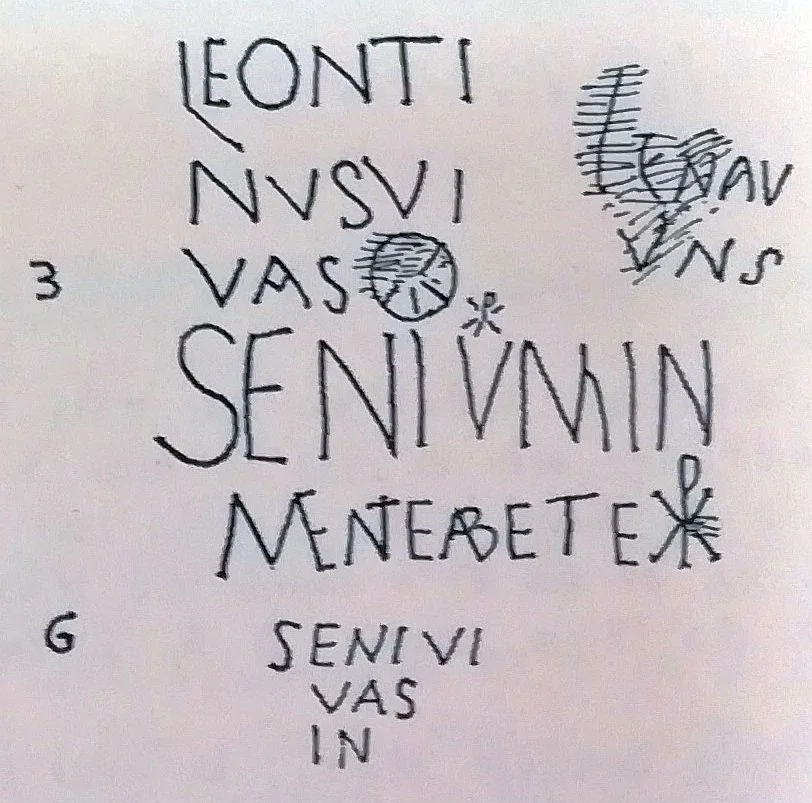
Leonti-
nus vi- Ienar[i]
vas ⳩ [vi]vas
⳩
Senium in
mente abete ⳩
Seni vi-
vas
in [- - -]
[Ar]senius: Stevenson, Senius = Xenios or Xenias: Ferrua
'Leontinus, may you live (in Christ)!’
'Have Senius (= Xenios) in mind! O Senius (Xenios), may you live in [(Christ)]!’
'Ienarius, may you live!’
Text: ICVR, n.s., VII, no. 19018b = EDB36976.
Source
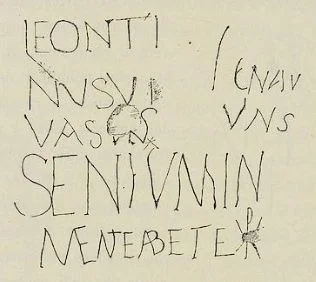
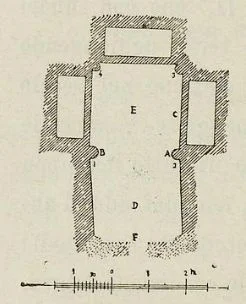
This group of graffiti was executed with a stylus on a plastered pilaster in a cubiculum in the cemetery of Cyriaca. The walls, and the other pilaster in this cubiculum also bear other, similar graffiti (see ICVR, n.s., VII, no. 18839). Letter height 1.5 - 2.6 cm.
The cubiculum, and the present group of graffiti were first recorded by Enrico Stevenson. The texts were first mentioned in an oral report of Stevenson's work in 1876, which appeared in print in 1877. It contains majuscule transcriptions of the texts. Drawings were offered by Stevenson in 1895, and by Antonio Ferrua in 1980 (from an unpublished drawing by Giovanni Battista de Rossi).
Discussion
Ferrua supposes that the graffiti were authored by at least two different people, one responsible for lines 1-5, and the other for 6-8. Stevenson and Ferrua also presume that all the invocations are on behalf of people buried in the cubiculum, and that the graffiti were authored by their relatives while visiting their tomb.
To us the most interesting is the invocation of unnamed figures, asking them to have in mind a certain Senius. In Christian graffiti from the suburban catacombs of the city of Rome, this formula was normally referred to martyrs, 'holy spirits', but also specific figures, for example the Apostles *Peter and *Paul, and the deceased popes. Here we can safely assume that unnamed martyrs, or just other deceased buried in the same cemetery are invoked.
The name of the deceased man is given as Senius, a name otherwise unattested. Stevenson supposed that it was a damaged name Arsenius, but Ferrua prefers to consider it as a Latin transliteration of the Greek name Ξένιος or Ξενίας.
Dating: The editors of the Epigraphic Database Bari date the graffiti to the second half of the 4th c.
Bibliography
Edition:
Epigraphic Database Bari, nos. EDB36976, see http://www.edb.uniba.it/epigraph/36976
De Rossi, G.B., Ferrua, A. (eds.), Inscriptiones Christianae Urbis Romae Septimo Saeculo Antiquiores, n.s., vol. 7: Coemeteria via Tiburtinae (Vatican: Pont. Institutum Archaeologiae Christianae, 1980), no. 19018.
Diehl, E., Inscriptiones Latinae Christianae Veteres, vol. 1 (Berlin: Apud Weidmannos, 1925), comments to no. 2329.
Armellini, M., Gli antichi cimeteri cristiani di Roma e d'Italia (Rome: Tipografia poliglotta, 1893), 296.
Stevenson, E., "Cubicolo con graffiti storici nel cimitero di Ciriaca" Nuovo bullettino di archeologia cristiana 1 (1895), 80.
Further reading:
Stevenson, E., "[Report, 5 March 1876]" in: O. Marucchi, "Conferenze della società di cultori della cristiana archeologia in Roma [1]", Bullettino di archeologia cristiana 3 Ser. 2 (1877), 61-62 (mentioned).
Images
Associated saints
| Saint | Name in source | Certainty |
|---|---|---|
| Martyrs, unnamed or name lost (S00060) | Uncertain | |
| Saints, unnamed (S00518) | Uncertain |
Cult classifications
- Cult Places
- Burial site of a saint - cemetery/catacomb; Burial site of a saint - crypt/ crypt with relics; Burial site of a saint - tomb/grave
- Non Liturgical Activity
- Prayer/supplication/invocation
- People
- Other lay individuals/ people
Record author
Paweł Nowakowski
Entry date
11/04/2018
Citation
Paweł Nowakowski, Cult of Saints, E05310 — https://csla.history.ox.ac.uk/record.php?recid=E05310