
E05788
Agnellus of Ravenna, in his Liber Pontificalis Ecclesiae Ravennatis, written in Latin, refers to the foundation of a monasterium dedicated to *George (soldier and martyr, S00259) which he claims took place in 557/570; written in Ravenna in 830/846.
- Author
- Agnellus of Ravenna
- Language
- Latin
- Date from
- 830
- Date to
- 846
- Evidence type
- Literary
- Evidence subtype
- Other narrative texts (including Histories)
- Evidence region
- Italy north of Rome with Corsica and Sardinia
- Evidence location
- Ravenna; Sardinia, Sardinia, Sardegna, Sardinia
- Cult region
- Italy north of Rome with Corsica and Sardinia
- Cult location
- ; Sardinia, Sardinia, Sardegna, Sardinia
- Cult date from
- 557
- Cult date to
- 570
Text
Agnellus of Ravenna, Liber Pontificalis Ecclesiae Ravennatis 89
Acquisiuit que rura in ecclesia Rauennae Argentea quae dicitur et infra ipsius rura monasterium beati Georgii a fundamentis aedificauit, sed in senectute positus; et sua effigies mire tabula depicta est, et ante introitum ipsius monasterii uersus metricos quos non potui clare uidere.
‘And he [Agnellus, Bishop of Ravenna, 557-570] acquired the estate which is called Argentea for the church of Ravenna and on this estate he built the monasterium of St George from the foundations, when he was placed in old age; and his image is wonderfully depicted on a tablet, and before the entrance of this monasterium there are metrical verses which I could not clearly see.’
Text: Deliyannis 2006.
Translation: Deliyannis 2004, lightly modified.
Source
Agnellus of Ravenna (ob. c. 846) was a deacon of the cathedral in Ravenna and – by hereditary right – abbot of two monasteries in the city. He wrote his Liber Pontificalis Ecclesiae Ravennatis between 830 and 846, following the model of the Roman Liber Pontificalis. It provides biographies of all the bishops of Ravenna from the legendary founder bishop Apollinaris to those active in Agnellus’ own day, and was originally composed to be delivered orally, most likely to clerics of Ravenna. The text is preserved in two manuscripts: one from the 15th century (Modena, Biblioteca Estense, Cod. Lat. 371 X.P.4.9.) and a fragmentary manuscript from the 16th century (Vatican, Lat. 5834). Agnellus bases his account of the lives of late antique bishops on documents preserved in Ravenna, stories transmitted orally, and his own experience of the architectural landscape of 9th c. Ravenna.
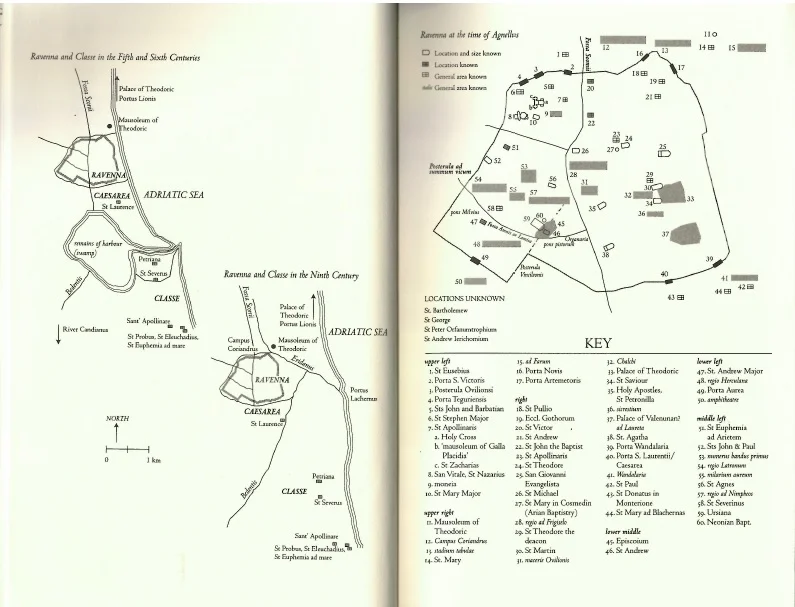
Agnellus' work contains invaluable architectural and art historical information about Ravenna. He refers to several religious buildings there and in the neighbouring settlements of Caesarea and Classe; he describes their decoration and preserves many inscriptions which are now lost. It must be remembered that this is a 9th c. work. Agnellus’ descriptions of buildings and their fixtures is based on his 9th c. experience, not late antique reality. Indeed, his accounts of the events of earlier years are often riddled with inaccuracies. Yet it is likely that his descriptions of the churches of Ravenna are more trustworthy. As Deborah Mauskopf Deliyannis argues, a comparison of surviving late antique mosaics with Agnellus’ account suggests that his descriptions were largely accurate. This is limited to what he does tell us – for example Arian foundations are often ignored whilst orthodox foundations are emphasised. Yet, overall, this text provides invaluable information about the cult of saints in late antique Ravenna.
Discussion
J.M. Sansterre and E. Morini have both convincingly shown that, throughout Agnellus’ account, monasterium can used to mean any foundation – for example a chapel or church – dedicated to a saint. It does not necessarily refer to a monastery. As such, the original Latin is preserved in this record.
It is probable that Agnellus gleaned this information from the inscription he mentions or from a textual source which is now lost to us.
Bibliography
Text:
Deliyannis, D.M., Agnelli Ravennatis Liber pontificalis ecclesiae Ravennatis (Corpus Christianorum Continuatio Mediaevalis 199; Turnhout: Brepols, 2006).
Translation:
Deliyannis, D.M., The Book of Pontiffs of the Church of Ravenna (Washington DC: CUA Press, 2004).
Further Reading:
Deichmann, F.W., Ravenna, Hauptstadt des spätantiken Abendlandes, vols. 1-3, (Wiesbaden: Steiner, 1958-89).
Deliyannis, D.M., Ravenna in Late Antiquity (Cambridge: Cambridge University Press, 2010).
Mackie, G., Early Christian Chapels in the West: Decoration, Function and Patronage (Toronto: University of Toronto Press, 2003).
Moffat, A., "Sixth Century Ravenna from the Perspective of Abbot Agnellus," in: P. Allen and E.M. Jeffreys (eds,), The Sixth Century – End or Beginning? (Brisbane: Australian Association for Byzantine Studies, 1996), 236-246.
Morini, E., "Le strutture monastische a Ravenna," in: A. Carile (ed.), Storia di Ravenna, 2.2, Dall’età bizantia all’ età ottania (Ravenna: Comune di Ravenna; Venice: Marsilio, 1992), 305-312.
Schoolman, E., Rediscovering Sainthood in Italy: Hagiography and the Late Antique Past in Medieval Ravenna (New York: Palgrave Macmillan, 2016).
Sansterre, J.M., "Monaci e monasteri greci a Ravenna," in: A. Carile (ed.), Storia di Ravenna, 2.1, Dall’età bizantia all’ età ottania (Ravenna: Comune di Ravenna; Venice: Marsilio, 1992), 323-329.
Verhoeven, M., The Early Christian Monuments of Ravenna: Transformations and Memory (Turnhout: Brepols, 2011).
Images
Associated saints
| Saint | Name in source | Certainty |
|---|---|---|
| George, soldier and martyr, and Companions (S00259) | Georgius | Certain |
Cult classifications
- Cult Places
- Cult building - dependent (chapel, baptistery, etc.); Cult building - monastic
- Cult Related Objects
- Inscription
- Non Liturgical Activity
- Bequests, donations, gifts and offerings; Construction of cult buildings
- People
- Ecclesiastics - bishops
Record author
Frances Trzeciak
Entry date
13/07/2018
Citation
Frances Trzeciak, Cult of Saints, E05788 — https://csla.history.ox.ac.uk/record.php?recid=E05788