
E05812
Agnellus of Ravenna, in his Liber Pontificalis Ecclesiae Ravennatis, quotes the dedicatory inscription of a church of *Stephen (the First Martyr, S00030) in Ravenna (northern Italy), founded by Bishop Maximian (546-557). Account written in Ravenna in 830/846.
- Author
- Agnellus of Ravenna
- Language
- Latin
- Date from
- 546
- Date to
- 846
- Evidence type
- Inscriptions; Literary
- Evidence subtype
- Formal inscriptions (stone, mosaic, etc.); Other
- Evidence region
- Italy north of Rome with Corsica and Sardinia
- Evidence location
- Ravenna; Sardinia, Sardinia, Sardegna, Sardinia
- Cult region
- Italy north of Rome with Corsica and Sardinia
- Cult location
- Ravenna; Sardinia, Sardinia, Sardegna, Sardinia
- Cult date from
- 546
- Cult date to
- 557
Text
Agnellus of Ravenna, Liber Pontificalis Ecclesiae Ravennatis 72
Aedificauit que ecclesiam beati Stephani hic Rauennae, leuitae et martiris, non longe a posterula Ouilionis a fundamentis; mira magnitudine decorauit pulcherrime que ornauit, et in cameris tribunae sua effigies tessellis uariis infixa est, et per in giro mirifice opere uitreo constructa est, multas que reliquias ibidem condidit sanctorum de corporibus, quorum nomina ita exarata inuenietis:
In honore sancti ac beatissimi primi martiris Stephani seruus Christi Maximianus episcopus hanc basilicam, ipso adiuuante, a fundamentis construxit et dedicauit die tertio Idus Decemb., indictione .xiiii., nouies p. c. Basilii iunioris.
‘And he [Maximian, Bishop of Ravenna, 546-557] built from the foundations the church of St Stephen, deacon and martyr, here in Ravenna, not far from the Ovilian gate; he enhanced it with wonderful size and furnished it most beautifully, and in the vaults of the apse his image is fixed in multi-coloured mosaic, and is surrounded by wonderful glasswork, and he established there many relics from the bodies of the saints, whose names you will find thus written:
In honour of the holy and most blessed first martyr Stephen, Bishop Maximian, servant of Christ, by God’s grace built this church from the foundations and dedicated it on the third ides of December [December 11] in the fourteenth indiction, in the ninth year after the consulship of Basilius the younger.
Agnellus refers to the presence of the relics of several saints in the church.
Templa micant Stephani meritis et nomine sacra,
Qui prius eximium martiris egit opus.
Omnibus una datur sacro pro sanguine palma,
Plus tamen hic fruitur, tempore quo prior est.
Ipse fidem uotum que tuum nunc, magne sacerdos [5]
Maximiane, iuuans, hoc opus explicuit.
Nam talem subito fundatis molibus aulam
Sola manus hominum non poterat facere.
Vndecimum fulgens renouat dum luna recursum
Excepta et pulchro condita fine nitet. [10]
The temple of Stephen shines, holy in relics and in name, he who first performed the exceptional act of martyrdom. The same palm is given to all for holy blood; however he benefits from it more who was earlier in time. He himself now assisting your faith and your vow, great priest [5]. Maximian has completed this work. For the hand of man alone could not so soon have made such a hall form its foundation walls. When the gleaming moon was new for the eleventh time, the church which had been begun shines established in beautiful completion [10].’
Text: Deliyannis 2006.
Translation: Deliyannis 2004.
Source
Agnellus of Ravenna (ob. c. 846) was a deacon of the cathedral in Ravenna and – by hereditary right – abbot of two monasteries in the city. He wrote his Liber Pontificalis Ecclesiae Ravennatis between 830 and 846, following the model of the Roman Liber Pontificalis. It provides biographies of all the bishops of Ravenna from the legendary founder bishop Apollinaris to those active in Agnellus’ own day, and was originally composed to be delivered orally, most likely to clerics of Ravenna. The text is preserved in two manuscripts: one from the 15th century (Modena, Biblioteca Estense, Cod. Lat. 371 X.P.4.9.) and a fragmentary manuscript from the 16th century (Vatican, Lat. 5834). Agnellus bases his account of the lives of late antique bishops on documents preserved in Ravenna, stories transmitted orally, and his own experience of the architectural landscape of 9th c. Ravenna.
Agnellus' work contains invaluable architectural and art historical information about Ravenna. He refers to several religious buildings there and in the neighbouring settlements of Caesarea and Classe; he describes their decoration and preserves many inscriptions which are now lost. It must be remembered that this is a 9th c. work. Agnellus’ descriptions of buildings and their fixtures is based on his 9th c. experience, not late antique reality. Indeed, his accounts of the events of earlier years are often riddled with inaccuracies. Yet it is likely that his descriptions of the churches of Ravenna are more trustworthy. As Deborah Mauskopf Deliyannis argues, a comparison of surviving late antique mosaics with Agnellus’ account suggests that his descriptions were largely accurate. This is limited to what he does tell us – for example Arian foundations are often ignored whilst orthodox foundations are emphasised. Yet, overall, this text provides invaluable information about the cult of saints in late antique Ravenna.
Discussion
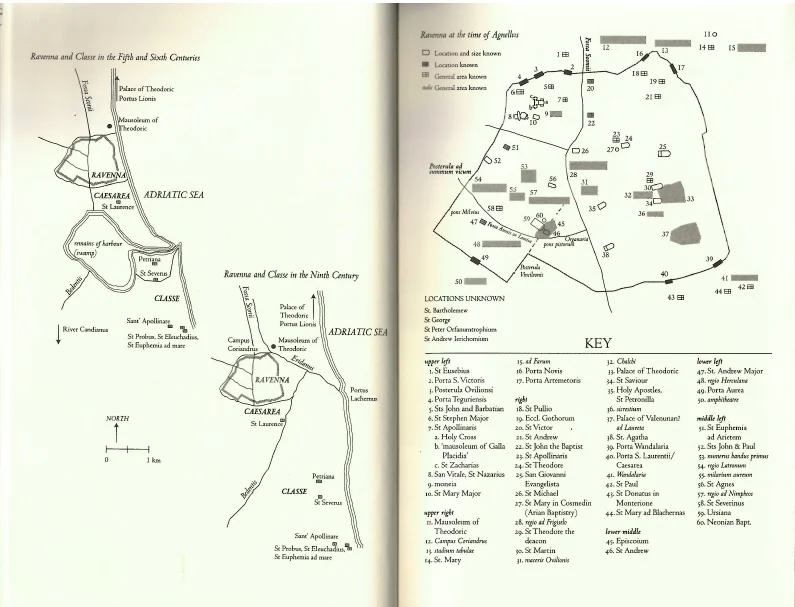
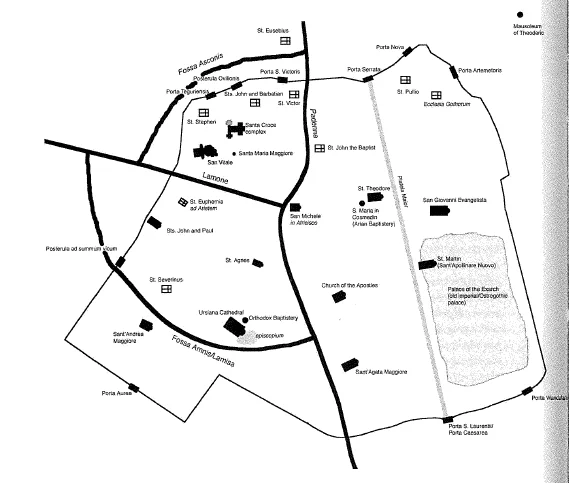
Maps showing the likely locations of the foundations in Classe and Ravenna are attached to this record.
Although Agnellus is a 9th c. text, on many occasions (as here) he copied into his work the dedicatory inscriptions he saw in and around Ravenna, providing us with reliable much older testimony.
Bibliography
Text:
Deliyannis, D.M., Agnelli Ravennatis Liber pontificalis ecclesiae Ravennatis (Corpus Christianorum Continuatio Mediaevalis 199; Turnhout: Brepols, 2006).
Translation:
Deliyannis, D.M., The Book of Pontiffs of the Church of Ravenna (Washington DC: CUA Press, 2004).
Further Reading:
Deichmann, F.W., Ravenna, Hauptstadt des spätantiken Abendlandes, vols. 1-3, (Wiesbaden: Steiner, 1958-89).
Deliyannis, D.M., Ravenna in Late Antiquity (Cambridge: Cambridge University Press, 2010).
Mackie, G., Early Christian Chapels in the West: Decoration, Function and Patronage (Toronto: University of Toronto Press, 2003).
Moffat, A., "Sixth Century Ravenna from the Perspective of Abbot Agnellus," in: P. Allen and E.M. Jeffreys (eds,), The Sixth Century – End or Beginning? (Brisbane: Australian Association for Byzantine Studies, 1996), 236-246.
Morini, E., "Le strutture monastische a Ravenna," in: A. Carile (ed.), Storia di Ravenna, 2.2, Dall’età bizantia all’ età ottania (Ravenna: Comune di Ravenna; Venice: Marsilio, 1992), 305-312.
Schoolman, E., Rediscovering Sainthood in Italy: Hagiography and the Late Antique Past in Medieval Ravenna (New York: Palgrave Macmillan, 2016).
Sansterre, J.M., "Monaci e monasteri greci a Ravenna," in: A. Carile (ed.), Storia di Ravenna, 2.1, Dall’età bizantia all’ età ottania (Ravenna: Comune di Ravenna; Venice: Marsilio, 1992), 323-329.
Verhoeven, M., The Early Christian Monuments of Ravenna: Transformations and Memory (Turnhout: Brepols, 2011).
Images
Associated saints
| Saint | Name in source | Certainty |
|---|---|---|
| Stephen, the First Martyr (S00030) | Stephanus | Certain |
Cult classifications
- Cult Places
- Cult building - independent (church); Descriptions of cult places
- Cult Related Objects
- Inscription
- Non Liturgical Activity
- Construction of cult buildings; Renovation and embellishment of cult buildings
- People
- Ecclesiastics - bishops
- Relics
- Bodily relic - unspecified; Unspecified relic
Record author
Frances Trzeciak
Entry date
13/07/2018
Citation
Frances Trzeciak, Cult of Saints, E05812 — https://csla.history.ox.ac.uk/record.php?recid=E05812