
E05862
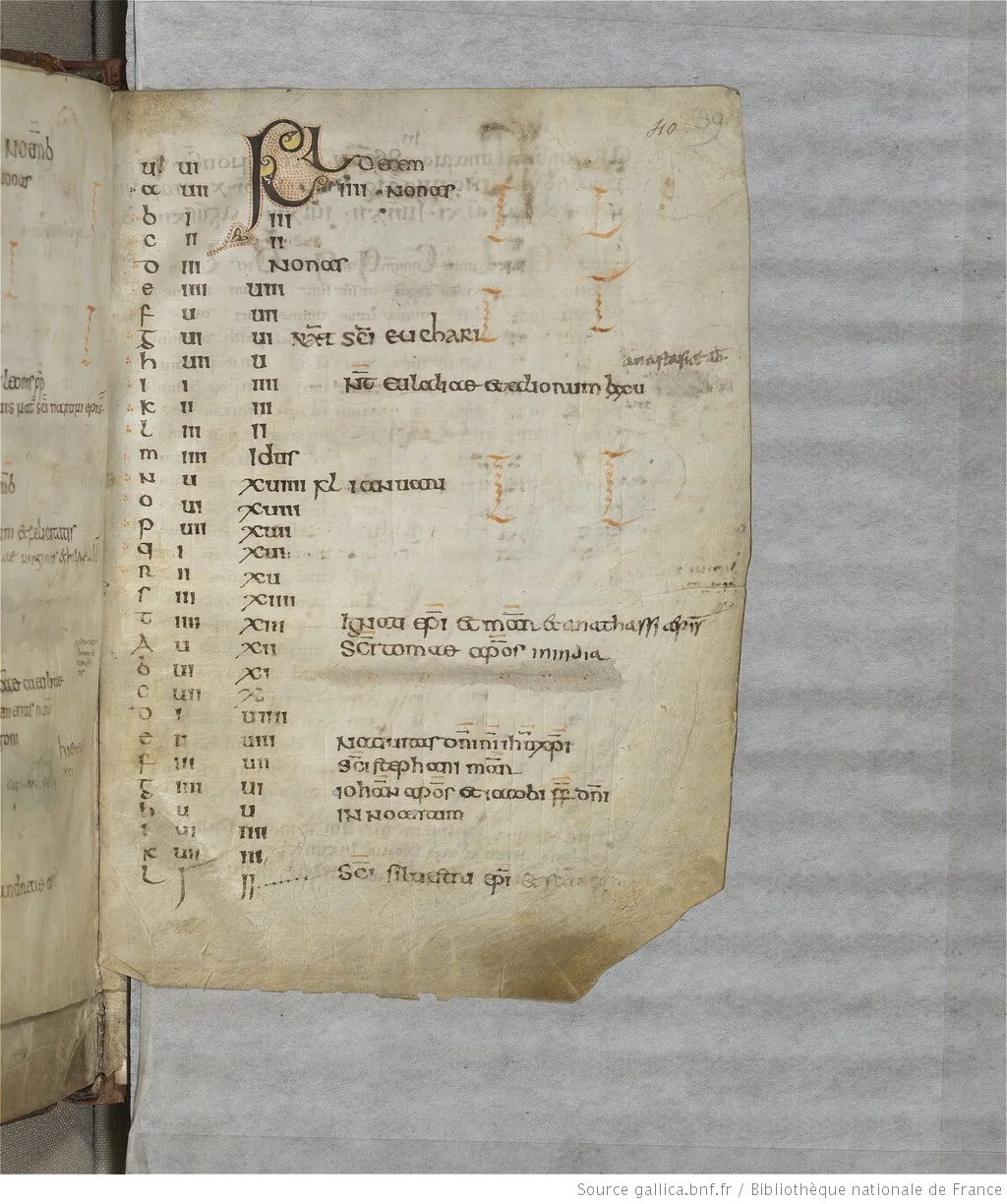
The Calendar of Willibrord, in its earliest version, records the feasts of various saints in December. Written in Latin at Echternach, Frisia (north-east Gaul), 703/710.
- Author
- The Calendar of Willibrord
- Language
- Latin
- Date from
- 703
- Date to
- 710
- Evidence type
- Late antique original manuscripts; Liturgical texts
- Evidence subtype
- Calendars and martyrologies; Parchment codex
- Evidence region
- Gaul and Frankish kingdoms
- Evidence location
- Echternach; Maastricht, Maastricht, Traiectus Mosae, Traiectum
- Cult region
- Gaul and Frankish kingdoms
- Cult location
- Echternach; Maastricht, Maastricht, Traiectus Mosae, Traiectum
- Cult date from
- 703
- Cult date to
- 710
Text
The Calendar of Willibrord records in December the feasts of the following saints:
*Eucharius (bishop of Trier, ob. 250/300, S00469)
*Eulalia (virgin and martyr of Mérida, S00407)
*Ignatios (bishop of Antioch and martyr of Rome, S00649)
*Thomas (the Apostle, S00199)
*Stephen (the First Martyr, S00030)
*James ('brother of the Lord', S00058)
*John (the Apostle and Evangelist, S00042)
*Innocents (children killed on the orders of Herod, S00268)
*Silvester (bishop of Rome, ob. 336, S00397)
Paris, Bibliothéque nationale de France, Lat. 10837, f. 40
Kalendas decembris
iiii nonas
iii
ii
nonas
viii
vii
vi NATALE SANCTI EUCHARI
v
iiii natale eulaliae et aliorum lxxv
iii
ii
idus
xviiii
xviii kalendas ianuari
xvii
xvi
xv
xiiii
xiii ignati episcopi et martyris
xii sancti tomae apostoli
xi
x
viiii
viii natiuitas domini nostri iesu christi
vii sancti stephani martyris
vi iohannis apostoli et iacobi fratris domini
v innocentum
iiii
iii
ii sancti siluestri episcopi
'1 December
2
3
4
5
6
7
8 - FEAST OF SAINT EUCHARIUS
9
10 - Feast of Eulalia and 75 others
11
12
13
14
15
16
17
18
19
20 - Ignatius, bishop and martyr
21 - Saint Thomas the Apostle
22
23
24
25 - Nativity of Our Lord Jesus Christ
26 - Saint Stephen, martyr
27 - John the Apostle and James, brother of the Lord
28 - Innocents
29
30
31 - Saint Silvester, bishop'
Text: Wilson 1918, 14 (adapted: Wilson's 'first hand' in roman type, 'Frankish uncial' in majuscule, later annotations omitted).
Translation: B. Savill.
Source
A liturgical calendar directly associated with Willibrord (archbishop of the Frisians, 695-739; abbot of Echternach, 697/8-739) survives as a contemporary manuscript in Paris, BnF, Lat. 10837, ff. 34v-40, where it immediately follows a version of the Martyrologium Hieronymianum of approximately the same date and provenance. Although it exceeds our database’s cut-off point of AD 700 by some three to ten years, the Calendar of Willibrord is included here since it almost certainly provides a key witness to cultic and liturgical practices in Britain and Ireland at the close of the 7th century – something not afforded by the relatively meagre contemporary Insular evidence.
Willibrord was born in Deira, Northumbria (northern Britain) in 657/8, and given as an oblate to the monastery of Ripon in 664. He left Britain for Ireland in 678, possibly under compulsion after the sudden fall from power that same year of his abbot and mentor, Bishop Wilfrid. He lived at the Irish monastery of Rath Melsigi until 690, before travelling to north-east Francia and embarking on his missionary career as 'apostle of the Frisians'. Pope Sergius I ordained Willibrord as archbishop in Rome in 695, and although he appears to have based his see at Utrecht, most sources suggest that his new monastic foundation at Echternach (near the modern-day Germany-Luxembourg border) served as his main ecclesiastical centre.
Echternach’s early scriptorium almost certainly produced the Calendar. A lunar cycle for the years 703-21 appended to the text indicates the widest possible time frame for its original composition, and moreover suggests a date within that cycle’s first few years. Meanwhile, the absence of any entry for Willbrord’s mentor Bishop Wilfrid (ob. 24 April, 710), whom we know was cultivated as a saint almost immediately after his death, strongly suggests against any date later than 710. The Calendar includes no identifiable saints later than Pope Sergius I (ob. 701) and Lambert, bishop of Maastricht and patron saint of Liège (ob. c. 701/5). On palaeographical grounds, we can date the so-called 'first' and 'second' Insular uncial hands of the Calendar, plus two entries in Frankish uncial, to the early 8th century, and we have treated these here as comprising the effectively 'original' form of the Calendar. The manuscript does, however, also include numerous later interpolations and annotations (including an autobiographical entry by Willibrord himself, from 728), which belong to various hands from across the 8th and 9th centuries, and cannot always be dated precisely (Hen 1995). We have, therefore, not included these later entries in our database.
Discussion
Eucharius (Dec. 8): one of two entries in a distinctive north-Frankish (rather than Insular) uncial hand in the Calendar. McKitterick (1994, 374, 384-5) suggests that this probably reflects the input of pre-existing Frankish scribal personnel from within the Trier diocese, possibly even women religious. Eucharius was thought to have been the first bishop of Trier, and so of obvious local interest.
James and John (Dec. 27): this entry is unusual in specifying James as the 'brother of the Lord,' since one would normally expect to find here James, son of Zebedee (S00108), the brother of John.
See Wilson, 1918, 44-5, for a full commentary.
Bibliography
Edition:
The Calendar of St. Willibrord from Paris Lat. 10837: A Facsimile, with Transcription, Introduction and Notes, ed. H.A. Wilson (London, 1918).
Further reading:
Costambeys, M., "Willibrord [St Willibrord] (657/8-739)," Oxford Dictionary of National Biography (2004), https://doi.org/10.1093/ref:odnb/29576
Hen, Y., Culture and Religion in Merovingian Gaul, AD 481-751 (Leiden, 1995), 102-6.
McKitterick, R., "Frankish Uncial: A New Context for the Work of the Echternach Scriptorium," in: A. Weiler and P. Bange (eds.), Willibrord zijn wereld en zijn werk (Nijmegen, 1990), 374-88; repr. in R. McKitterick, Books, Scribes and Learning in the Frankish Kingdoms, 6th-9th Centuries (Aldershot, 1994), part V.
Netzer, N., "The Early Scriptorium at Echternach: The State of the Question," in: G. Kiesel and J. Schroeder (eds.), Willibrord. Apostel der Niederande, Gründer der Abtei Echternach (Luxembourg, 1990), 127-34.
Images
Associated saints
| Saint | Name in source | Certainty |
|---|---|---|
| Eulalia, virgin and martyr of Mérida (S00407) | Eulalia | Certain |
| Ignatios, bishop of Antioch and martyr of Rome (S00649) | Ignatius | Certain |
| Thomas, the Apostle (S00199) | Tomas | Certain |
| Stephen, the First Martyr (S00030) | Stephanus | Certain |
| John, the Apostle and Evangelist (S00042) | Iohannes | Certain |
| James, 'brother of the Lord' (S00058) | Iacobus frater Domini | Certain |
| Innocents, children killed on the orders of Herod (S00268) | Innocentes | Certain |
| Silvester, bishop of Rome, ob. 336 (S00397) | Silvester | Certain |
| Eucharius, bishop of Trier, ob. 250/300 (S00469) | Eucharus | Certain |
Cult classifications
- Festivals
- Saint’s feast
Record author
Benjamin Savill
Entry date
14/07/2018
Citation
Benjamin Savill, Cult of Saints, E05862 — https://csla.history.ox.ac.uk/record.php?recid=E05862