
E05864
Latin epitaph to a married couple buried by their daughter near an unnamed female martyr, ad sancta(m) martura(m), probably *Agnes (virgin and martyr of Rome, S00097). Found at the cemetery of Agnes, via Nomentana, Rome. Probably late 4th c.
- Language
- Latin
- Date from
- 375
- Date to
- 400
- Evidence type
- Archaeological and architectural; Inscriptions
- Evidence subtype
- Funerary inscriptions; Internal cult fixtures (crypts, ciboria, etc.)
- Evidence region
- Rome and region
- Evidence location
- Suburban catacombs and cemeteries; Rome, Rome, Roma, Ῥώμη, Rhōmē
- Cult region
- Rome and region
- Cult location
- Suburban catacombs and cemeteries; Rome, Rome, Roma, Ῥώμη, Rhōmē
- Cult date from
- 375
- Cult date to
- 400
Text
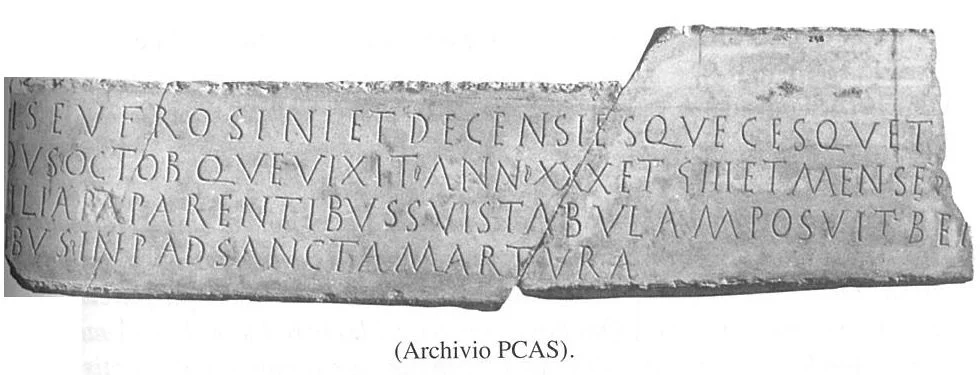
[- - -]is Eufrosini et Decensies que cesquet
[- - - i]dus octob(res) que vixit ann(os) XXX et VIIII et mense(s) I
[- - - f]ilia {pa}parentibus suis tabulam posuit ben[e]-
[merenti]bus in p(ace) ad sancta martura
1. possibly [locus quiet]is Ferrua || 4. possibly ad sancta(m) martyra(m)
'[- - -] of Eufrosinus, and Decensies who died [- - -] ides of October, who lived 30 years and 9, and months 1[- - -] daughter set this plaque up to her parents, well merited, in peace, near the holy martyr.'
Text: ICVR, n.s., VIII, no. 21017 = EDB10944.
Source
Marble plaque broken into three conjoining fragments. The left-hand end is lost. Preserved dimensions: H. 0.30 m; W. 1.45 m; Th. 0.04 m. Letter height 0.045 m.
The two left-hand fragments were known to Francesco Scipione Maffei who published them in 1749. The existing fragments were first assembled by Luigi Gaetano Marini in an unpublished manuscript. They were later presented in print by Mariano Armellini in 1880. The edition by Ernst Diehl in the Inscriptiones Latinae Christianae Veteres presents an incomplete text. The present-day reference edition is by Antonio Ferrua in the eighth volume of the Inscriptiones Christianae Urbis Romae.
Maffei noted that the inscription came from the church or cemetery of Agnes on the via Nomentana. The stone is now exhibited on a staircase leading to the cemetery (catacombs) of Agnes. Ferrua notes that a gypsum copy is kept at the Lateran Museum, see Marucchi, O., I Monumenti del Museo Cristiano Pio-Lateranense riprodotti in Atlante di XCVI tavole (Milan: Ulrico Hoepli, 1910), Tav. LI no. 26.
Discussion
The inscription records the burial of a married couple by their daughter next to a saintly figure. Hence, probably an intentional burial ad sanctos (i.e. a burial meant to aid the deceased by its proximity a martyr).
Ferrua probably understood the final formula, ad sancta martura, as neuter genitive plural ('near holy martyrs'), here used to denote a burial next to the martyr Agnes, the principal saint venerated in this cemetery (Ferrua: 'dictum collectiue, sed certe sancta Agnes intellegetur'). It is, however, possible that we have here a reference to a single female martyr, ad sancta(m) martura(m), with dropped final nasal consonants 'm', which sometimes happens in vernacular Latin.
Dating: The editors of the Epigraphic Database Bari date the inscription to the late 4th c.
Bibliography
Edition:
Complete text:
Epigraphic Database Bari, no. EDB10944, see http://www.edb.uniba.it/epigraph/10944
De Santis, P., Sanctorum Monumenta: "Aree sacre" del suburbio di Roma nella documentazione epigrafica (IV-VII secolo) (Bari: Edipuglia, 2010), no. 97.
De Rossi, G.B., Ferrua, A. (eds.) Inscriptiones Christianae Urbis Romae Septimo Saeculo Antiquiores, n.s., vol. 8: Coemeteria viarum Nomentanae et Salariae (Vatican: Pont. Institutum Archaeologiae Christianae, 1983), no. 21017 (with further bibliography).
Armellini, M., Gli antichi cimeteri cristiani di Roma e d'Italia (Rome: Tipografia poliglotta, 1893), 263.
Armellini, M., Il cimitero di s. Agnese sulla via Nomentana (Rome: Tipografia Poliglotta della S.C. di Propoganda Fide, 1880), 67.
Two left-hand fragments:
Diehl, E., Inscriptiones Latinae Christianae Veteres, vol. 1 (Berlin: Apud Weidmannos, 1925), no. 2136A.
Maffei, F.S., Museum Veronense, hoc est antiquarum inscriptionum et anaglyphorum collectio, cui Taurinensis adjungitur et Vindobonensis (Veronæ: Typis Seminarii, 1749), 279, no. 7.
Further reading:
Lapidge, M., The Roman Martyrs. Introduction, Translations, and Commentary (Oxford: OUP, 2018), chapter XVII.
Images
Associated saints
| Saint | Name in source | Certainty |
|---|---|---|
| Agnes, virgin and martyr of Rome (S00097) | sancta martura | Uncertain |
Cult classifications
- Cult Places
- Burial site of a saint - cemetery/catacomb; Burial site of a saint - crypt/ crypt with relics; Burial site of a saint - tomb/grave
- Non Liturgical Activity
- Burial ad sanctos
- People
- Children; Other lay individuals/ people; Women
Record author
Paweł Nowakowski
Entry date
22/06/2018
Citation
Paweł Nowakowski, Cult of Saints, E05864 — https://csla.history.ox.ac.uk/record.php?recid=E05864