
E07066
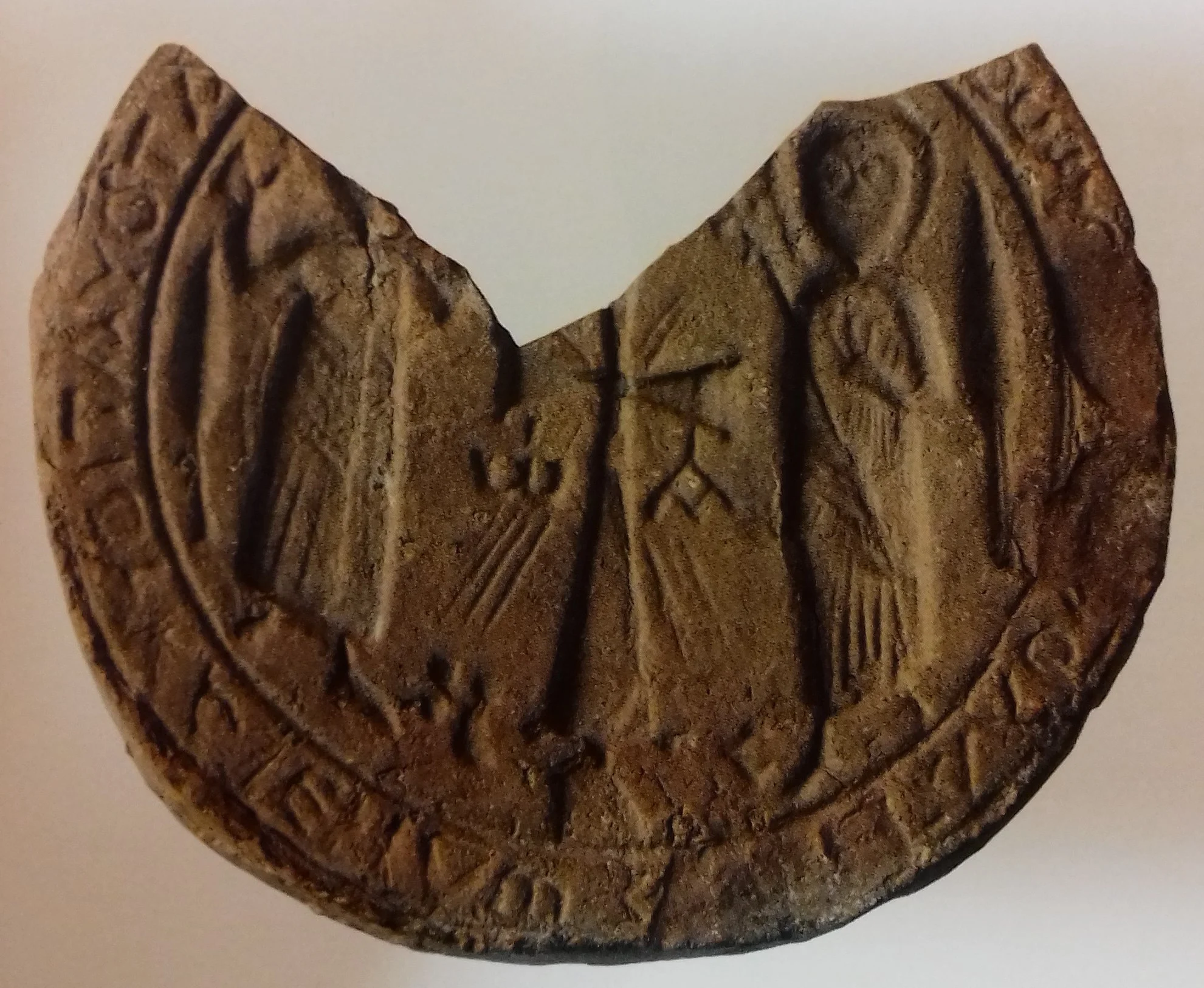
Clay stamp bearing an image of two male saints, and a Greek inscription mentioning a martyr whose name is lost. Found during archaeological excavations at Chersonesos/Cherson (north Black Sea); 6th century.
- Language
- Greek
- Date from
- 500
- Date to
- 700
- Evidence type
- Images and objects; Inscriptions
- Evidence subtype
- Inscribed objects; Lamps, ampullae and tokens
- Evidence region
- Northern Black Sea
- Evidence location
- Chersonesos in Tauris; Chersonesos in Tauris, Chersonesos, Chersonesus Taurica, Χερσόνησος, Χερσών, Chersonesos, Cherson
- Cult region
- Northern Black Sea
- Cult location
- Chersonesos in Tauris; Chersonesos in Tauris, Chersonesos, Chersonesus Taurica, Χερσόνησος, Χερσών, Chersonesos, Cherson
- Cult date from
- 500
- Cult date to
- 700
Text
The stamp depicts two saints flanking a cross with the apocalyptic letters alpha and omega on either side of it.
The right figure is almost fully preserved. The saint is a bearded man with halo, wearing a tunic and himation. He raises his left hand in prayer and holds a cross staff in his right.
The left figure is missing its head. This figure was also male, wearing a chlamys with tablion, and standing with both of his hands raised in prayer.
Both saints are flanked by cypress trees or palm branches, and the scene is encircled by the legend, written in mirror writing:
+Εὐλογί]α τοῦ ἁγίου καὶ ἐνδώξ[ου με]γαλο[μάρτ]υρoς[
'Blessing of the holy and glorious great martyr ...'
Diameter: 9 cm
Discussion
The piece was found in 1898 in the south-eastern area of Cherson. It was probably used for stamping bread. Cherson has produced evidence for the veneration of saints from other regions (*Phokas, E07064, and Longinos, E07065), and ampullae of *Menas (soldier and martyr buried at Abu Mena, Egypt, S00073).
Unfortunately the piece is missing the name of the saint in the inscription. Based on the epithet megalomartys, Latyshev suggested completing the name of Georgios, but given the presence of two figures on the image, this seems unlikely.
The different dress types of the two figures indicate that one of them was understood to be a soldier, and the other a civilian. On this basis, we can suggest a tentative identification as the popular healing martyrs of Egypt, Kyros and Ioannes (Cyrus and John), a physician and soldier respectively.
Like the other clay stamps found at Cherson with figures of saints, this is also likely to belong to a local shrine dedicated to these saints.
Bibliography
Yashaeva, T., The Legacy of Byzantine Cherson (Sevastopol-Austin, 2011), Cat. Nr. 370.
Images
Associated saints
| Saint | Name in source | Certainty |
|---|---|---|
| Kyros and Ioannes/Cyrus and John, physician and soldier, martyrs of Egypt (S00406) | Uncertain | |
| George, soldier and martyr, and Companions (S00259) | Uncertain |
Cult classifications
- Activities
- Production and selling of eulogiai, tokens
- Use of Images
- Commissioning/producing an image
Record author
Efthymios Rizos
Entry date
06/11/2018
Citation
Efthymios Rizos, Cult of Saints, E07066 — https://csla.history.ox.ac.uk/record.php?recid=E07066