
E07370
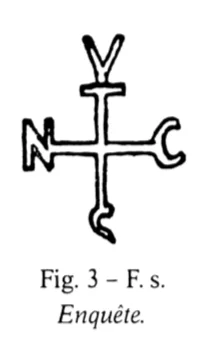
Monogram on a column capital found at Carthage (central North Africa), probably commemorating a 'Vincentius', just possibly *Vincent (deacon of Zaragoza and martyr of Valencia, S00290). Probably 6th/7th c.
- Language
- Latin
- Date from
- 533
- Date to
- 698
- Evidence type
- Archaeological and architectural; Inscriptions
- Evidence subtype
- Inscribed architectural elements; Internal cult fixtures (crypts, ciboria, etc.)
- Evidence region
- Latin North Africa
- Evidence location
- Carthage; ‘Ein Dab, ‘Ein Dab
- Cult region
- Latin North Africa
- Cult location
- Carthage; ‘Ein Dab, ‘Ein Dab
- Cult date from
- 533
- Cult date to
- 698
Text
A monogram in the form of a Greek cross, containing these letters: V over T at the top, N on the left, C on the right, and S at the bottom.
Source
The monogram is on a capital found in ruins in the valley of Byrsa in Carthage. Duval recorded it in the Museum of Carthage.
Discussion
Yvette Duval identified the name borne by this monogram as probably 'Vincentius', and, if this is correct, associated it with the famous Spanish martyr, Vincent, deacon of Zaragoza and martyr of Valencia. She suggested a date in the Byzantine period (after 533).
Monograms on capitals, however, almost invariably commemorate donors; so this is much more likely to be a record of the building's patron, than of its dedicatee.
Bibliography
Edition and discussion:
Duval, Y., Loca sanctorum Africae: Le culte des martyrs en Afrique du IVe au VIIe siècle (Rome: École Française de Rome, 1982), vol. 1, 6-7, no. 2.
Images
Associated saints
| Saint | Name in source | Certainty |
|---|---|---|
| Vincentius/Vincent, deacon of Zaragoza and martyr of Valencia (S00290) | Uncertain |
Cult classifications
- Cult Related Objects
- Inscription
Record author
Stanisław Adamiak
Entry date
28/01/2019
Citation
Stanisław Adamiak, Cult of Saints, E07370 — https://csla.history.ox.ac.uk/record.php?recid=E07370