
E07371
Latin mosaic roundels from Carthage (central North Africa), with the names of seven martyrs: *Speratus (probably one of the Scillitan martyrs, S00913); *Stephen (The First Martyr, S00030); *Sirica (otherwise unknown martyr of Africa, S02764); *Saturus and Saturninus, and probably Perpetua and Felicitas (all compnion martyrs of Carthage, S00009). Probably 6th/7th c.
- Language
- Latin
- Date from
- 533
- Date to
- 698
- Evidence type
- Inscriptions
- Evidence subtype
- Formal inscriptions (stone, mosaic, etc.)
- Evidence region
- Latin North Africa
- Evidence location
- Carthage; ‘Ein Dab, ‘Ein Dab
- Cult region
- Latin North Africa
- Cult location
- Carthage; ‘Ein Dab, ‘Ein Dab
- Cult date from
- 533
- Cult date to
- 698
Text
Inscription 1 (above Inscription 2):
Beatiss[i]
mi martyres
'The most blessed martyrs'
Inscription 2
(in seven individual roundels, each inscribed with a single name):
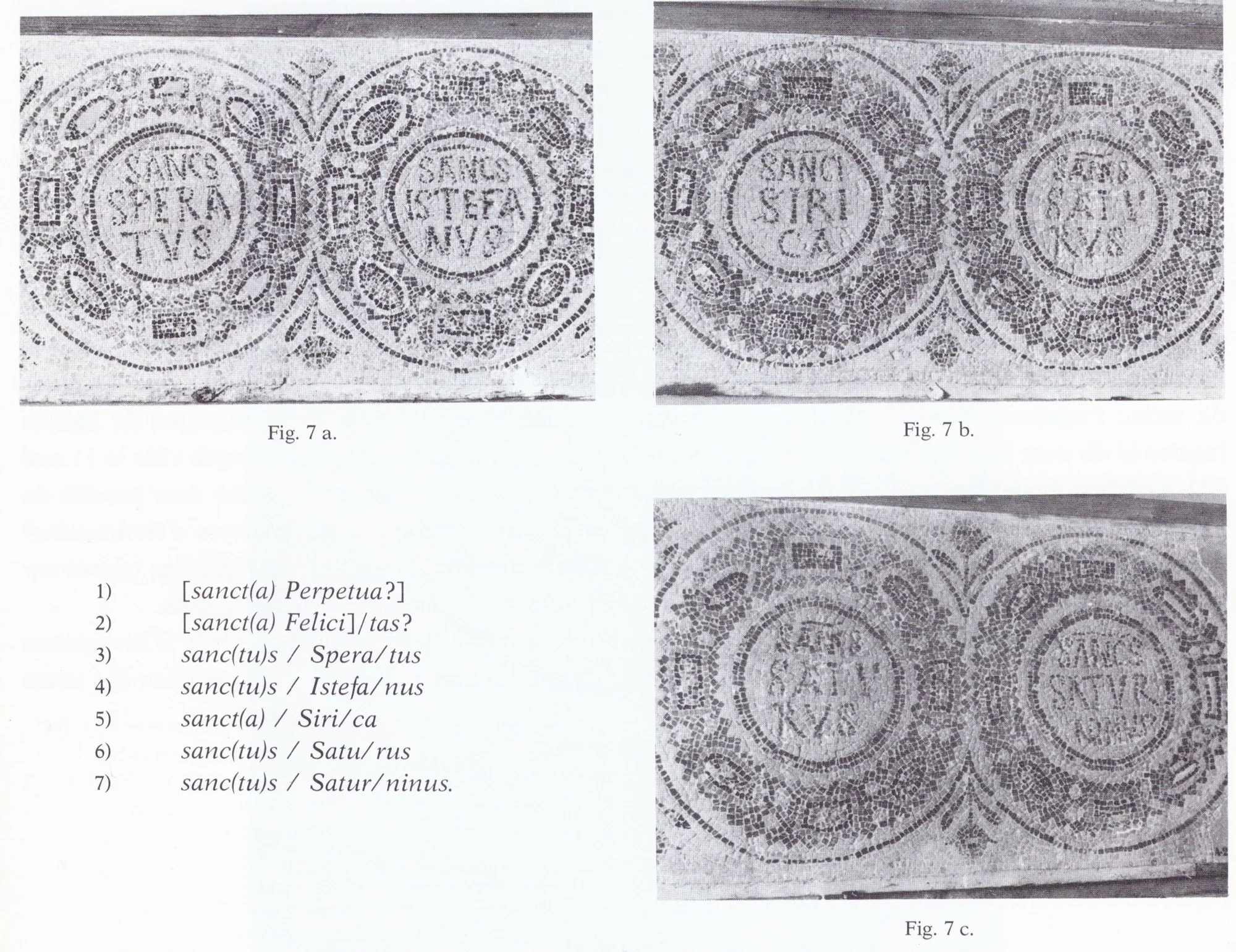
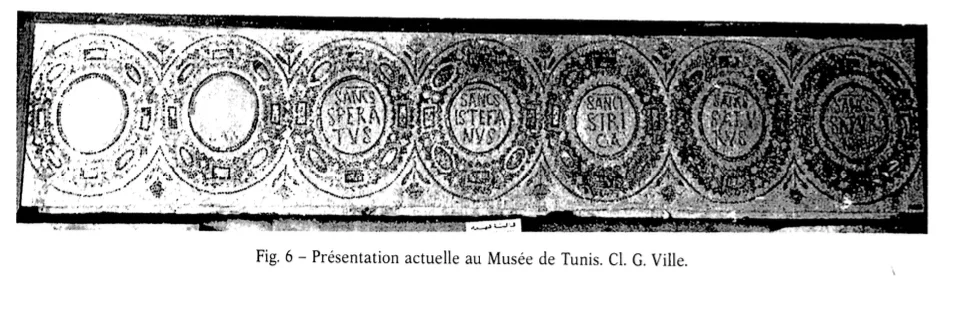
[sanct(a) Perpetua?] [sanct(a) Felici]/tas? sanc(tu)s / Spera/tus sanc(tu)s / Istefa/nus sanct(a) / Siri/ca sanc(tu)s / Satu/rus sanc(tu)s / Satur/ninus.
'Saint Perpetua (?) Saint Felicitas (?) Saint Speratus Saint Stephen Saint Sirica Saint Saturus Saint Saturninus'
Text: Duval 1982, no. 3 (after P. Gauckler).
Source
This mosaic was found in 1902 in a building in the Dermech district of Carthage, which, because of this inscription, was termed 'the monastery of St Stephen' by its finder, P. Gauckler; it may, however, have been a rich private house. The mosaic was set into the floor in front of the apse of a small room, presumed to be a chapel.
Inscription 1 ('Beatissimi martyres') is in two lines followed by the Constantinian chrism, in the middle of a medallion set within a rectangular frame (180 x 50 cm), with letters 10,5 cm in height. It was apparently of an earlier phase of flooring than Inscription 2, which covered it in part.
Inscription 2 consists of seven medallions, each with a diameter of about 65 cm. The first roundel had been destroyed, and there are only parts of a few letters preserved in the next one, but the last five medaillons are in a good state of preservation.
Recorded by Duval as in the Christian room of the Museum of Tunis.
Discussion
Y. Duval thinks that the style of the mosaics and other finds from the site date it to the Byzantine period.
The central medaillon is reserved for Stephen, the First Martyr, who was perhaps the saint to whom this building was dedicated.
The names on the two right-hand medaillons, Saturus and Saturninus, are on the list of the companions of Perpetua and Felicitas. Together with the letters 'tas' that can be read in the second medaillon on the left, this suggest that the first two medallions commemorated Perpetua and Felicitas.
Speratus is probably one of the Scillitan martyrs, but Sirica is otherwise unknown.
The inscription does not suggest that there are any relics deposited in the place, it is rather an invocation of the famous saints of Carthage buried in the great basilicas nearby.
Bibliography
Edition and discussion:
Duval, Y., Loca sanctorum Africae: Le culte des martyrs en Afrique du IVe au VIIe siècle (Rome: École Française de Rome, 1982), vol. 1, 7-10, no. 3.
Images
Associated saints
| Saint | Name in source | Certainty |
|---|---|---|
| Perpetua, Felicitas and their companions, martyrs of Carthage (S00009) | Saturus, Saturninus | Certain |
| Stephen, the First Martyr (S00030) | Istefanus | Certain |
| Scillitan Martyrs, martyrs in Carthage from Scillium (S00913) | Speratus | Uncertain |
| Sirica, martyr of Africa (S02764) | Sirica | Certain |
Cult classifications
- Cult Related Objects
- Inscription
Record author
Stanisław Adamiak
Entry date
29/01/2019
Citation
Stanisław Adamiak, Cult of Saints, E07371 — https://csla.history.ox.ac.uk/record.php?recid=E07371