
E07372
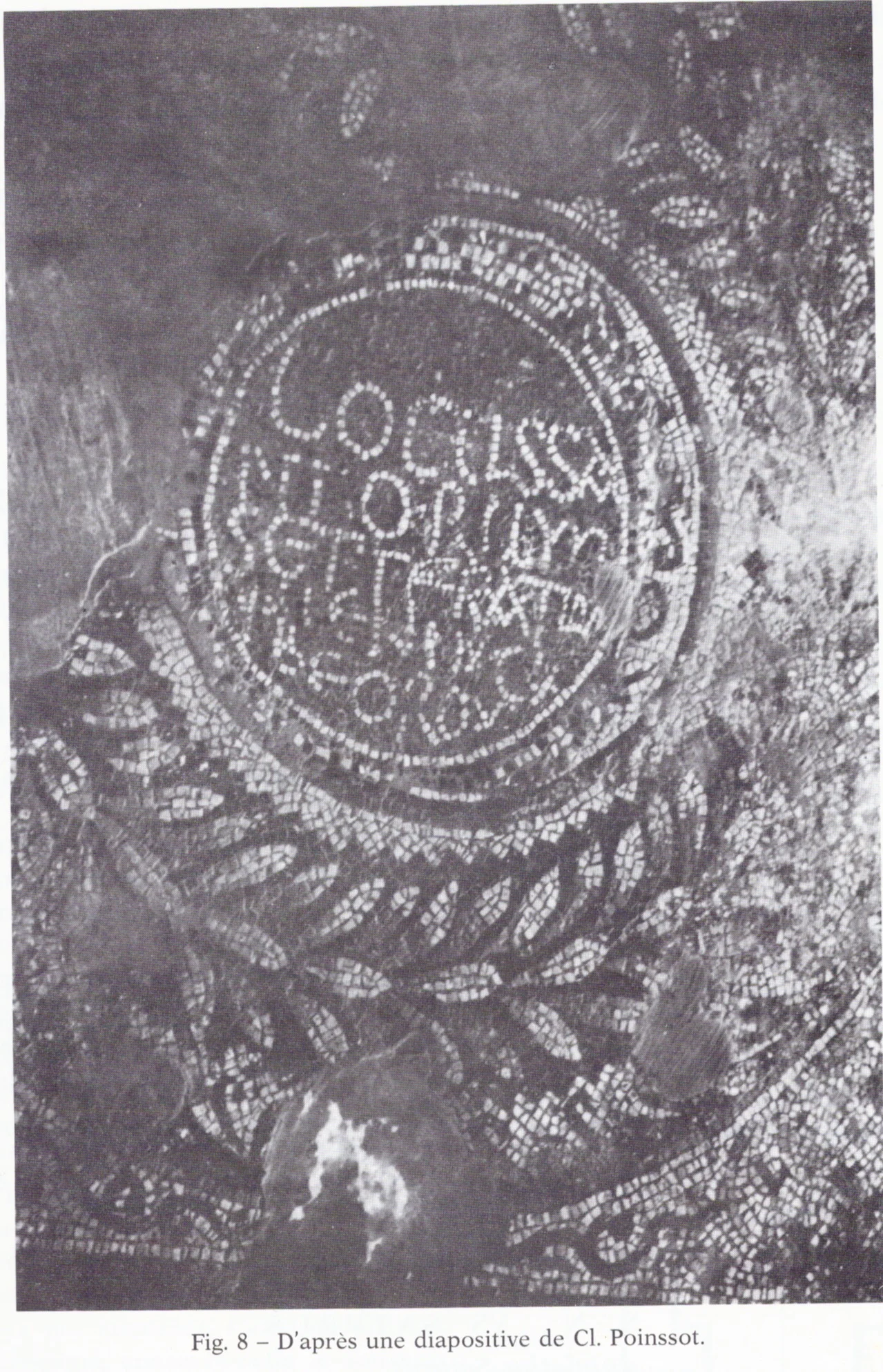
Mosaic medallion from Carthage (central North Africa), with Latin inscription commemorating the *Maccabean martyrs (S00303), and possibly the *Seven monastic brothers (martyrs of Carthage under the Vandals, S02936). 6th/7th c.
- Language
- Latin
- Date from
- 533
- Date to
- 698
- Evidence type
- Inscriptions
- Evidence subtype
- Formal inscriptions (stone, mosaic, etc.)
- Evidence region
- Latin North Africa
- Evidence location
- Carthage; ‘Ein Dab, ‘Ein Dab
- Cult region
- Latin North Africa
- Cult location
- Carthage; ‘Ein Dab, ‘Ein Dab
- Cult date from
- 533
- Cult date to
- 698
Text
Locus sa
n(c)torum
septe(m) fratrum.
(H)ic me(moriae) Maca
beorum.
'The place of the Seven Brothers. Here is the memorial [or 'Here are relics'] of the Maccabees.'
Text: Ennabli 1991, no. 299.
Translation: Stanisław Adamiak.
Source
This mosaic medaillon was found during the construction of the highway of La Goulette between Carthage and Tunis, near the so-called 'chapel of St Stephen'. The inscription is set within a garland of leaves, with letters 7 to 9 cm high. Their character suggests a date for the inscription in the Byzantine period.
Recorded by Ennabli as in the museum of Carthage.
Discussion
L. Ennabli interprets the inscription as commemorating the place of burial of seven monastic brothers, martyred in Carthage under the Vandals (see E08279 and E08290), understanding 'the place (locus) of the seven holy brothers' as the burial place of these spiritual brothers. She suggests that the whole structure, on the floor of which the inscription was found, was constructed to host the bodies of these martyrs, whose deaths, in their Martyrdom (E08279) was explicitly associated with that of the seven Maccabean blood brothers.
Alternatively, this may be a record of relics (memoria) of the seven Maccabean brothers. The word memoria had multiple precise meanings in Africa, when applied to saints; but could be used to refer to relics (see, for instance E01109 and E01111).
Bibliography
Editions:
Duval, Y., Loca sanctorum Africae: Le culte des martyrs en Afrique du IVe au VIIe siècle (Rome: École Française de Rome, 1982), vol. 1, 10-11, no. 4.
Ennabli, L., Les inscriptions funéraires chrétiennes de Carthage. III. Carthage intra et extra muros (Rome: École Française de Rome, 1991), 211, no. 299.
Ennabli, L., La Basilique de Carthagenna et le locus des sept moines de Gafsa. Nouveaux édifices chrétiens de Carthage (Paris: Éditions du Centre National de la Recherche Scientifique, 2000), 83-87; 122-124.
Images
Associated saints
| Saint | Name in source | Certainty |
|---|---|---|
| Maccabean Martyrs, pre-Christian Jewish martyrs of Antioch (S00303) | Certain | |
| Seven monastic brothers, martyrs of Carthage under the Vandals in 484. (S02936) | Uncertain |
Cult classifications
- Cult Places
- Cult building - unspecified
- Cult Related Objects
- Inscription
- Relics
- Unspecified relic
- Religious Grouping
- Early/Nicene/Chalcedonian
Record author
Stanisław Adamiak
Entry date
29/01/2019
Citation
Stanisław Adamiak, Cult of Saints, E07372 — https://csla.history.ox.ac.uk/record.php?recid=E07372