
E07391
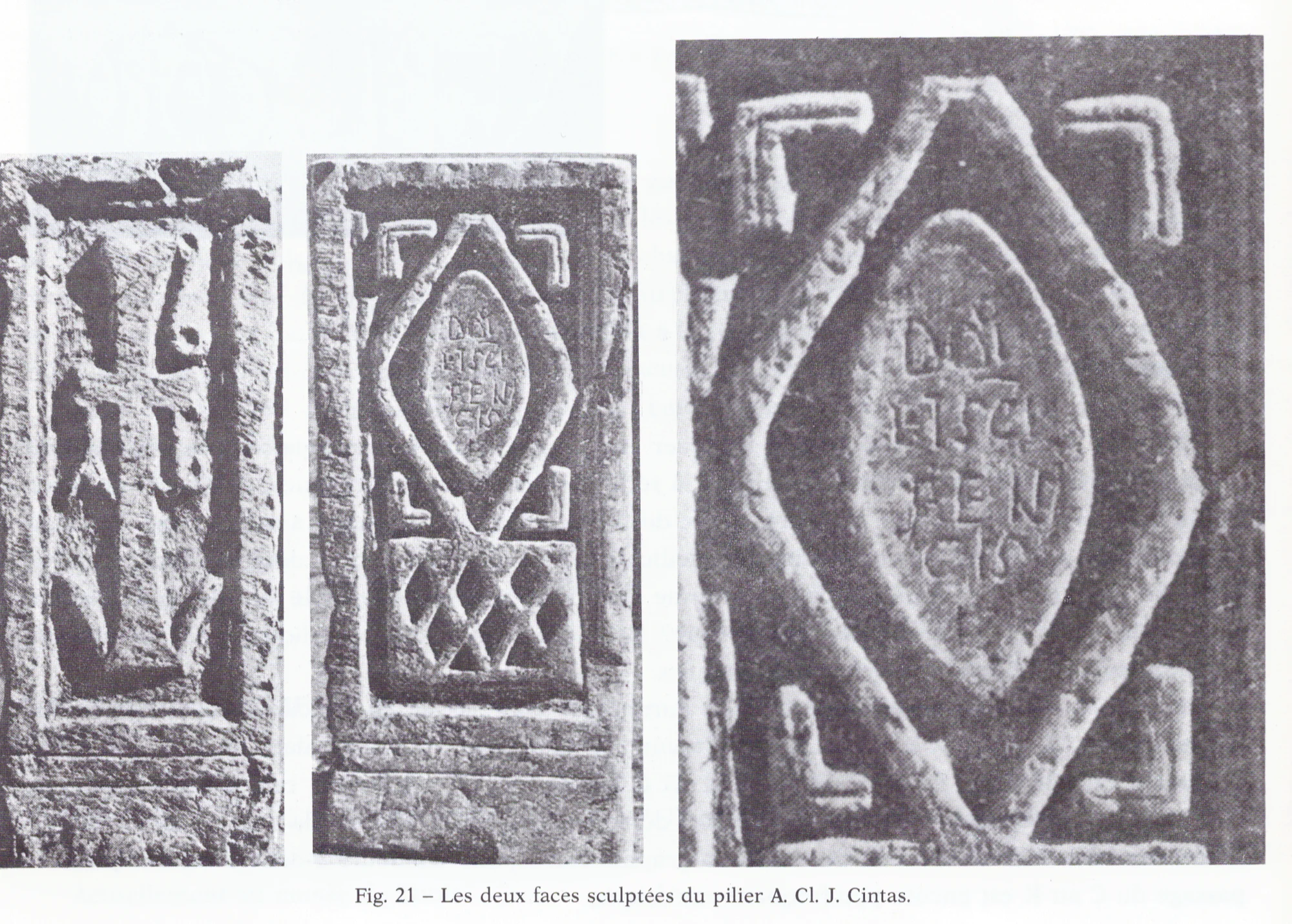
Latin inscription commemorating *Felix (probably Felix, bishop of Thibiuca, and martyr in Italy or of Carthage, S02084), found at Thibiuca (Proconsularis, central North Africa). Probably 6th c.
- Language
- Latin
- Date from
- 438
- Date to
- 699
- Evidence type
- Inscriptions
- Evidence subtype
- Formal inscriptions (stone, mosaic, etc.)
- Evidence region
- Latin North Africa
- Evidence location
- Thibiuca; ‘Ein Dab, ‘Ein Dab
- Cult region
- Latin North Africa
- Cult location
- Thibiuca; ‘Ein Dab, ‘Ein Dab
- Cult date from
- 400
- Cult date to
- 600
Text
Inscription 1:
D(ono) [or: D(e donis)] D(ei)
et s(an)c(t)i Feli
cis.
'By the gift of God and saint Felix'
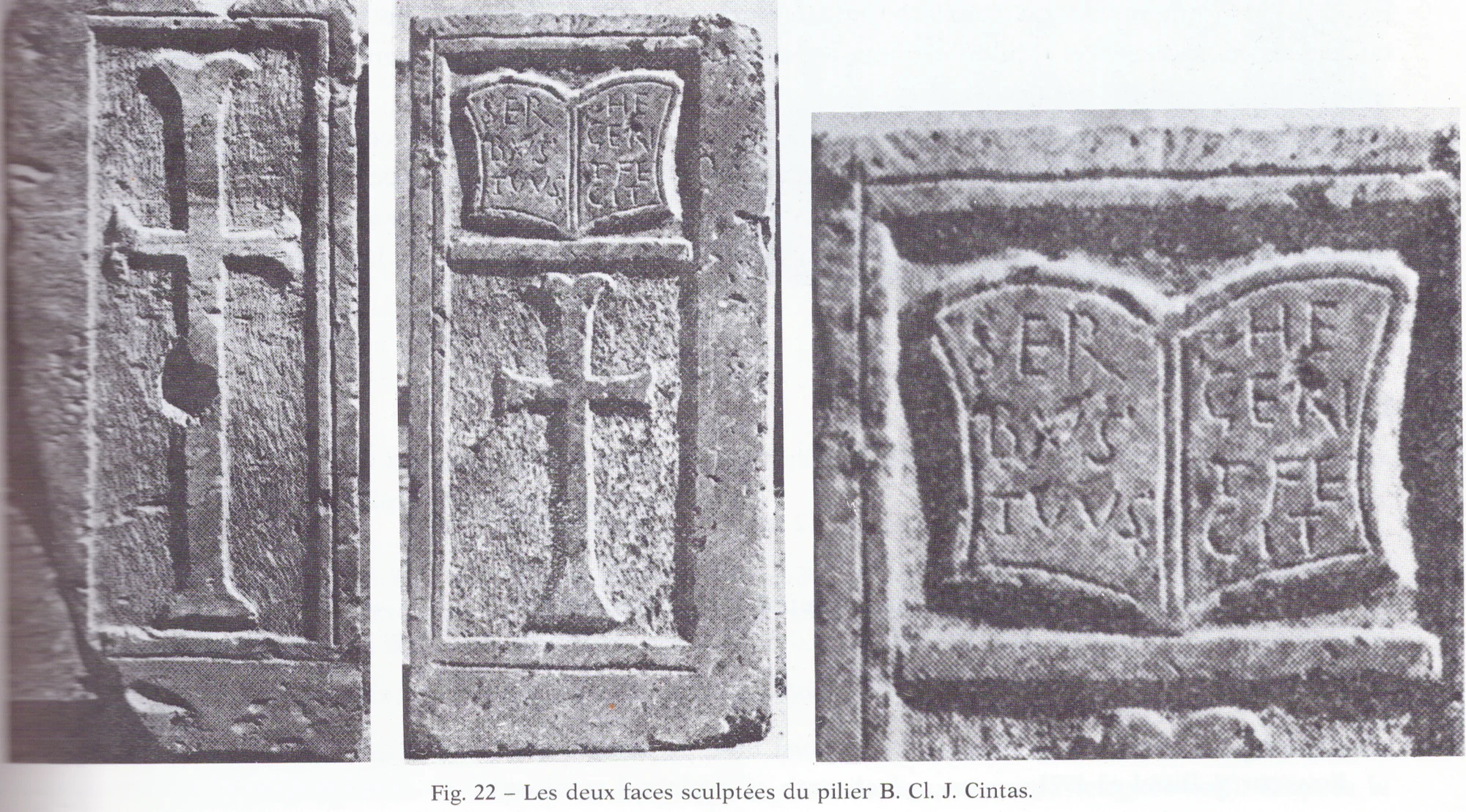
Inscription 2:
Ser
bus
tuus
He
geri
t fe
cit.
'Your servant Hegerit made [this]'
Text: Duval 1982, no. 13.
Translation: Stanisław Adamiak.
Source
Four small stone pillars (approximately 65-70 cm in height, and about 20-30 cm in width), described in 1948 and in 1968 as found in a baptistery next to the wall of the church in modern Henchir Zoutina (probably ancient Thibiuca). They were then used as pillars for the altar of the modern church in Tébourba (ancient Thuburbo Minus), serving as a room for public receptions when recorded by Duval. In all probability, the pillars once supported the ciborium above the baptismal font.
The pillars are decorated, with inscriptions on two of them: the first one in a diamond, the second one in an open book above a Latin cross. Duval argues that they probably post-date the Byzantine conquest of Africa in 533.
Discussion
'Felix' commemorated here is probably Felix, whose Martyrdom (E07390) records that he was bishop of a see close to Carthage. This see could well be Thibiuca (as argued by Delehaye 1921, 259-60), which would surely clinch the identification. There is, however, some uncertainty over whether the Felix of the Martyrdom was bishop of Thibiuca – see the Discussion under E07390. It is therefore possible that our Felix was a different African saint (the name being common in the late Roman world).
Hegerit is a name of Germanic origin, which may suggest that the baptistery was created during the Vandal period (438-533); however the form of its basin and of the letters suggests rather a later 6th c. date.
Bibliography
Edition and discussion:
Duval, Y., Loca sanctorum Africae: Le culte des martyrs en Afrique du IVe au VIIe siècle (Rome: École Française de Rome, 1982), vol. 1, 28–30, no. 13.
Further reading:
Delehaye, H., "La passion de S. Félix de Thibiuca", Analecta Bollandiana 39 (1921), 241-276.
Images
Associated saints
| Saint | Name in source | Certainty |
|---|---|---|
| Felix, bishop of Thibiuca, martyr in Italy or of Carthage (S02084) | Felix | Uncertain |
Cult classifications
- Cult Places
- Cult building - dependent (chapel, baptistery, etc.)
- Cult Related Objects
- Inscription
- Liturgical Activity
- Ceremony of dedication
- People
- Ecclesiastics - bishops
Record author
Stanisław Adamiak
Entry date
22/02/2021
Citation
Stanisław Adamiak, Cult of Saints, E07391 — https://csla.history.ox.ac.uk/record.php?recid=E07391