
E07433
A Latin inscription on a stone slab at Whithorn (north-west Britain) refers to a 'place' (locus) of *Peter (the Apostle, S00036). Written at Whithorn, c. 500/700.
- Language
- Latin
- Date from
- 500
- Date to
- 700
- Evidence type
- Inscriptions
- Evidence subtype
- Formal inscriptions (stone, mosaic, etc.)
- Evidence region
- Britain and Ireland
- Evidence location
- Whithorn; St Albans, St Albans, Verulamium
- Cult region
- Britain and Ireland
- Cult location
- Whithorn; St Albans, St Albans, Verulamium
- Cult date from
- 500
- Cult date to
- 700
Text
Thomas no. 5 (= CIIC 519)
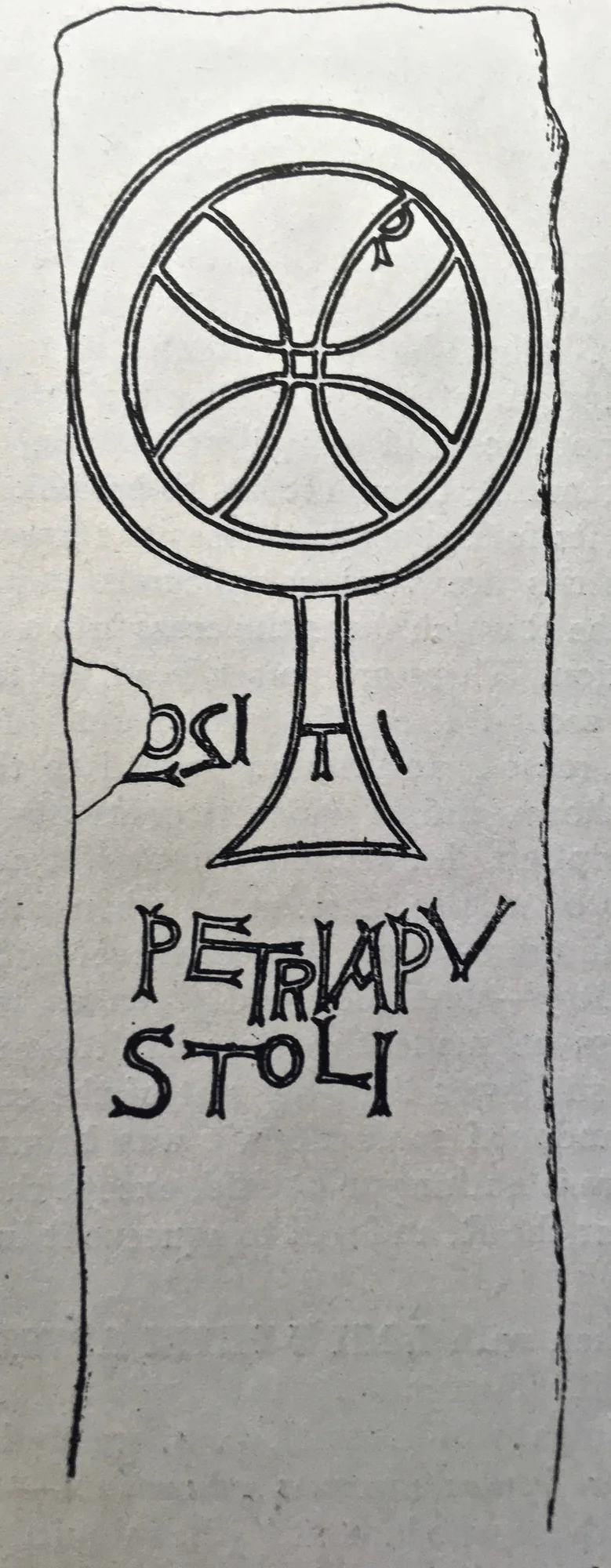
LOCI / PETRI APVSTOLI
'[Stone, marker, or sign] of the locus of Peter, apostle'
Text and Translation: Thomas 1991-92, 3.
Source
Stone slab (112 x 33 x 24 cm), bearing a large cruciform device, with an (apparently contemporary) inscription in three lines beneath (see image).
Discussion
Bede, writing in 731, shortly after Whithorn (Candida Casa) had become established as an Anglo-Saxon bishopric, claimed that Saint Ninian, a Briton, had originally founded the site (Ecclesiastical History, 3.4, 5.23). The early history of Whithorn is obscure, but this inscription appears to point to the development of a cult of Peter there, perhaps as early as the 6th century.
The inscription is 'unique in British epigraphy of 400-700 in that it is clearly not a memorial' (Charles-Edwards, 2013, 146). It has usually been read as referring to the 'place' (locus) of Peter, although Macalister insisted on an alternative reading of 'lodging' (logium), with the 'T' shape at the base of the cross supposedly representing the signa thau of Ezekiel 9:4 ('mark a T on the foreheads of those who lament'): 'the T is, therefore, a sign, a seal, or a mark', with the correct translation therefore "the seal of the lodging of Peter the Apostle" (Macalister, 1945, i. 498). This interpretation is not generally accepted. Either way, the ultimate significance of the inscription remains unclear.
Bibliography
Texts and discussion:
Macalister, R.A.S., Corpus inscriptionum insularum celticarum, 2 vols. (Dublin, 1945-49).
Thomas, A.C., "The Early Christian Inscriptions of Southern Scotland," Glasgow Archaeological Journal, 17 (1991-92), 1-10.
Further reading:
Charles-Edwards, T.M., Wales and the Britons 350-1064 (Oxford, 2013), 139-152.
Thomas, A.C., Whithorn's Christian Beginnings (Whithorn, 1992).
Images
Associated saints
| Saint | Name in source | Certainty |
|---|---|---|
| Peter, the Apostle (S00036) | Petrus | Certain |
Cult classifications
- Cult Related Objects
- Inscription
- Places Names after Saint
- Other
Record author
Benjamin Savill
Entry date
09/03/2019
Citation
Benjamin Savill, Cult of Saints, E07433 — https://csla.history.ox.ac.uk/record.php?recid=E07433