
E07436
Two inscriptions, at Llantrisant, Anglesey and Cynwyl Gaeo, Carmarthenshire (both western Britain), may commemorate *Paulinus (holy man of western Britain, 6th c., S02803). Written in Latin in western Britain, possibly c. 550/600.
- Language
- Latin
- Date from
- 550
- Date to
- 600
- Evidence type
- Inscriptions
- Evidence subtype
- Funerary inscriptions
- Evidence region
- Britain and Ireland
- Evidence location
- Cynwyl Gaeo; St Albans, St Albans, Verulamium; Llantrisant; St Albans, St Albans, Verulamium
- Cult region
- Britain and Ireland
- Cult location
- Cynwyl Gaeo; St Albans, St Albans, Verulamium; Llantrisant; St Albans, St Albans, Verulamium
- Cult date from
- 550
- Cult date to
- 600
Text
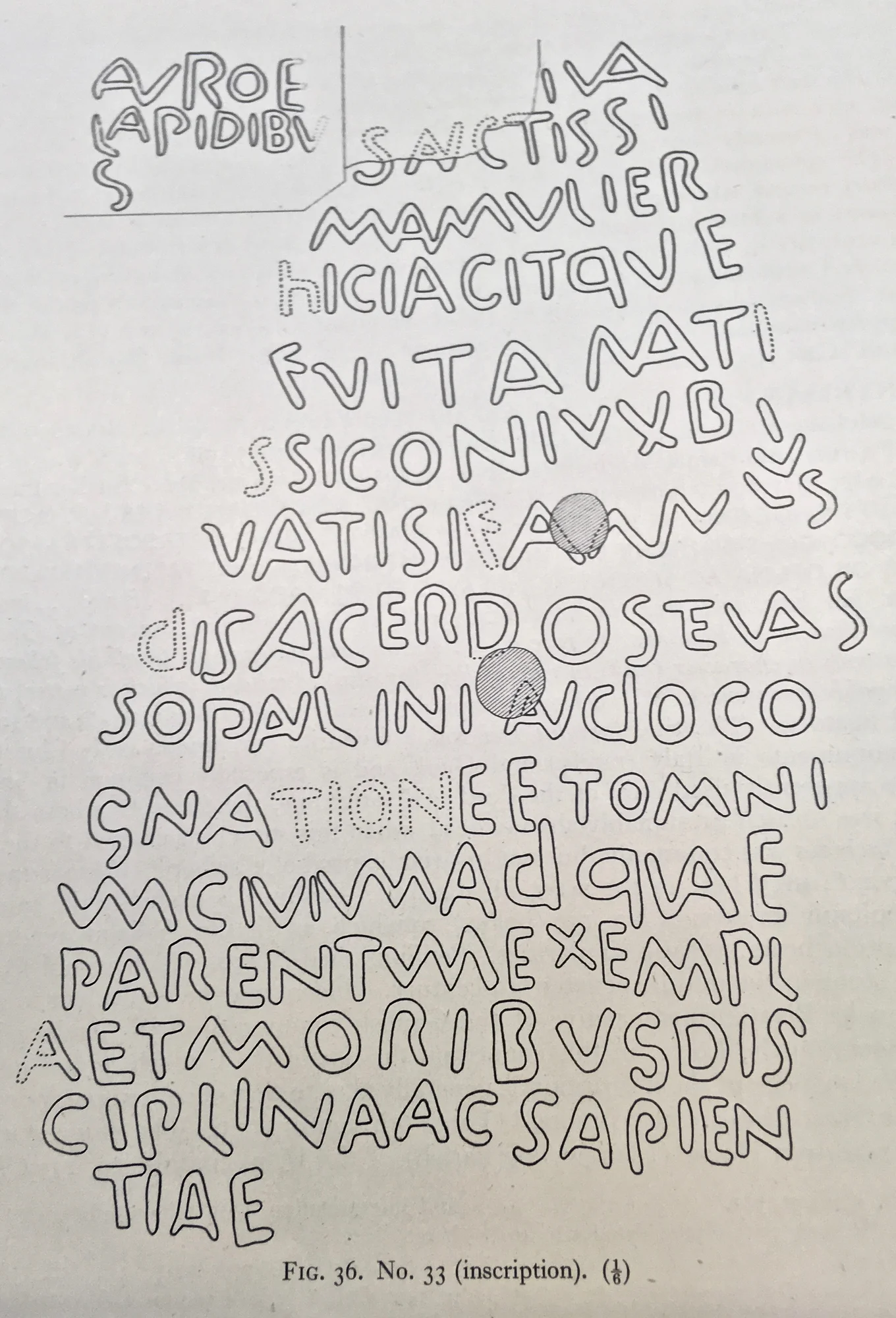
Nash-Williams, no. 33 (Llantrisant) (= CIIC 325)
(a) IVA (or INA) / SANCTISSIMA MVLIER / HIC IACIT QV(a)E / FVIT AMA(n)ti/ssi(ma) CONIV(n)X BI/VATIG(or S)I(rni) [F]AMVLVS / [D](e)I SACERDOS ET VASSO PAVLINI AN(or AV)DOCO / G(or S) NA[TION]E ET OMNI/VM CIVIVM ADQVAE (= atque) / PARENTVM EXEMPL/[VM(?)] ET MORIBVS DIS/CIPLINA AC SAPIEN/TIAE // (b) AVRO E[T(?)] / LAPIDIBV/S
'... iva (?... ina), most holy woman, lies here, who was the very loving wife of Bivatig(irnus), servant of God, bishop (?priest), and a disciple of Paulinus, of the kin of Ando, and an example to all his fellow citizens and relatives both in character (and) in rule of life, (as also) of wisdom (which is better) than gold and gems (or gold from stones).'
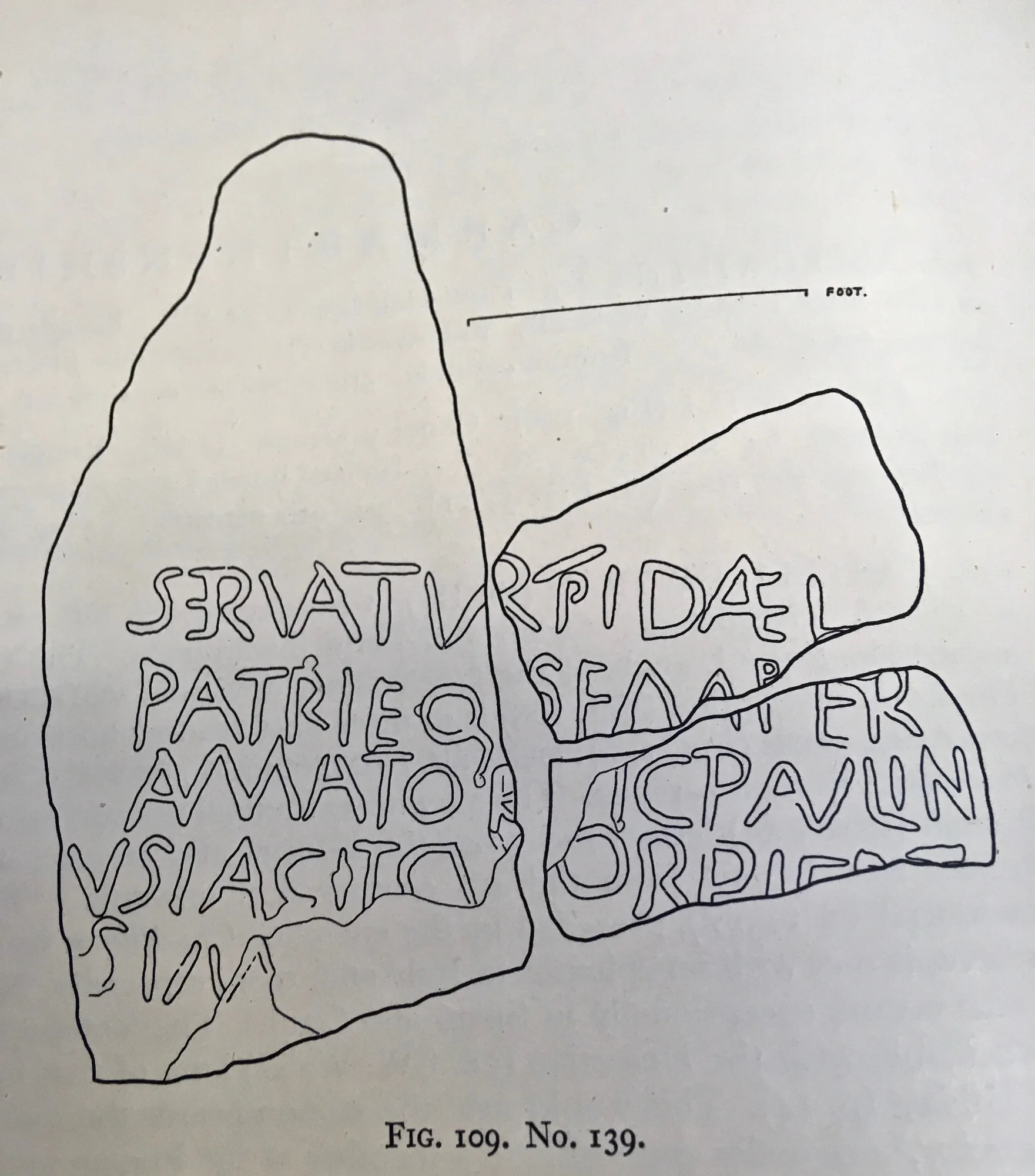
Nash-Williams, no. 139 (Cynwl Gaeo) (= CIIC 360)
SERVATVR FIDAEI / PATRI(a)EQ(ue) SEMPER / AMATOR HIC PAVLIN/VS IACIT CVL[T]OR PIENT[-]/(s)SIM[VS AEQVI]
'Preserver of the Faith, constant lover of his country, here lies Paulinus, the devoted champion of righteousness.'
Text and translation: Nash-Williams 1950, 63, 107-9 (translation of no. 33 lightly modified, following Handley 2001).
Source
No. 33 (Llantrisant): Rough pillar-stone or boulder (147 x 71 x 23 cm). Latin inscription in fifteen lines on the main face, and three further lines on the right-hand edge, all reading horizontally (see image). As of 1950, standing in the shrubbery of Trescawen House, Wales.
No. 139 (Cynwyl Gaeo): Fragmentary slab in three pieces (87 x 77 x 20 cm overall). Latin inscription in five lines reading horizontally (see image). As of 1950 in Carmarthen Museum, Wales.
Discussion
Nash-Williams (1950, 109) linked the Paulinus found in both inscriptions to the figure of the same name mentioned in Rhygyfarch's 11th c. Life of David/Dewi in connection with the Synod of Llandewibrefi (c. 560), itself less than 12 miles/19 km from Maes Llanwrthwl, where no. 139 was originally discovered. 'One wonders whether Rhygyfarch incorporated Paulinus into his story at this point, not because he had any known historical connection with Dewi, but rather because his inscribed stone remained and its site had become the focus of a local saint's cult.' (Edwards 2002, 230).
Bibliography
Editions:
Macalister, R.A.S., Corpus inscriptionum insularum celticarum, 2 vols. (Dublin, 1945-9).
Nash-Williams, V.E., The Early Christian Monuments of Wales (Cardiff, 1950).
Further reading:
Charles-Edwards, T.M., Wales and the Britons 350-1064 (Oxford, 2013), 116-173.
Edwards, N., "Celtic Saints and Early Medieval Archaeology," in: A. Thacker and R. Sharpe (eds.), Local Saints and Local Churches in the Early Medieval West (Oxford, 2002), 225-265.
Handley, M.A., "The Origins of Christian Commemoration in Late Antique Britain," Early Medieval Europe 10 (2001), 177-199.
Images
Associated saints
| Saint | Name in source | Certainty |
|---|---|---|
| Paulinus, holy man of western Britain, 6th c. (S02803) | Paulinus | Uncertain |
Cult classifications
- Cult Places
- Burial site of a saint - unspecified
- Cult Related Objects
- Inscription
- People
- Ecclesiastics - bishops; Ecclesiastics - lesser clergy; Women
Record author
Benjamin Savill
Entry date
09/03/2019
Citation
Benjamin Savill, Cult of Saints, E07436 — https://csla.history.ox.ac.uk/record.php?recid=E07436