
E07437
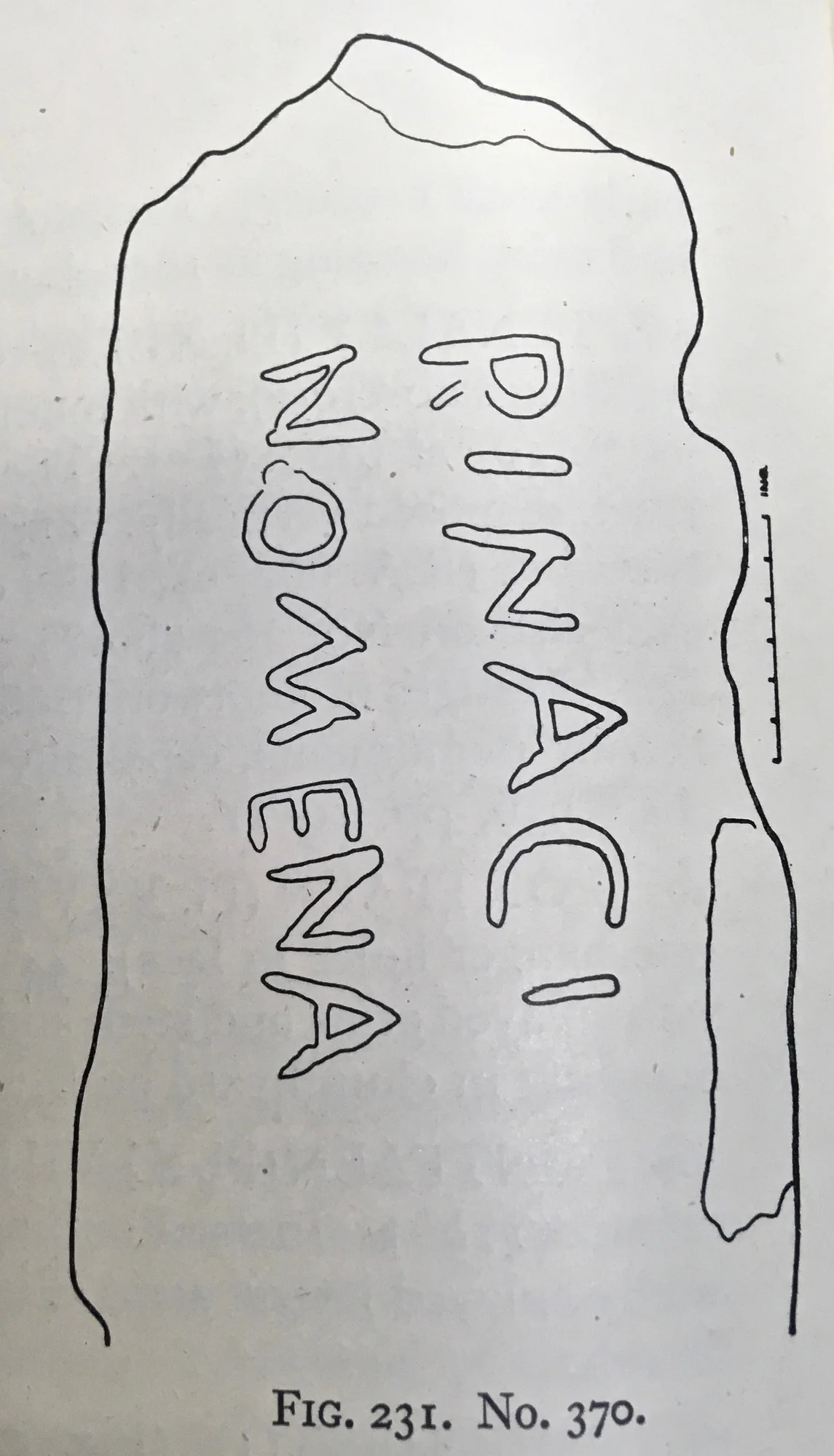
An inscribed stone at Tyddewi/St Davids (western Britain) perhaps marking the relics of *Rinacus, or Pinax (possible holy man of western Britain, 6th c., S02804). Written in Latin at Tyddewi/St Davids, possibly c. 400/550.
- Language
- Latin
- Date from
- 400
- Date to
- 550
- Evidence type
- Inscriptions
- Evidence subtype
- Formal inscriptions (stone, mosaic, etc.)
- Evidence region
- Britain and Ireland
- Evidence location
- Tyddewi/St Davids; St Albans, St Albans, Verulamium
- Cult region
- Britain and Ireland
- Cult location
- Tyddewi/St Davids; St Albans, St Albans, Verulamium
- Cult date from
- 400
- Cult date to
- 550
Text
Nash-Williams, no. 370 (= CIIC 516)
RINACI (or PINACI(s)) / NOMENA
'The relics(?) of Rinacus (? or Pinax) (lie here)'
Text and translation: Nash-Williams 1950, 205.
Source
Rough pillar-stone (145+ x 51 x 37 cm). Latin inscription in two lines reading vertically downwards (see image). As of 1950, mounted on a cement base inside church porch.
Discussion
Nash-Williams suggested the translation of nomena (for nomina) as 'relics' or 'remains', noting the use of this formula in North African epitaphs of 4th century and later, 'usually commemorating martyrs'. Rinacus/Pinax is otherwise unknown.
Bibliography
Editions:
Macalister, R.A.S., Corpus inscriptionum insularum celticarum, 2 vols (Dublin, 1945-9).
Nash-Williams, V.E., The Early Christian Monuments of Wales (Cardiff, 1950).
Images
Associated saints
| Saint | Name in source | Certainty |
|---|---|---|
| Rinacus or Pinax, possible holy man of western Britain, 6th c. (S02804) | Rinacus, Pinax | Certain |
Cult classifications
- Cult Related Objects
- Inscription
- Relics
- Unspecified relic
Record author
Benjamin Savill
Entry date
09/03/2019
Citation
Benjamin Savill, Cult of Saints, E07437 — https://csla.history.ox.ac.uk/record.php?recid=E07437