
E07488
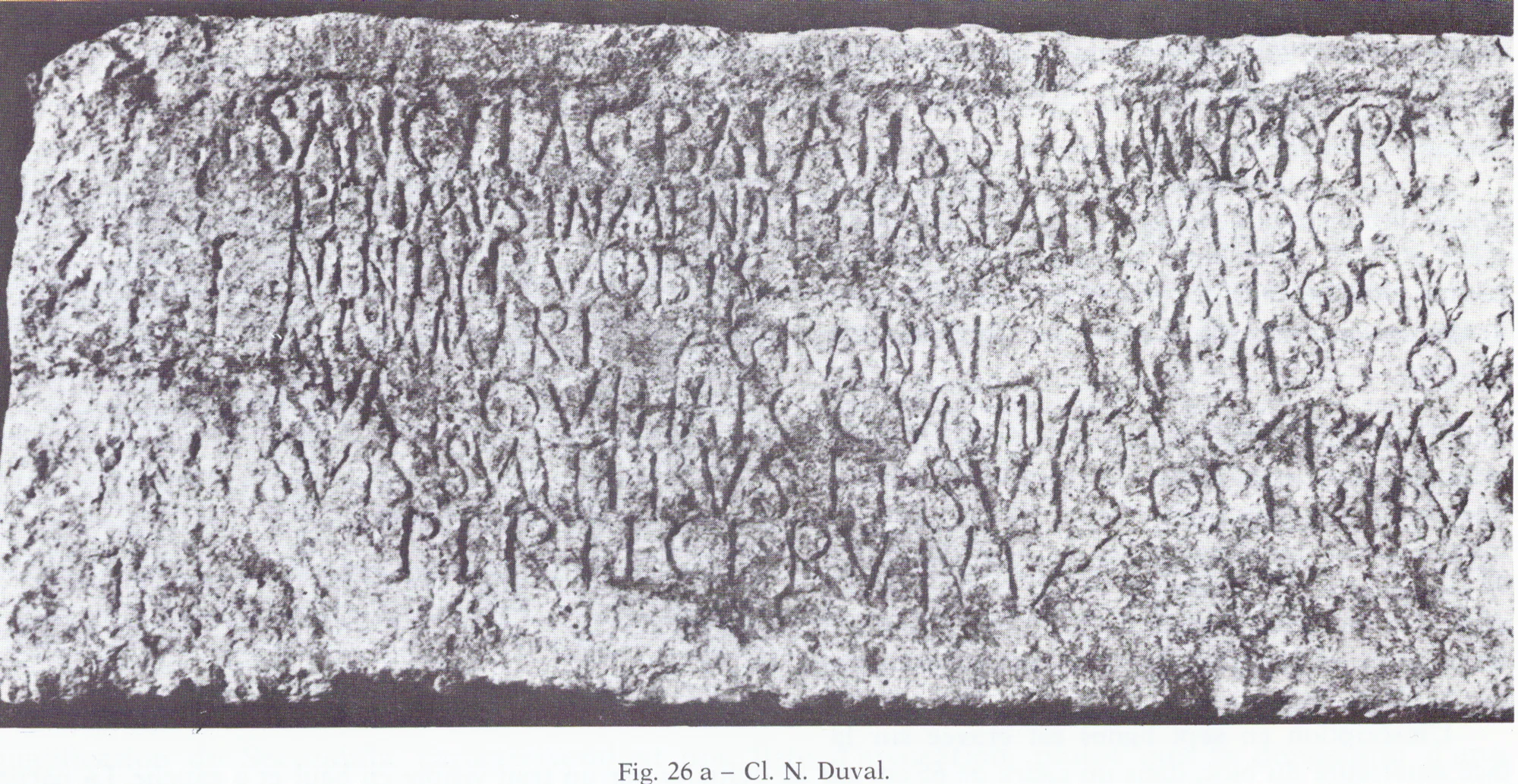
Latin inscription invoking anonymous martyrs, to whom four 'cubicula' have been offered. Found at Dougga (Proconsularis, central North Africa). Probably 4th/earlier 5th century.
- Language
- Latin
- Date from
- 350
- Date to
- 500
- Evidence type
- Inscriptions
- Evidence subtype
- Formal inscriptions (stone, mosaic, etc.)
- Evidence region
- Latin North Africa
- Evidence location
- Dougga; ‘Ein Dab, ‘Ein Dab
- Cult region
- Latin North Africa
- Cult location
- Dougga; ‘Ein Dab, ‘Ein Dab
- Cult date from
- 350
- Cult date to
- 500
Text
Sancti ac beatissimi martures,
petimus in mente habeatis ut do-
nentur vobis [...] Simposium
Mammari Graniu(m) Elpidefo-
rum qui haec cub(icula) IIII a[.] C P M
suis sum(p)tibus et suis operibus
perfecerunt
'Holy and most blessed martyrs, we ask you that you have in mind, that they might offer to you...
Symposius, Mammarius, Granius, Elpideforus, who completed these four cubicula at their expense and by their efforts.'
Text: Y. Duval 1982, no. 16 (after Merlin-Poinssot).
Translation: Stanisław Adamiak.
Source
Stone block of 74 x 43 cm, found near the ruins of the church in Dougga. The inscription on it is in seven lines, in letters of about 3-4 cm in height. Recorded as in the theatre of Dougga, on the right of the stage.
The inscription was probably made at the time of the construction of the church, which is dated to the end of the 4th and the beginning of the 5th century. It is unlikely that the custom of holding banquets at the tombs of the martyrs survived long into the 5th century.
Discussion
The general sense of the inscription is clear. It is an invocation of the anonymous saints, to whom four 'cubicula' (funeral chambers or perhaps small rooms for ritual banquets) have been offered. We do not know the names of the martyrs, because probably the whole church was dedicated to them.
The meaning of the abbreviation A. CPM is very unclear. Explanations proposed are: 'ad pedes C plus minus', 'ad convivia pro martyribus', 'ad centum pedes martyrum', 'apud corpora martyrum'. It is also unclear whether 'symposium' is the name of one of the donors, or is the noun for a 'banquet' and thus specifying the nature of the 'cubicula' in question.
This is the only possible epigraphical evidence from Africa for the practice of 'refrigerium', i.e. banquets at the tombs of martyrs.
Bibliography
Edition:
Duval, Y., Loca sanctorum Africae: Le culte des martyrs en Afrique du IVe au VIIe siècle (Rome: École Française de Rome, 1982), vol. 1, 34–39, no. 16.
Images
Associated saints
| Saint | Name in source | Certainty |
|---|---|---|
| Anonymous martyrs from Dougga (North Africa) (S02807) | Certain |
Cult classifications
- Activities
- Feasting (eating, drinking, dancing, singing, bathing)
- Cult Places
- Cult building - dependent (chapel, baptistery, etc.)
- Cult Related Objects
- Inscription
- Non Liturgical Activity
- Bequests, donations, gifts and offerings; Construction of cult buildings; Prayer/supplication/invocation; Vow
Record author
Stanisław Adamiak
Entry date
04/04/2019
Citation
Stanisław Adamiak, Cult of Saints, E07488 — https://csla.history.ox.ac.uk/record.php?recid=E07488