
E07510
Latin inscription commemorating the deposition of relics of the martyrs *Menas (soldier and martyr, buried at Abu Mena, S00073) and *Sebastianus (martyr of Rome, S00400) from a rural site at Henchir Fallous (Proconsularis, central North Africa). Later 6th or 7th century.
- Date from
- 550
- Date to
- 698
- Evidence type
- Inscriptions
- Evidence region
- Latin North Africa
- Evidence location
- Henchir Fallous; ‘Ein Dab, ‘Ein Dab
- Cult region
- Latin North Africa
- Cult location
- Henchir Fallous; ‘Ein Dab, ‘Ein Dab
- Cult date from
- 550
- Cult date to
- 698
Text
On one edge of the slab:
Me(n)sa m[arturum]
On the top of the slab:
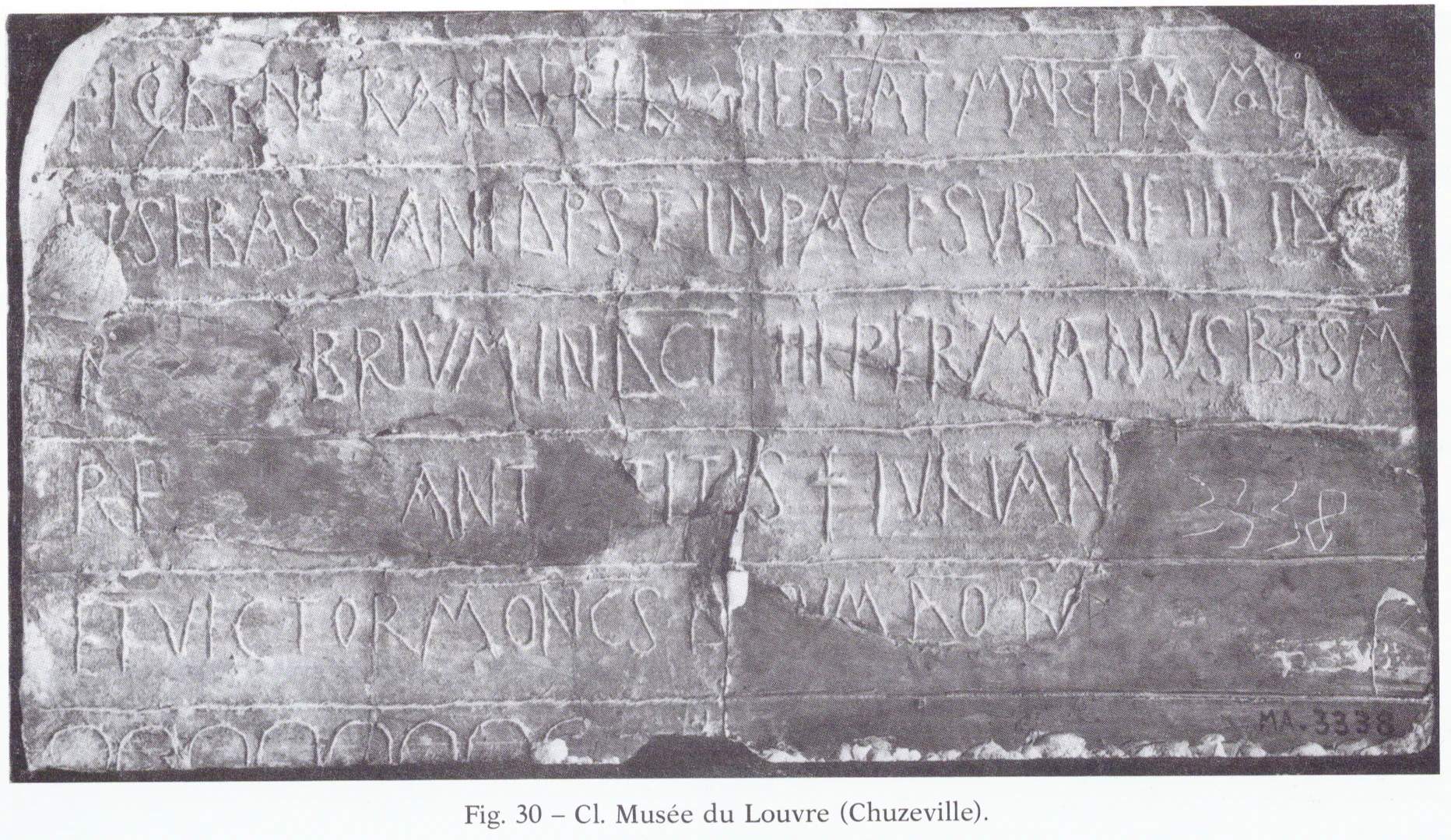
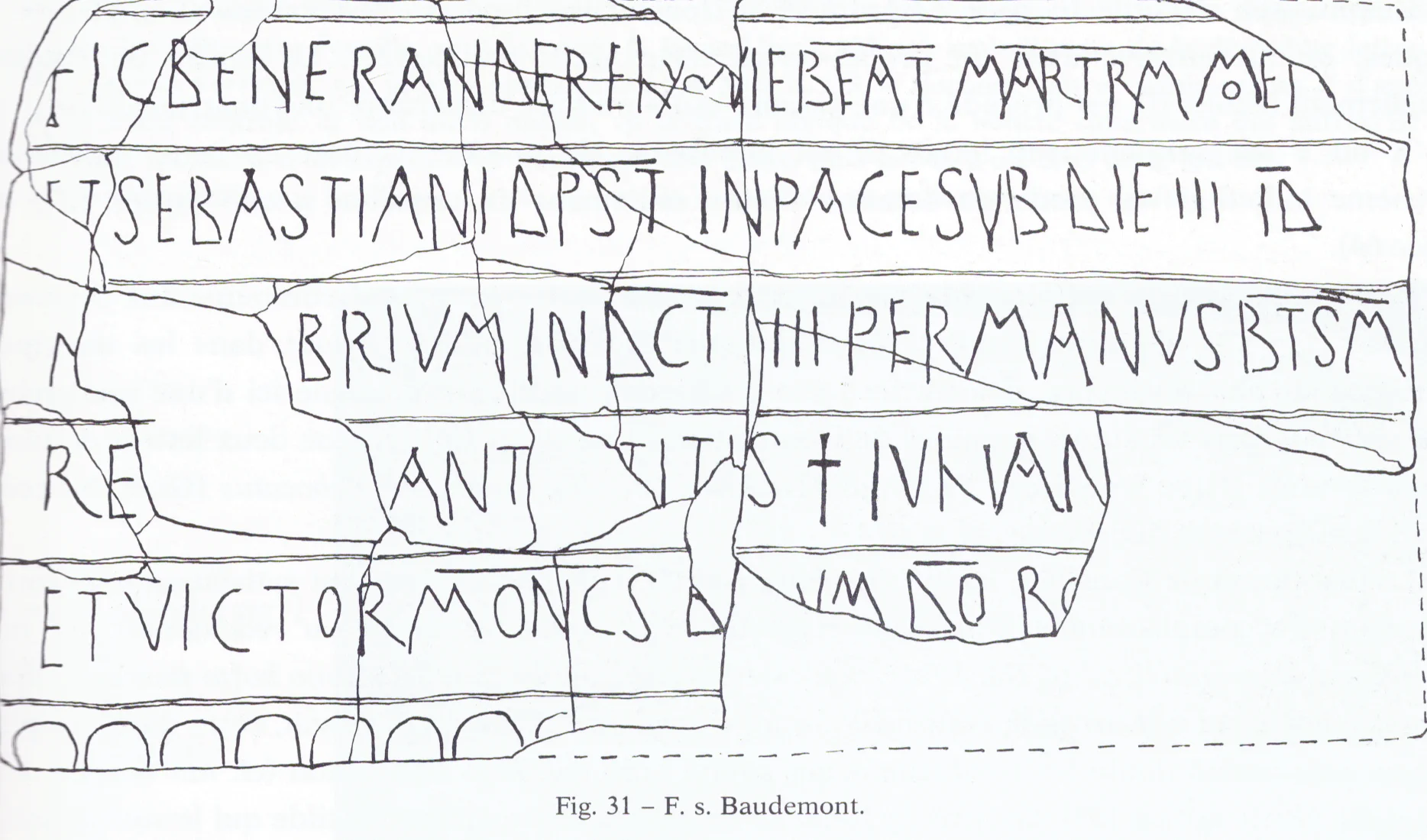
Ic benerande relyquie beat(orum) mart(y)r(u)m Moen[ae?]
et Sebastiani, d(e)p(o)s(i)t(e) in pace sub die III id(uum)
n[ovem]brium ind(i)ct(ione) III (or: IIII?) per manus b(ea)t(i)s(si)mi
Reb (or d) .... ant[is]titis. Iulian[us presb(yter)?]
et Victor mon(a)c(u)s b[ot]um D(e)o bo[verunt?]
'The table of the martyrs'
'Here [are] venerable relics of the blessed martyrs Menas and Sebastian, deposited in peace on the 3rd day before the Ides of November [11 November], in the 3rd (or 4th?) indiction, by the hand of the most blessed bishop Reb (?).
The presbyter(?) Iulianus and monk Victor made this vow to God'.
Text: Y. Duval 1982, no. 21.
Translation: Stanisław Adamiak.
Source
A marble slab, 75 x 40.5 x 8,5 cm, reconstructed from one large and seventeen smaller fragments found in 1896 in Henchir Fallous. 'Mensa marturym' is written on the edge of the slab, the longer inscription on its upper face. The inscriptions are not in the same hand, and so not necessarily contemporary.
Currently in the Musée du Louvre in Paris (inv. no. 3338).
Discussion
The first inscription identifies this as a table used for oblations near the tombs or relics of saints. The second one commemorates the deposition of relics in Byzantine times (proven by the use of the indiction in the date).
The saints in question are from outside Africa. Menas is the famous Egyptian saint, and 11 November is his usual feast day. The mention of Sebastian, martyr of Rome, is unique evidence of his cult in Africa.
Bibliography
Edition and discussion:
Duval, Y., Loca sanctorum Africae: Le culte des martyrs en Afrique du IVe au VIIe siècle (Rome: École Francaise de Rome, 1982), vol. 1, 44-48, no. 21.
Images
Captions for unavailable images
From Y. Duval 1982, no. 21
Associated saints
| Saint | Name in source | Certainty |
|---|---|---|
| Menas, soldier and martyr buried at Abu Mena (S00073) | Moena | Uncertain |
| Sebastianus, martyr of Rome (S00400) | Sebastianus | Certain |
Cult classifications
- Activities
- Feasting (eating, drinking, dancing, singing, bathing)
- Non Liturgical Activity
- Vow
- Relics
- Transfer, translation and deposition of relics; Transfer/presence of relics from distant countries; Unspecified relic
Record author
Stanisław Adamiak
Entry date
21/05/2019
Citation
Stanisław Adamiak, Cult of Saints, E07510 — https://csla.history.ox.ac.uk/record.php?recid=E07510