
E07517
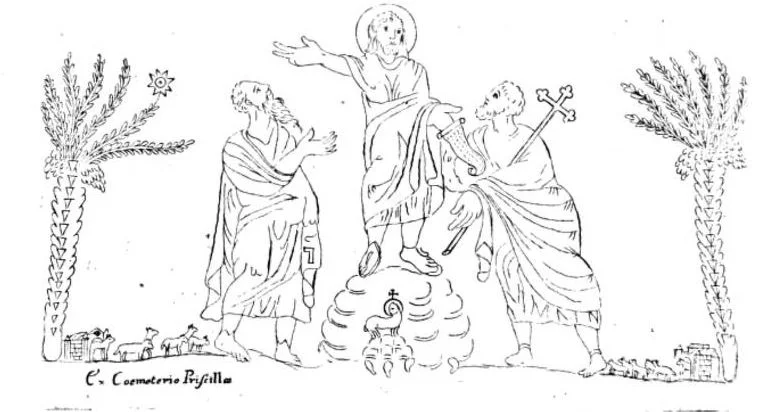
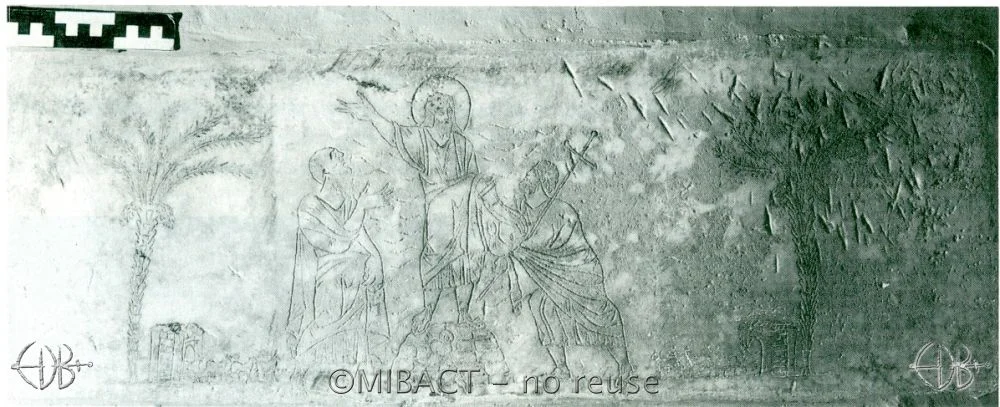
Funerary plaque with a carving showing unlabelled figures of *Peter (S00036) and *Paul (S00008) the Apostles, and Christ in the scene of the traditio legis. Found in the Catacombs of Priscilla on the via Salaria, Rome. Probably late 4th c. [provisional entry]
- Language
- Latin
- Date from
- 350
- Date to
- 400
- Evidence type
- Images and objects; Inscriptions
- Evidence subtype
- Funerary inscriptions; Narrative scenes; Sculpture/reliefs
- Evidence region
- Rome and region
- Evidence location
- Suburban catacombs and cemeteries; Rome, Rome, Roma, Ῥώμη, Rhōmē
- Cult region
- Rome and region
- Cult location
- Suburban catacombs and cemeteries; Rome, Rome, Roma, Ῥώμη, Rhōmē
- Cult date from
- 350
- Cult date to
- 400
Text
The carving is executed on a marble plaque, probably closing the aperture of a tomb in the catacombs, measuring H. 0.30 m; W. 0.85 m. Its existence was first reported by Giovanni Marangoni in 1740 (in his Acta S. Victorini, p. 42), who found it in the Cemetery of Priscilla on the via Salaria, and transferred it to the church of Saints Kosmas and Damianos in Anagni. Now in the lapidarium of the Cistercian monastery at Anagni (monastero delle suore Cistercensi della Carità).
The carving shows a bearded male figure with nimbus, standing on a small rock. He is raising up his right hand in the gesture of a conqueror or orator and, with his left hand, is passing a scroll with three lines of text to a male figure on his his left-hand side. The recipient of the scroll is holding a long cross, he is kneeling before the central figure, and looking into his face. He is also wearing a pallium, wrapped around his hands, through which he is going to hold the scroll. The figure on the opposite side is also bearded, and is reaching towards the central figure with his right hand. He is wearing a robe with the letter L or Γ. The three figures are flanked by palm trees. A phoenix with a nimbus and seven rays is shown on the right-hand one. Below the palm trees one can see schematic images of cities behind walls, and flocks of sheep (six animals in each of the two flocks). Three rivers flow out of the rock, and a small lamb with nimbus and a small superimposed cross is shown in front of it.
The scene is usually interpreted as the traditio legis, the ‘handling over of the law’.
The inscription on the scroll, although illegible, almost certainly read Dominus | legem | dat/'The Lord gives the law'. The central figure is Christ, the two men flanking him are the Apostles Peter (the recipient of the scroll) and Paul. The cities are probably Bethlehem and Jerusalem.
Discussion
The scene, conventionally dubbed traditio legis, is common in early Christian funerary art. Its actual meaning is, however, far from being clear. It is frequently found on sarcophagi and plaques in the catacombs, especially in Rome (in St Peter's, in the basilica of San Paolo fuori le mura, and at the ancient Basilica Apostolorum/the church of San Sebastiano on the via Appia), but also in Naples, Milan, Ravenna, Marseille, Arles, Pula in Istrien, and Nea Herakleia in the Balkans. We also find it on mosaics, pieces of gold glass, and reliquaries. The composition does not reflect any known scene from the Gospels or the extant apocrypha. A peculiar variant of the scene (presented on sarcophagi from Ravenna) is that where the scroll is given to Paul, not Peter. For a closer discussion, see, for example Rasmussen 2001, 21-52.
The editors of the Epigraphic Database Bari date the inscription to the late 4th c.
Bibliography
Edition:
Epigraphic Database Bari, no. EDB12899.
see http://www.edb.uniba.it/epigraph/12899
Solin, H., Tuomisto, P., Le iscrizioni urbane di Anagni (Rome: , 1996), 110 n. 185.
De Rossi, G.B., Ferrua, A., Mazzoleni, D. (eds.), Inscriptiones Christianae Urbis Romae Septimo Saeculo Antiquiores, n.s., vol. 9: Viae Salariae coemeteria reliqua (Vatican: Pont. Institutum Archaeologiae Christianae, 1985), no. 24303 (with further bibliography).
Marangoni, G., Acta Sancti Victorini episcopi amiterni et martyris (Rome: Typographum Vaticanum, 1740), 42.
Further reading:
Rasmussen, M.B., "Traditio legis - Bedeutung und Kontext", in: J. Fleischer, J. Lund, M. Nielsen (eds.), Late Antiquity: Art in Context (Acta Hyperborea 8, Copenhagen: Museum Tusculanum Press - University of Copenhagen, 2001), 21-52.
Images
Associated saints
| Saint | Name in source | Certainty |
|---|---|---|
| Paul, the Apostle (S00008) | Certain | |
| Peter, the Apostle (S00036) | Certain |
Cult classifications
- Cult Places
- Burial site of a saint - cemetery/catacomb; Burial site of a saint - crypt/ crypt with relics; Burial site of a saint - tomb/grave
- Use of Images
- Commissioning/producing an image; Public display of an image
Record author
Paweł Nowakowski
Entry date
06/04/2019
Citation
Paweł Nowakowski, Cult of Saints, E07517 — https://csla.history.ox.ac.uk/record.php?recid=E07517