
E07646
Latin epitaph on a marble plaque for a boy who served in the martyrium of an *unnamed martyr or martyrs(S00060), probably *Irenaeus (bishop and martyr of Lyon, S02832), and *Epipodius and Alexander (martyrs of Lyon, S00318). Found near the church of Saint Irenaeus in Lyon (south-east Gaul). Date: 546-606.
- Language
- Latin
- Date from
- 546
- Date to
- 606
- Evidence type
- Inscriptions
- Evidence subtype
- Funerary inscriptions
- Evidence region
- Gaul and Frankish kingdoms
- Evidence location
- Lyon; Maastricht, Maastricht, Traiectus Mosae, Traiectum
- Cult region
- Gaul and Frankish kingdoms
- Cult location
- Lyon; Maastricht, Maastricht, Traiectus Mosae, Traiectum
- Cult date from
- 546
- Cult date to
- 606
Text
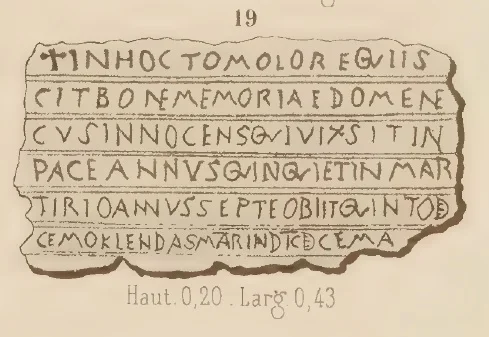
✝ In hoc tomolo requiis-
cit bone memoriae Domene-
cus innocens qui vixsit in
pace annus quinqui et in mar-
5 tirio annus septe. Obiit quinto de-
cemo K(a)lendas Mar(tias) indic(tione) decema.
'In this tomb rests Domenecus, an innocent, of good memory, who lived in peace for five years and [then] in the martyrium for seven years. He died on the fifteenth day before the Kalends of March [= 15 February], in the tenth indiction.'
Text: Le Blant, ICG, no. 37, p. 78.
Translation: David Lambert.
Source
Marble plaque. Dimensions: H. 0.21 m; W. 0.45 m; letter height 0.02-0.03 m (Reynolds 2000, 418). Found in 1835, near the church of Saint-Irénée in Lyon (Le Blant 1856, 78). The plaque is now held by the Louvre Museum in Paris.
The inscription is dated to approximately the second half of the 6th century on stylistic grounds. This means that the year of Domenecus' death, as the tenth year of an indication, would have been in one of the following years: 546, 561, 576, 591, or 606.
Discussion
The epitaph for Domenecus states that he lived 'in the martyrium' from the age of five until his death at the age of twelve, probably as a child oblate who served in the shrine. The inscription does not give the location of this martyrium or name the martyrs it commemorated, but it was found near the church of St Irenaeus (present-day Saint-Irénée, in late antiquity the church of St John), whose crypt contained the tombs of Irenaeus, the early bishop of Lyon, and of Epipodius and Alexander, all of whom received martyr cult in the 6th century (see E00570). It is most likely that this is the shrine referred to.
Bibliography
Editions:
Corpus Inscriptionum Latinarum XIII, no. 2412.
Le Blant, E., Inscriptions chrétiennes de la Gaule antérieures au VIIIe siècle, vol. 1 (Paris: Imprimerie impériale, 1856), no. 37, p. 78.
Diehl, E., Inscriptiones Latinae Christianae Veteres, vol. 1 (Berlin, 1925), no. 2024.
Ducroux, S., Catalogue analytique des inscriptions latines sur pierre conservées au Musée du Louvre (Paris: A. Merlin, 1975), 864.
Reynolds, P., "A Comparative and Statistical Survey of the Late Antique and Early Medieval Inscriptions of South-Eastern Gaul (c. 300-750 AD)" (Ph.D. thesis, University of Leicester, 2000), 418, no. 289.
Further reading:
Février, P.-A., et al., "Lyon", in N. Gauthier and J.-Ch. Picard (eds.), Topographie chrétienne des cités de la Gaule, vol. 4: Province ecclésiastique de Lyon (Lugdunensis Prima) (Paris, 1986), 15-35.
Le Mer, A.-C., Chomer, C., Carte archéologique de la Gaule, vol. 69/2: Lyon (Paris: Éditions de la Maison des sciences de l'homme, 2007), 509-510.
Images
Associated saints
| Saint | Name in source | Certainty |
|---|---|---|
| Martyrs, unnamed or name lost (S00060) | Certain | |
| Irenaeus, bishop and martyr of Lyon (S02832) | Uncertain | |
| Epipodius and Alexander, martyrs of Lyon (S00318) | Uncertain |
Cult classifications
- Cult Places
- Martyr shrine (martyrion, bet sāhedwātā, etc.)
- Non Liturgical Activity
- Consecrating a child, or oneself, to a saint
- People
- Children
Record author
Małgorzata Krawczyk; David Lambert
Entry date
29/06/2024
Citation
Małgorzata Krawczyk; David Lambert, Cult of Saints, E07646 — https://csla.history.ox.ac.uk/record.php?recid=E07646