
E08255
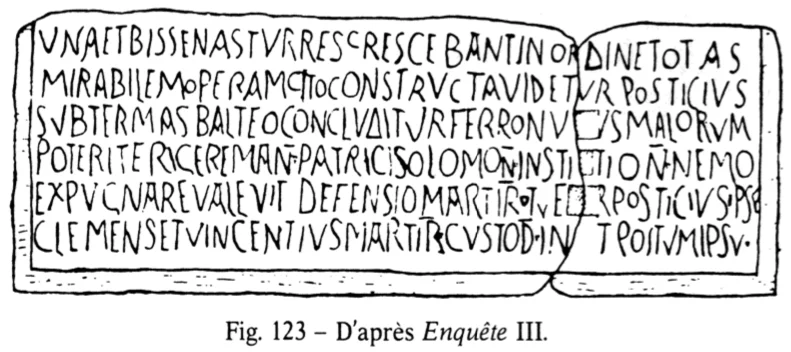
Latin inscription over a postern gate at Calama (Numidia, central North Africa), saying it is defended by the martyrs *Clemens/Clement (probably the bishop of Rome and martyr of the Crimea, S00111) and *Vincentius (deacon of Zaragoza and martyr of Valencia, S00290), built by the patricius Solomon as part of the fortifications of Calama, 539/544.
- Language
- Latin
- Date from
- 539
- Date to
- 544
- Evidence type
- Inscriptions
- Evidence subtype
- Inscribed architectural elements
- Evidence region
- Latin North Africa
- Evidence location
- Calama; ‘Ein Dab, ‘Ein Dab
- Cult region
- Latin North Africa
- Cult location
- Calama; ‘Ein Dab, ‘Ein Dab
- Cult date from
- 539
- Cult date to
- 544
Text
In seven awkward dactylic hexameters, laid out over six lines:
Una et bis senas turres crescebant in ordine totas. /
Mirabilem operam cito constructa videtur.
Posticius / sub termas balteo concluditur ferro.
Nu[ll]us mallorum / poterit erigere man(um),
Patrici Solomon(is) insti[tu]tion(em) nemo /(5) expugnare valevit.
Defensio martir(um) tuet[u]r posticius ipse, /
Clemens et Vincentius martir(es) custod(iunt) introitum ipsu(m).
'One and twice six towers grew in one sequence.
The admirable work seems to have been quickly built.
The postern gate by the baths is closed with an iron girdle.
No evil man will be able to raise his hand [against it],
Nobody will have the strength to break down this creation of the Patricius Solomon.
May the protection of the martyrs defend this gate,
The martyrs Clemens and Vincentius guard this entry.'
Text: Duval 1982, no. 88.
Translation: Stanisław Adamiak.
Source
Recorded in situ above a gate by one of the towers of the fortress. On a block 1.63 m long, with letters about 6 cm high. The inscription is no longer in place and its current location is unknown.
Discussion
Solomon was nominated patricius and sent back to Africa in 539, where he governed the province until his death in battle in 544 (Martindale 1992. II, 1173). This provides a close dating for this inscription.
Of the two saints mentioned here, Vincentius is certainly the deacon of Zaragoza and martyr of Valencia, whose veneration in Africa is well attested, particularly in the sermons of Augustine. The identity of Clemens is less certain: a local martyr is always possible, but probably the most likely identification is with Clemens, bishop of Rome and martyr of the Crimea, whose feast on 23 November is listed in the Calendar of Carthage (E02202); there is, however, no other evidence of his veneration in Africa. There is no obvious explanation for why this particular pair of saints were chosen as the protectors of this postern. Y. Duval speculates that relics of the saints were placed in the gates, or even small oratories erected there; but this is by no means certain.
A substantial number of inscriptions recording defensive building-works are known from Byzantine Africa, with several attributed to Solomon (they are collected in Pringle 1981, 318-332). A few mention the help of God or Christ in the execution of the work, but this inscription from Calama is unique in mentioning saints.
Bibliography
Editions:
Duval, Y., Loca sanctorum Africae: Le culte des martyrs en Afrique du IVe au VIIe siècle (Rome: École Française de Rome, 1982), vol. 1, 180-182, no. 88. With detailed commentary.
Corpus Inscriptionum Latinarum, no. 5352.
Further reading:
Martindale, J.R., The Prosopography of the Later Roman Empire III, A.D. 527-641 (Cambridge 1992), II, 1167-77, 'Solomon 1'.
Pringle, D., The Defence of Byzantine Africa from Justinian to the Arab Conquest (Oxford: British Archaeological Reports, international series 99, 1981).
Images
Associated saints
| Saint | Name in source | Certainty |
|---|---|---|
| Clemens/Clement, bishop of Rome, martyr of the Crimea (S00111) | Clemens | Uncertain |
| Vincentius/Vincent, deacon of Zaragoza and martyr of Valencia (S00290) | Vincentius | Uncertain |
Cult classifications
- Non Liturgical Activity
- Prayer/supplication/invocation; Saint as patron - of a community
- Places Names after Saint
- Gates, bridges and roads
- Recorded Miracles
- Miraculous interventions in war; Miraculous protection - of communities, towns, armies
- Religious Grouping
- Early/Nicene/Chalcedonian
Record author
Stanisław Adamiak
Entry date
16/11/2021
Citation
Stanisław Adamiak, Cult of Saints, E08255 — https://csla.history.ox.ac.uk/record.php?recid=E08255