
E08363
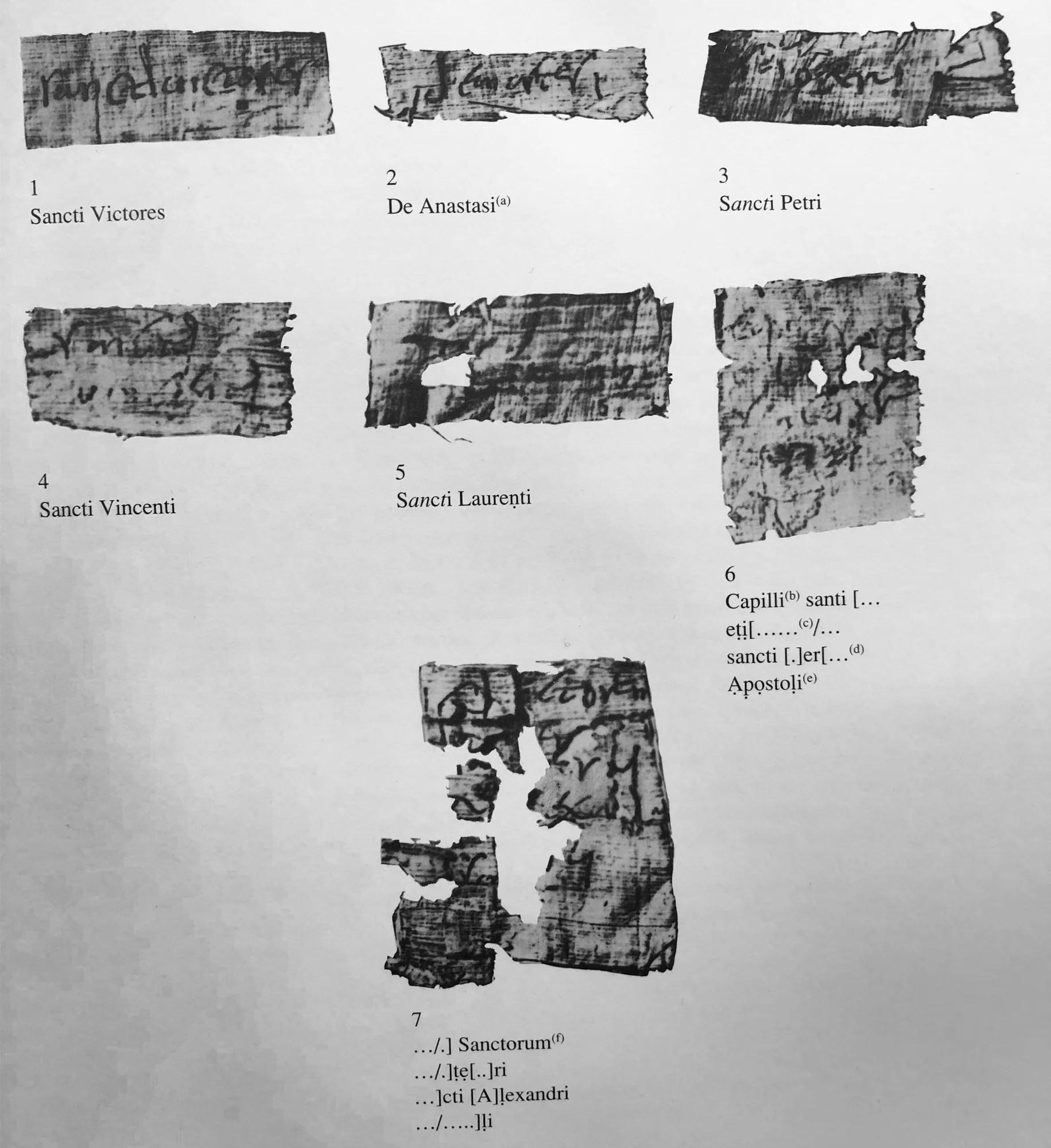
Seven relic labels from Cantù (north-west Italy), datable by their script to c. 700, for relics of various saints. Written in Latin, perhaps at Cantù, or possibly Rome or Milan.
- Language
- Latin
- Date from
- 700
- Date to
- 700
- Evidence type
- Documentary texts; Late antique original manuscripts
- Evidence subtype
- Papyrus sheet; Relic label
- Evidence region
- Italy north of Rome with Corsica and Sardinia; Rome and region
- Evidence location
- ; Rome, Rome, Roma, Ῥώμη, Rhōmē; Cantù; Sardinia, Sardinia, Sardegna, Sardinia; Milan; Sardinia, Sardinia, Sardegna, Sardinia
- Cult region
- Italy north of Rome with Corsica and Sardinia; Rome and region
- Cult location
- ; Rome, Rome, Roma, Ῥώμη, Rhōmē; Cantù; Sardinia, Sardinia, Sardegna, Sardinia; Milan; Sardinia, Sardinia, Sardegna, Sardinia
- Cult date from
- 700
- Cult date to
- 700
Text
Chartae Latinae Antiquiores, XXIX, no. 862
1.
Sancti Victores
'(Relics) of Saint Victor'
[possibly *Victor, soldier and martyr of Milan, S00312; or perhaps one of the martyrs of Rome, S00144 or S02229]
2.
De Anastasi
'[Relics] of Anastasius'
[probably *Anastasius, monk and martyr of Persia, ob. 628, S02052]
3.
Sancti Petri
'[Relics] of Saint Peter'
[*Peter, the Apostle, S00036]
4.
Sancti Vincenti
'[Relics] of Saint Vincent'
[probably *Vincent, deacon of Zaragoza and martyr of Valencia, S00290; or perhaps one of the martyrs of Rome, S01472 or S02866).'
5.
Sancti Laurenti
'[Relics] of Saint Laurence'
[*Laurence, deacon and martyr of Rome, S00037]
6.
Capilli santi [...] eti [...] sancti [.]er[...] Apostoli
'Of the hair of Saint (...) of Saint (...) Apostle.'
7.
[...] Sanctorum [...]te[..]ri [...]cti [A]lexandri [...]li
'(...) of Saints (...) of Saint Alexander'
[probably *Alexander, bishop and martyr of Rome, S00127; or perhaps the martyr of Bergamo, S01121).
Text: Tjäder et al., 1993
Translation: B. Savill.
Source
These seven relic labels (authentiques) were written on small strips of papyrus – perhaps, according to the view of their most recent editor, by two scribes working in a 'non-professional New Italian Cursive', c. 700 (scribe one: nos. 1-2; scribe two: nos. 3-7). The labels were discovered in the church of San Vincenzo di Galliano, outside Cantù (province of Como), and are now kept at the sacristy of San Paolo di Cantù. It is has not been established whether the labels were written in Rome (as preferred by Tjäder 1993), Cantù, or elsewhere.
For further collections of relic labels, see those extant from Saint-Maurice d'Agaune (E07438, E08075, E08076, E08077, E08078, E08079), Sens (E08315), Solignac (E08316) and the Roman Sancta sanctorum (E08361). The other major surviving collection, that of the nunnery of Chelles, does not include any items datable to before 700.
For full discussion of this category of evidence, see Smith 2020.
Discussion
Tjäder argues that there is a 'great probability that the relics came to Cantù from Rome.' However, he allows for the possibility that some may have come from Milan: in part because of the potentially Milanese identity of label no. 1's 'Victor', but also through the (extremely generous) reading of the fragmentary letters er in no. 6 as possibly deriving from 'Gervasius' (martyr of Milan: S00313). In fact, there is no reason to think that there might not have been various routes by which these relics could have ultimately made their way to Cantù, with the labels then written-up at a later stage (by two scribes working together? or on two separate occasions?) around the year 700.
Bibliography
Edition:
Tjäder, J.-O., et al., Chartae Latinae Antiquiores XXIX. Italy X (Dietikon-Zurich, 1993).
Further reading:
Smith, J.M.H., "The Remains of the Saints: The Evidence of Early Medieval Relic Collections," Early Medieval Europe 28 (2020), 388-424.
Images
Associated saints
Cult classifications
- Relics
- Bodily relic - nails, hair and bodily products; Collections of multiple relics; Transfer, translation and deposition of relics; Unspecified relic
Record author
Benjamin Savill
Entry date
19/11/2022
Citation
Benjamin Savill, Cult of Saints, E08363 — https://csla.history.ox.ac.uk/record.php?recid=E08363