
E08388
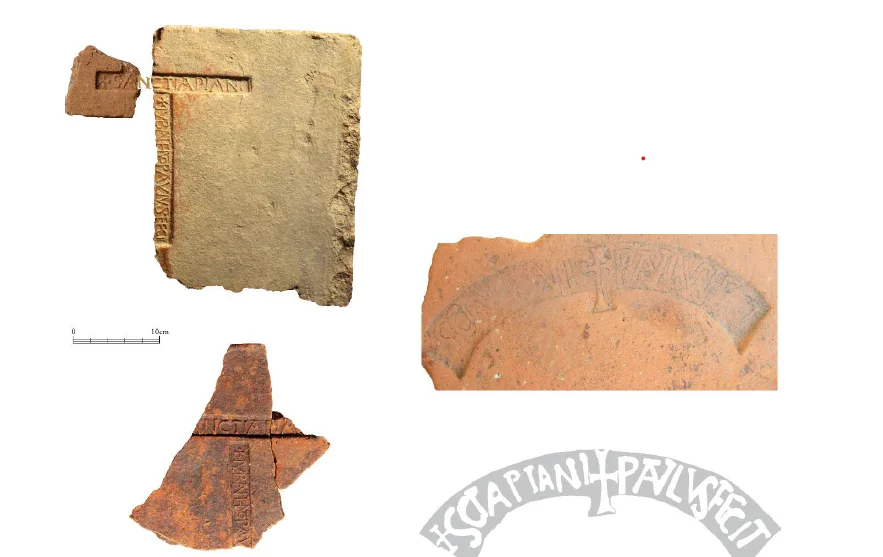
Stamped tiles with Latin inscriptions for *Apianus (saint venerated on Corsica, S03039), 'made by Paulus' and found at a church of the earlier 5th century at Sagone (west coast of Corsica). Early 5th century.
- Language
- Latin
- Date from
- 390
- Date to
- 450
- Evidence type
- Inscriptions
- Evidence subtype
- Inscribed architectural elements
- Evidence region
- Italy north of Rome with Corsica and Sardinia
- Evidence location
- Sagone; Sardinia, Sardinia, Sardegna, Sardinia
- Cult region
- Italy north of Rome with Corsica and Sardinia
- Cult location
- Sagone; Sardinia, Sardinia, Sardegna, Sardinia
- Cult date from
- 390
- Cult date to
- 450
Text
Tiles inscribed with name of Apianus
A number of tiles were discovered, bearing two different stamps:
Stamp 1:
Inscription in two lines arranged to form a Tau-cross:
+ SANCTI APIANI
+ IVBANTE D(E)O PAVLUS FECIT
'+ Of saint Apianus
+ at the command of God, Paulus made [this]'
Stamp 2:
Within a curved arc, the two halves of the inscription set either side of a prominent cross :
+S(AN)C(T)I APIANI + PAVLVS FECIT
'+ Of saint Apianus + Paulus made [this]'
Text: Istria 2021, 128.
Translation: Bryan Ward-Perkins
Source
These stamped tiles were found during excavations of a small single-aisled church at Sagone, a coastal settlement about halfway down the west coast of Corsica. The church's foundation-trench rendered pottery suggesting a date of building between about 410 and 450.
Stamp 1 is made up of two rectangular stamps, each 17.8 x 2.2 cm, arranged to form a Tau-cross. Stamp 2 is 14.3 cm long and between 1.8 and 2.2 cm wide. Stylistically a date in the earlier 5th century fits both stamps well.
Discussion
These tiles name the dedicatee of the church, a saint Apianus, and its builder, a certain Paulus. The phrase iubante Deo (literally, 'God commanding') is difficult to translate – it probably means that Paulus felt internally prompted by God to build the church.
Nothing certain is know about Apianus (and this is his sole appearance in our database). Much later medieval tradition said that he was an African bishop, in exile through Vandal persecution. Whoever he was, his cult at Sagone was durable, because in the 17th century it is recorded that he was the patron of the cathedral built at Sagone in the 12th century.
Paulus is presumably the same man as is mentioned on late-antique tiles found elsewhere at Sagone, on which he is described as follows: PA[V]LVS EP[I]SCOPVS CORSIC[AE]. If so he was a bishop holding, or at least claiming, overall authority in Corsica.
Bibliography
Edition:
Istria, D., "La basilique Saint-Appien de Sagone (Vico, Corse du Sud)," Mélanges de l'école française de Rome 133/1 (2021), 121-130. With full discussion of the site and tiles.
Images
Associated saints
| Saint | Name in source | Certainty |
|---|---|---|
| Apianus, saint venerated on Corsica (S03039) | Apianus | Certain |
Cult classifications
- Cult Places
- Cult building - independent (church)
- Non Liturgical Activity
- Construction of cult buildings
- People
- Ecclesiastics - bishops
Record author
Bryan Ward-Perkins
Entry date
04/02/2023
Citation
Bryan Ward-Perkins, Cult of Saints, E08388 — https://csla.history.ox.ac.uk/record.php?recid=E08388