
E01966
Greek building inscription just possibly for a church dedicated to a saint *Kosmas. Found at Umm Hartaine to the east of Apamea on the Orontes and Ḥamāh/Amathe (central Syria). Probably 5th-7th c.
- Language
- Greek
- Date from
- 450
- Date to
- 750
- Evidence type
- Inscriptions
- Evidence subtype
- Formal inscriptions (stone, mosaic, etc.)
- Evidence region
- Syria with Phoenicia
- Evidence location
- Apamea on the Orontes; Antioch on the Orontes, Ἀντιόχεια, Antiocheia, Antiochia ad Orontem, Ἀντιόχεια Μεγάλη, Ἀντιόχεια ἐπὶ Ὀρόντου, Antakya; Umm Hartayn; Antioch on the Orontes, Ἀντιόχεια, Antiocheia, Antiochia ad Orontem, Ἀντιόχεια Μεγάλη, Ἀντιόχεια ἐπὶ Ὀρόντου, Antakya; Ḥamāh; Antioch on the Orontes, Ἀντιόχεια, Antiocheia, Antiochia ad Orontem, Ἀντιόχεια Μεγάλη, Ἀντιόχεια ἐπὶ Ὀρόντου, Antakya
- Cult region
- Syria with Phoenicia
- Cult location
- Apamea on the Orontes; Antioch on the Orontes, Ἀντιόχεια, Antiocheia, Antiochia ad Orontem, Ἀντιόχεια Μεγάλη, Ἀντιόχεια ἐπὶ Ὀρόντου, Antakya; Umm Hartayn; Antioch on the Orontes, Ἀντιόχεια, Antiocheia, Antiochia ad Orontem, Ἀντιόχεια Μεγάλη, Ἀντιόχεια ἐπὶ Ὀρόντου, Antakya; Ḥamāh; Antioch on the Orontes, Ἀντιόχεια, Antiocheia, Antiochia ad Orontem, Ἀντιόχεια Μεγάλη, Ἀντιόχεια ἐπὶ Ὀρόντου, Antakya
- Cult date from
- 450
- Cult date to
- 750
Text
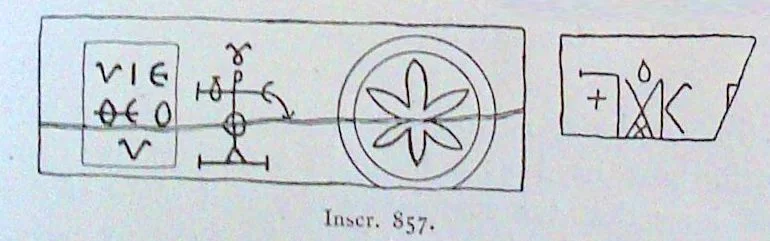
Two conjoining and one loose fragment of a lintel. Dimensions of the first two fragments: H. 0.53 m; W. 1.82 m; of the third fragment: H. 0.36 m; W. 0.72 m. The inscription is divided into three phrases, the first is written within a frame, the other two have the form of monograms. The first two phrases are probably invocations of Jesus and the Son of God. The last one was expanded by William Prentice as Κοσμᾶ/'Of Kosmas'. If so, our inscription could commemorate the construction of a church dedicated to Kosmas/Cosmas, a physician martyr in Syria and brother of Damianos (S00385). This interpretation is, of course, disputable, as the actual meaning of the last monogram is not clear and the figure is apparently not named ἅγιος/'saint'. Also Kosmas was usually venerated together with his brother and his individual cult seems unlikely.
Another possibility is that we have here the name of the donor or founder of a building.
If the inscription does refer to a saint Kosmas, it is possible that Kosmas, a local martyr of Sekizlar (near Manbij and al-Bab in north Syria) is the saint mentioned here. This Kosmas apparently died under the emperor Trajan and is attested by a single Syriac inscription (see: E01968).
See also E04563.
Bibliography
Edition:
Jalabert, L., Mouterde, R., Mondésert, Cl., Inscriptions grecques et latines de la Syrie, vol. 4: Laodicée, Apamène (BAH 61, Paris: Librairie orientalise Paul Geuthner, 1955), no. 1919.
Prentice, W.K. (ed.), Publications of the Princeton University of archaeological Expeditions to Syria in 1904-1905 and 1909, Division III: Greek and Latin Inscriptions, Section B: Northern Syria (Leyden: E.J. Brill, 1922), 22, no. 857.
Images
Associated saints
| Saint | Name in source | Certainty |
|---|---|---|
| Kosmas and Damianos, brothers, physician martyrs of Syria (S00385) | Κοσμᾶς | Uncertain |
| Kosmas, martyr of the area of Sekizlar (north Syria), ob. 110/111 (S01005) | Κοσμᾶς | Uncertain |
Cult classifications
- Cult Places
- Cult building - independent (church)
- Non Liturgical Activity
- Construction of cult buildings
Record author
Paweł Nowakowski
Entry date
28/10/2016
Citation
Paweł Nowakowski, Cult of Saints, E01966 — https://csla.history.ox.ac.uk/record.php?recid=E01966