
E01967
Greek building inscription just possibly for a church dedicated to a saint *Kosmas. Found at eṭ-Ṭayyibe to the east of Apamea on the Orontes and Ḥamāh/Amathe (central Syria). Probably 5th-7th c.
- Language
- Greek
- Date from
- 450
- Date to
- 750
- Evidence type
- Inscriptions
- Evidence subtype
- Formal inscriptions (stone, mosaic, etc.)
- Evidence region
- Syria with Phoenicia
- Evidence location
- Apamea on the Orontes; Antioch on the Orontes, Ἀντιόχεια, Antiocheia, Antiochia ad Orontem, Ἀντιόχεια Μεγάλη, Ἀντιόχεια ἐπὶ Ὀρόντου, Antakya; eṭ-Ṭayyibe; Antioch on the Orontes, Ἀντιόχεια, Antiocheia, Antiochia ad Orontem, Ἀντιόχεια Μεγάλη, Ἀντιόχεια ἐπὶ Ὀρόντου, Antakya; Ḥamāh; Antioch on the Orontes, Ἀντιόχεια, Antiocheia, Antiochia ad Orontem, Ἀντιόχεια Μεγάλη, Ἀντιόχεια ἐπὶ Ὀρόντου, Antakya
- Cult region
- Syria with Phoenicia
- Cult location
- Apamea on the Orontes; Antioch on the Orontes, Ἀντιόχεια, Antiocheia, Antiochia ad Orontem, Ἀντιόχεια Μεγάλη, Ἀντιόχεια ἐπὶ Ὀρόντου, Antakya; eṭ-Ṭayyibe; Antioch on the Orontes, Ἀντιόχεια, Antiocheia, Antiochia ad Orontem, Ἀντιόχεια Μεγάλη, Ἀντιόχεια ἐπὶ Ὀρόντου, Antakya; Ḥamāh; Antioch on the Orontes, Ἀντιόχεια, Antiocheia, Antiochia ad Orontem, Ἀντιόχεια Μεγάλη, Ἀντιόχεια ἐπὶ Ὀρόντου, Antakya
- Cult date from
- 450
- Cult date to
- 750
Text
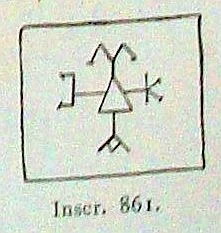
The inscription is written in the form of a framed cross-shaped monogram (H. 0.33 m; W. 0.28 m) on a lintel, at one of its ends. William Prentice suggested that the monogram should be expanded as Κοσμᾶ/'Of Kosmas.' This interpretation was accepted by René Mouterde. If so, our inscription could commemorate the construction of a church dedicated to Kosmas, a physician martyr of Syria and brother of *Damianos (S00385), but such a statement is, of course, disputable, as the figure is apparently not named ἅγιος/'saint'. Also Kosmas was usually venerated together with his brother and his individual cult seems unlikely.
Another possibility is that we have here the name of the donor or founder of a building.
If the inscription does refer to a saint Kosmas, it is possible that Kosmas, a local martyr of Sekizlar (near Manbij and al-Bab in north Syria) is referred to. This Kosmas apparently died under the emperor Trajan and is attested by a single Syriac inscription (see: E01968).
See also E04563.
Bibliography
Edition:
Jalabert, L., Mouterde, R., Mondésert, Cl., Inscriptions grecques et latines de la Syrie, vol. 4: Laodicée, Apamène (BAH 61, Paris: Librairie orientalise Paul Geuthner, 1955), no. 1918.
Prentice, W.K. (ed.), Publications of the Princeton University of archaeological Expeditions to Syria in 1904-1905 and 1909, Division III: Greek and Latin Inscriptions, Section B: Northern Syria (Leyden: E.J. Brill, 1922), 23, no. 861.
Images
Associated saints
| Saint | Name in source | Certainty |
|---|---|---|
| Kosmas and Damianos, brothers, physician martyrs of Syria (S00385) | Κοσμᾶς | Uncertain |
| Kosmas, martyr of the area of Sekizlar (north Syria), ob. 110/111 (S01005) | Κοσμᾶς | Uncertain |
Cult classifications
- Cult Places
- Cult building - independent (church)
- Non Liturgical Activity
- Construction of cult buildings
Record author
Paweł Nowakowski
Entry date
28/10/2016
Citation
Paweł Nowakowski, Cult of Saints, E01967 — https://csla.history.ox.ac.uk/record.php?recid=E01967