
E02012
Greek building inscription for a church (naos) dedicated to *Theodore (probably the soldier and martyr of Amaseia and Euchaita, S00480). Found at Jizeh, midway between Bostra and Adraha (north Roman province of Arabia). Probably the 6th c.
- Language
- Greek
- Date from
- 500
- Date to
- 600
- Evidence type
- Inscriptions
- Evidence subtype
- Formal inscriptions (stone, mosaic, etc.)
- Evidence region
- Arabia
- Evidence location
- Adraha; Sakkaia / Maximianopolis, Σακκαια, Sakkaia, Saccaea, Eaccaea, Maximianopolis, Shaqqa, Schaqqa, Shakka; Bosra; Sakkaia / Maximianopolis, Σακκαια, Sakkaia, Saccaea, Eaccaea, Maximianopolis, Shaqqa, Schaqqa, Shakka; Jizeh; Sakkaia / Maximianopolis, Σακκαια, Sakkaia, Saccaea, Eaccaea, Maximianopolis, Shaqqa, Schaqqa, Shakka
- Cult region
- Arabia
- Cult location
- Adraha; Sakkaia / Maximianopolis, Σακκαια, Sakkaia, Saccaea, Eaccaea, Maximianopolis, Shaqqa, Schaqqa, Shakka; Bosra; Sakkaia / Maximianopolis, Σακκαια, Sakkaia, Saccaea, Eaccaea, Maximianopolis, Shaqqa, Schaqqa, Shakka; Jizeh; Sakkaia / Maximianopolis, Σακκαια, Sakkaia, Saccaea, Eaccaea, Maximianopolis, Shaqqa, Schaqqa, Shakka
- Cult date from
- 500
- Cult date to
- 600
Text
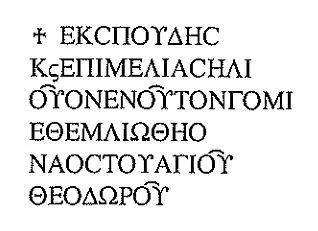
+ ἐκ σπουδῆς
κ(αὶ) ἐπιμελίας Ἠλί-
ου Ὀνενου ΤΟΝΓΟΜΙ
ἐθεμ<ε>λιώθη ὁ
ναὸς τοῦ ἁγίου
Θεοδώρου
[3. possibly ΤΟΥΗΓΟΥΜS Sartre Clermont-Ganneau, ΤΟΝΓΟΜΙ Savignac & Abel]
'+ By the efforts and under the supervision of <the abbot (?)> Elias, son of Onenos, the church (naos) of Saint Theodore was founded.'
Text: IGLS 13/2, no. 9714.
Translation: P. Nowakowski.
Source
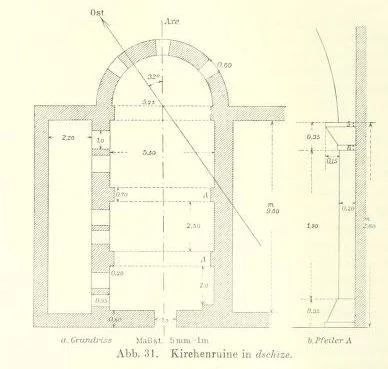
The inscription was reportedly carved on a stone from an arch in the church in Jizeh, surveyed by Gottlieb Schumacher in 1894, but does not appear in his report on the site. The text was first recorded, copied, and published in 1905 by Raphaël Savignac and Félix-Marie Abel who revisited Jizeh during their journey across the Hauran. The stone has never been seen again, though the site was thoroughly examined by Maurice Sartre. The present edition is by Sartre, based on the copy published by Savignac and Abel.
There is no published drawing or photograph and description.
Discussion
The inscription, as represented by Savignac and Abel, is not fully understandable (especially the exact meaning of line 3), but it certainly commemorates the construction of a church (naos) of Saint Theodore. The difficult line 3 contains probably the patronym of the founder of the church, Elias, and possibly a reference to his tribal affiliation τῶν Γομι/'of the Gomoi', as argued by the two first editors. On the other hand, Charles Clermont-Ganneau preferred to read the dubious passage as ΤΟΥΗΓΟΥΜS = τοῦ ἡγουμ(ένου)/'the abbot' (in the genitive form) and this explanation is accepted as more plausible by Maurice Sartre.
As for the identity of the saint, Sartre lists a number of obscure martyrs bearing this name, but he rightly points out that our Theodore was probably the martyr of Amaseia and Euchaita in Pontus (north-east Asia Minor), widely venerated in the East.
Dating: the inscription probably dates to the 6th c., when the cult of Theodore of Euchaita was becoming more and more popular. Also, our text might be more or less contemporary to the building inscription for the local church of *George, which is dated 538/539 (see: E02009) and to the inscription naming the martyr *Sergios, dated 590 (see: E02014).
Bibliography
Edition:
Sartre, M., Sartre-Fauriat, A. (eds.), Inscriptions grecques et latines de la Syrie, vol. 13/2: Bostra (Supplément) et la plaine de la Nuqrah (BAH 194, Beirut: Institut français du Proche-Orient, 2011), no. 9714.
Savignac, R., Abel, F.-M., "Glanures épigraphiques", Revue biblique 14 (1905), 597, no. 4
Further reading:
Clermont-Ganneau, Ch., “Nouvelles inscriptions latines et grecques du Haurân”, Recueil d'archéologie orientale 7 (1906), 179; 8 (1924), 79.
Sartre-Fauriat, A., "Georges, Serge, Élie et quelques autres saints connus et inédits de la province d'Arabie", in: Fr. Prévot (ed.), Romanité et cité chrétienne. Permances et mutations. Intégration et exclusion du Ier au VIe siècle. Mélanges en l'honneur d'Yvette Duval (Paris: De Boccard, 2000), 300.
Schumacher, G., "Das südliche Basan", Zeitschrift des deutschen Palästina-Vereins 20 (1897), 133-136.
Images
Associated saints
| Saint | Name in source | Certainty |
|---|---|---|
| Theodore, soldier and martyr of Amaseia and Euchaita (S00480) | Θεόδωρος | Uncertain |
Cult classifications
- Cult Places
- Cult building - independent (church)
- Non Liturgical Activity
- Construction of cult buildings
- People
- Ecclesiastics - abbots
Record author
Paweł Nowakowski
Entry date
18/11/2016
Citation
Paweł Nowakowski, Cult of Saints, E02012 — https://csla.history.ox.ac.uk/record.php?recid=E02012