
E02730
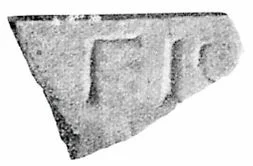
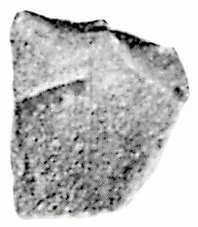
Two marble fragments, possibly of an inscribed reliquary, with remnants of a label in Greek, referring to saints/martyrs whose names are lost. Found at 'Ein Kerem, south-west outskirts of Jerusalem (Roman province of Palaestina I). Probably 5th-7th c.
- Language
- Greek
- Date from
- 500
- Date to
- 700
- Evidence type
- Archaeological and architectural; Inscriptions
- Evidence subtype
- Extant reliquaries and related fixtures; Inscribed objects
- Evidence region
- Palestine with Sinai
- Evidence location
- 'Ein Kerem; Caesarea Maritima, Καισάρεια, Kaisareia, Caesarea, Kayseri, Turris Stratonis; Jerusalem; Caesarea Maritima, Καισάρεια, Kaisareia, Caesarea, Kayseri, Turris Stratonis
- Cult region
- Palestine with Sinai
- Cult location
- 'Ein Kerem; Caesarea Maritima, Καισάρεια, Kaisareia, Caesarea, Kayseri, Turris Stratonis; Jerusalem; Caesarea Maritima, Καισάρεια, Kaisareia, Caesarea, Kayseri, Turris Stratonis
- Cult date from
- 500
- Cult date to
- 700
Text
Fragment A:
[- - -] ̣ἁγίω[ν - - - (?)]
ἁγίῳ Bagatti
'[- - -] of the saints [- - -]'
Fragment B:
[- - -]Υ[- - -]
Text: CIIP 1/2, no. 852.
Source
Two very small and non-conjoining marble fragments found in cistern M at 'Ein Kerem, in stratum b of its filling. For a description of the village, see E02723.
Fragment A: Broken and lost on all sides. Letter height 0.02 m. Almost certainly from the upper rim of a reliquary.
Fragment B: Broken and lost on all sides. Letter height 0.02 m. Possibly from the upper rim of a reliquary.
First published by Bellarmino Bagatti in 1948. Republished with a lightly modified restoration by Leah Di Segni in 2012, in the Corpus Inscriptionum Iudaeae/Palaestinae.
Discussion
The fragments, certainly belonging to the same reliquary, bear remnants of its label. Although their order is not clear, it is tempting to suggest the following restoration [λείψανα τῶν] ̣ἁγίω[ν μαρτ]ύ[ρων - - -]/[relics of the] holy [martyrs - - -], based on the text of other labels incised directly onto caskets with relics (see E01829). Of course other restorations are also possible, for example with the Υ from the second fragment interpreted as the ending of the name of a saint, in the genitive form.
Dating: Di Segni notes that as the filling of the cistern consists of Byzantine pottery, lamps, fragments of mosaics, and architectural elements, the basin must have been being used up to a considerably late period. The reliquary was produced earlier, probably in the 5th or 6th c.
Bibliography
Edition:
Cotton, H.M., Di Segni, L., Eck, W., Isaac, B., Kushnir-Stein, A., Misgav, H., Price, J.J., Yardeni, A. and others (eds.), Corpus inscriptionum Iudaeae/Palaestinae: A Multi-Lingual Corpus of the Inscriptions from Alexander to Muhammad, vol. 1, part 2: Jerusalem, nos. 705-1120 (Berlin, Boston: De Gruyter, 2012), no. 852.
Bagatti, B., Il Santuario della Visitazione ad 'Ain Karim (Montana Judaeae): Esplorazione archeologica e ripristino (Studium Biblicum Franciscanum. Collectio maior 5, Jerusalem: Tip. dei PP. Francescani, 1948), 76 and Pl. 22, figs. 46, 1-2.
Images
Associated saints
| Saint | Name in source | Certainty |
|---|---|---|
| Martyrs, unnamed or name lost (S00060) | Certain | |
| Saints, name lost or very partially preserved (S01744) | Certain |
Cult classifications
- Relics
- Reliquary – institutionally owned
Record author
Paweł Nowakowski
Entry date
21/04/2017
Citation
Paweł Nowakowski, Cult of Saints, E02730 — https://csla.history.ox.ac.uk/record.php?recid=E02730