
E02798
Limestone mould for the production of inscribed metal ampullae with labelled depictions of *Abraham (Old Testament patriarch, S00275), and *Daniel (Old Testament prophet, S00727). Found at Silwan/Siloam, close to Jerusalem (Roman province of Palaestina I). Late antique.
- Language
- Greek
- Date from
- 400
- Date to
- 700
- Evidence type
- Images and objects; Inscriptions
- Evidence subtype
- Inscribed objects; Lamps, ampullae and tokens; Narrative scenes; Other portable objects (metalwork, ivory, etc.)
- Evidence region
- Palestine with Sinai
- Evidence location
- Jerusalem; Caesarea Maritima, Καισάρεια, Kaisareia, Caesarea, Kayseri, Turris Stratonis
- Cult region
- Palestine with Sinai
- Cult location
- Jerusalem; Caesarea Maritima, Καισάρεια, Kaisareia, Caesarea, Kayseri, Turris Stratonis
- Cult date from
- 400
- Cult date to
- 700
Text
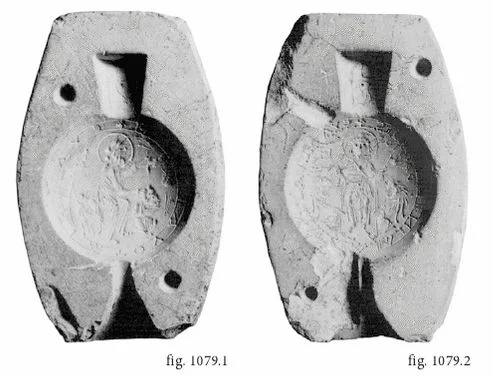
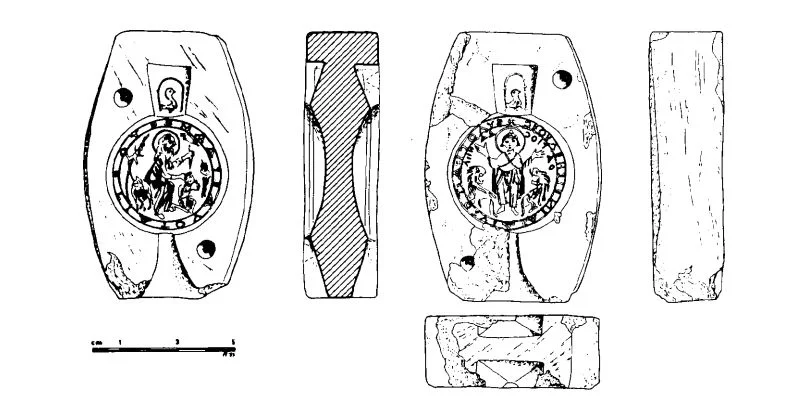
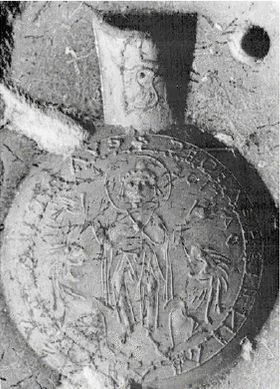
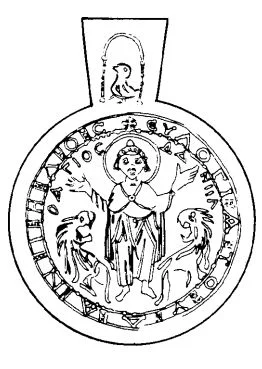
Two conjoining faces of a grey limestone mould. Each face has a concave space with images and inscriptions in mirror writing. In its upper left-hand side, Face 2 has a channel for the introduction of liquid metal (probably bronze). Dimensions: H. 0.093 m; W. 0.06 m; Th. 0.026 m. Letter height 0.002-0.003 m. Reportedly found at Silwan/Siloam near Jerusalem by a dealer in antiquities and acquired by the Museum of the Studium Biblicum Franciscanum in the spring of 1992. First published by Michele Piccirillo in 1994. We follow the edition by Leah Di Segni (2012).
Face 1:
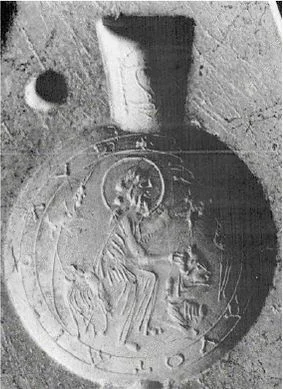
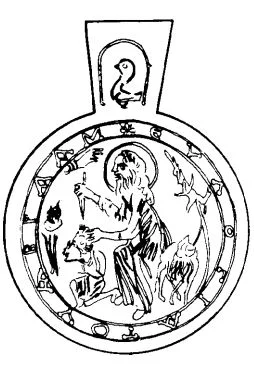
The middle of the mould shows the scene of the binding of Isaac. The central standing figure is Abraham with nimbus. He is holding a knife over a kneeling Isaac (much smaller than his father). Next to them one can see a burning altar, and a ram tied to a tree.
Inscription (running in a band around the scene):
+ εὐλογία τοῦ Ἀβραάμ
'+ Blessing of Abraham.'
Face 2:
In the middle one can see the scene of the prophet Daniel in the lions' den. The prophet has a nimbus, and is depicted en face, with raised arms, in the posture of an orant. He is flanked by two lions.
Inscription 1 runs in a band around the scene:
εὐλογία τοῦ Δανιῆλος
'Blessing of Daniel.'
Inscription 2 is positioned next to the head of the prophet:
ὁ ἅγιος Δανιήλ
'Saint Daniel.'
Text: CIIP 1/2, no. 1079.
Discussion
The mould was certainly used to produce ampullae for carrying holy oil or water from a pilgrimage sanctuary. Piccirillo hypothesises that the mould was owned by a workshop at Jerusalem or in its surroundings, which was a centre of production of ampullae ordered by several sanctuaries. It is not clear if the present mould was designed for a shrine specifically dedicated to Abraham and/or Daniel, but Piccirillo and Di Segni note that Jerusalem lies close to several sites where, for example, Abraham was likely to have been venerated. They are: the Tombs of the Patriarchs in Hebron, the Oak of Mamre (the site of Abraham's meeting with angelic envoys), and Mount Moriah, traditionally identified as the site of the binding of Isaac. For the first two, see: E00489; E02524.
A cave believed by early Christians to have been the biblical lions' den, was situated near Eleutheropolis ($EXXXX). Di Segni points out that the Piacenza Pilgrim mentions one such cave to the east of that city, probably at Beth Zur, while a modern survey revealed the existence of another cave with graffiti showing Daniel among lions at Tel Lavnin (see E04598).
It is notable that the label of Abraham, lacks the epithet ἅγιος/'holy' or 'saint', which is featured in the second label of Daniel. In addition, Di Segni notes that no feast of Abraham is recorded in the calendars used in churches at Jerusalem.
A similar mould was found in 1903, in the cemetery of Mount Zion (now also in the Museum of the SBF), but that object bears no inscriptions.
Bibliography
Edition:
Cotton, H.M., Di Segni, L., Eck, W., Isaac, B., Kushnir-Stein, A., Misgav, H., Price, J.J., Yardeni, A. and others (eds.), Corpus inscriptionum Iudaeae/Palaestinae: A Multi-Lingual Corpus of the Inscriptions from Alexander to Muhammad, vol. 1, part 2: Jerusalem, nos. 705-1120 (Berlin, Boston: De Gruyter, 2012), no. 1079.
Piccirillo, M., "Uno stampo per eulogia trovato a Gerusalemme", Liber Annuus 44 (1994), 585-590 and Pl. 47-49.
Reference works:
Bulletin épigraphique (1996), 488; (2012), 445.
Chroniques d'épigraphie byzantine, 742.
Supplementum Epigraphicum Graecum 44, 1359.
Images
Associated saints
| Saint | Name in source | Certainty |
|---|---|---|
| Abraham, Old Testament patriarch (S00275) | Ἀβραάμ | Certain |
| Daniel, Old Testament prophet (S00727) | Δανιήλ | Certain |
Cult classifications
- Activities
- Production and selling of eulogiai, tokens
- Cult Related Objects
- Ampullae, flasks, etc.; Other
- Non Liturgical Activity
- Pilgrimage; Visiting graves and shrines
- Relics
- Ampullae, eulogiai, tokens
- Use of Images
- Private ownership of an image
Record author
Paweł Nowakowski
Entry date
13/05/2017
Citation
Paweł Nowakowski, Cult of Saints, E02798 — https://csla.history.ox.ac.uk/record.php?recid=E02798