
E04598
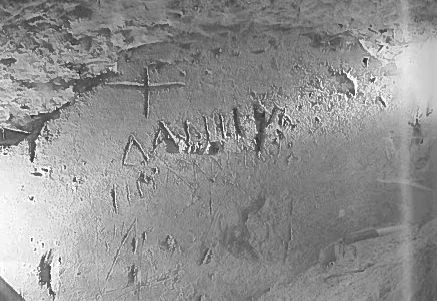
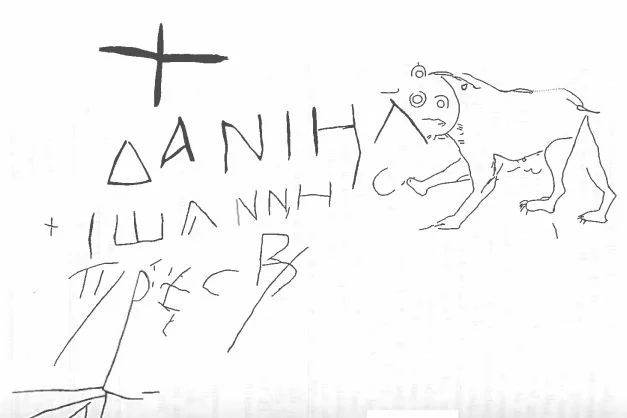
Greek graffito labelling a carving of a cross, and of a lioness, probably referring to the biblical story of *Daniel (the Old Testament Prophet, S00727) in the Lion's Den. Found in a cave at Tel Lavnin near Beit Guvrin and Eleutheropolis, in the Judean Hills (Roman province of Palaestina I). Probably 5th or 6th c.
- Language
- Greek
- Date from
- 450
- Date to
- 600
- Evidence type
- Images and objects; Inscriptions
- Evidence subtype
- Graffiti; Narrative scenes; Sculpture/reliefs; Wall paintings and mosaics
- Evidence region
- Palestine with Sinai
- Evidence location
- Eleutheropolis; Caesarea Maritima, Καισάρεια, Kaisareia, Caesarea, Kayseri, Turris Stratonis; Tel Lavnin; Caesarea Maritima, Καισάρεια, Kaisareia, Caesarea, Kayseri, Turris Stratonis
- Cult region
- Palestine with Sinai
- Cult location
- Eleutheropolis; Caesarea Maritima, Καισάρεια, Kaisareia, Caesarea, Kayseri, Turris Stratonis; Tel Lavnin; Caesarea Maritima, Καισάρεια, Kaisareia, Caesarea, Kayseri, Turris Stratonis
- Cult date from
- 450
- Cult date to
- 600
Text
In 1999 Boaz Zissu published a report of his exploration of the environs of Tell Lavnin near Eleutheropolis, where two rock-cut, bell-shaped artificial caves had been discovered by Yair Tzoran. The site (also called Tell el-Beida, and possibly identical with Libnah/Λοβανά, known to Eusebius of Caesarea) lies close to unidentified ruins unearthed by antiquities robbers. The caves were explored by Zissu with the aid of Nili and Abraham Graicer, and Alone Klein in 1998. The north cave houses a Greek inscription accompanied by a carving of a large cross, and of a lioness, almost certainly referring to the biblical story of Daniel in the Lion's Den.
The north cave
The north cave is accessible through a rectangular doorway carved in the rock. The interior of the cave widens towards the bottom. A stone staircase leads down to the bottom of the cave round the east, north, and west walls. The cave is about 7 m deep, and its maximum diameter is c. 6 m. The bottom of the cave is covered with dirt and debris, which has not been lifted, so the actual floor-level has not been explored. Cracks in the walls were filled in with plaster and pottery shards, which suggests that the cave was originally a cistern.
An inscription, carved on the upper part of the western wall, reads as follows:
+
Δανιήλ
+ Ἰωάννης
πρεσβ(ύτερος)
'+ Daniel. + Ioannes the presbyter.'
Text: Zissu 1999, 565.
A carving of a large cross is superimposed over the name Daniel. To the right of the inscription there is a scratched image of a lioness. Her body is facing left, and she is shown approaching the cross, but her head faces the reader. She has long claws on the hind legs. The editor notes that it is very likely that another lion(ess) was depicted symmetrically, to the left of the inscription, but only faint traces of eyes or ears are preserved.
The south cave
The south cave also has the shape of a bell. It is connected to the north cave through a hole in the upper section of the shared wall. The south cave is about 8 m deep, and has a diameter of about 6.5 m. Its interior is, likewise, accessible through a staircase which this time leads to a rock shelf. The shelf gives access to three rock-cut chambers, with walls covered by crosses. Their length varies from 3.6 to 7 m. The western chamber has a small front room and two inner ones.
Discussion
The editor probably rightly supposes that the inscription and the lioness refer to the story of the Prophet Daniel among lions, as described in Daniel 6:16-24. As the scene lacks a figural depiction of Daniel, he presumes that the prophet was identified with the cross superimposing the graffito. The author of the carving was probably the presbyter Ioannes mentioned below the name of Daniel. Zissu suggests that Ioannes was a hermit living in the chambers by the adjacent south cave (which can readily be identified as monastic cells), and that local monks were using the north cave as a cistern.
Leah Di Segni notes that there must have been a cult of the prophet Daniel in the territory of Eleutheropolis. She points out that first of all the Piacenza Pilgrim says that a cave believed to have been the site of Daniel's sojourn with the lions, was situated near Eleutheropolis (see EXXX Itinerarium, Recensio altera 32, CCSL 175, 168f.). She links this report with a mould for the production of ampullae, inscribed with the name of a 'Saint Daniel', and showing him in the posture of an orant among lions (see E02798), which was found in nearby Silwan/Siloam.
Our cave is, however, unlikely to be the very 'cave of Daniel' mentioned by the pilgrim, but rather was a hermitage decorated with graffiti and images inspired by a locally important cult of the prophet.
Dating: The graffito was also examined by Leah Di Segni who dates it to the second half of the 5th or the 6th c., based on the shape of letters.
Bibliography
Edition:
Zissu, B., "Daniel in the Lion's Den (?) at Tel Lavnin, Judaean Shephelah", La Revue biblique 106 (1999), 563-573.
Further reading:
Cotton, H.M., Di Segni, L., Eck, W., Isaac, B., Kushnir-Stein, A., Misgav, H., Price, J.J., Yardeni, A. and others (eds.), Corpus inscriptionum Iudaeae/Palaestinae: A Multi-Lingual Corpus of the Inscriptions from Alexander to Muhammad, vol. 1, part 2: Jerusalem, nos. 705-1120 (Berlin, Boston: De Gruyter, 2012), comments to no. 1079 (by Leah Di Segni).
Reference works:
Supplementum Epigraphicum Graecum 49, 2088.
Images
Associated saints
| Saint | Name in source | Certainty |
|---|---|---|
| Daniel, Old Testament prophet (S00727) | Δανιήλ | Certain |
Cult classifications
- Cult Places
- Cult building - monastic; Holy cave; Place associated with saint's life
- People
- Animals; Ecclesiastics - monks/nuns/hermits
- Use of Images
- Commissioning/producing an image; Public display of an image
Record author
Paweł Nowakowski
Entry date
13/01/2018
Citation
Paweł Nowakowski, Cult of Saints, E04598 — https://csla.history.ox.ac.uk/record.php?recid=E04598