
E05836
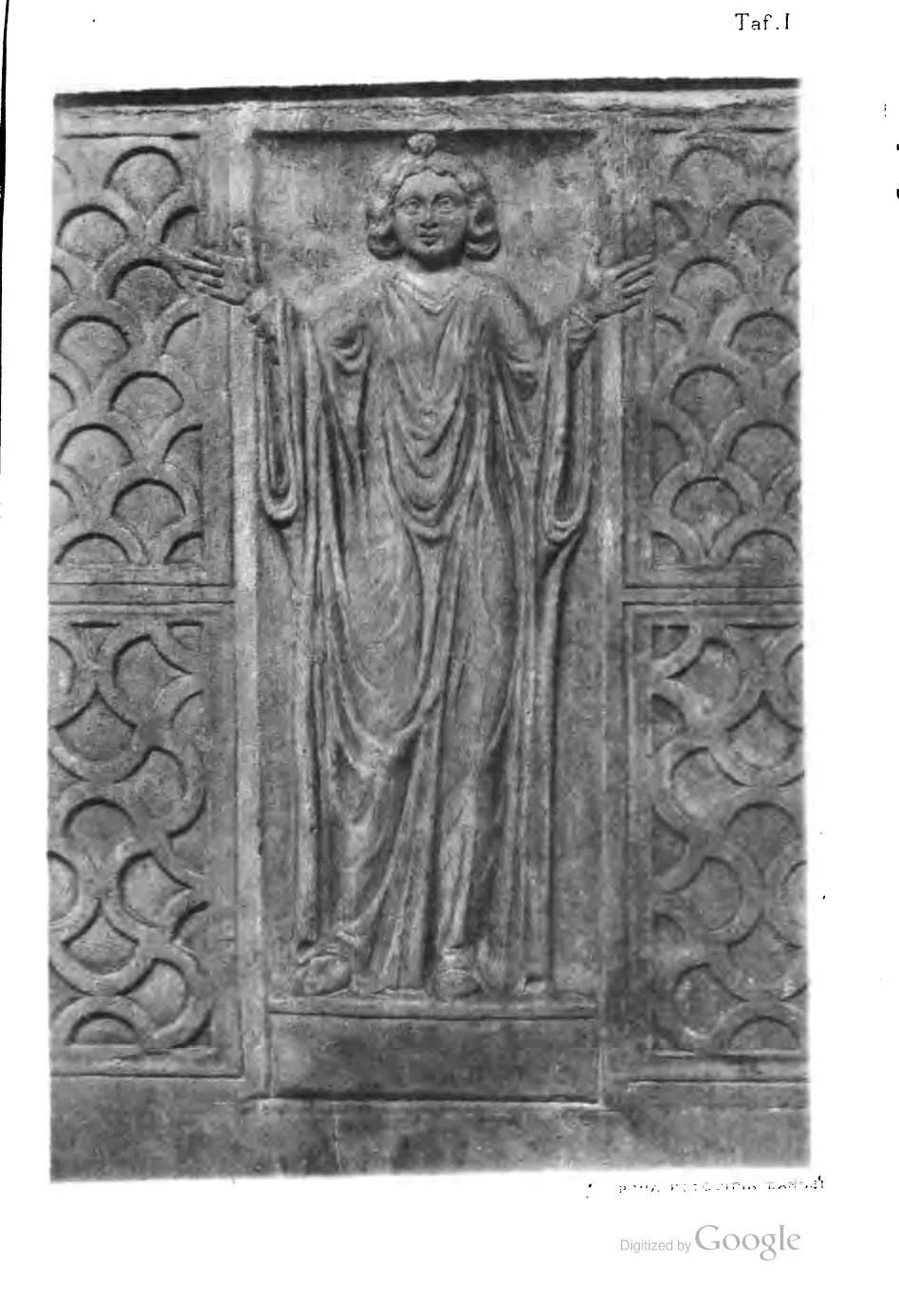
Image of a praying girl, on a marble plaque in low-relief, perhaps labelled as *Agnes (virgin and martyr of Rome, S00097). The label is, however, scarcely legible, and its text and date have been questioned. According to different reports found in the cemetery or church of Agnes on the via Nomentana (Sant'Agnese fuori-le-mua), Rome. Usually dated to the 4th c.
- Language
- Latin
- Date from
- 300
- Date to
- 400
- Evidence type
- Archaeological and architectural; Images and objects; Inscriptions
- Evidence subtype
- Formal inscriptions (stone, mosaic, etc.); Inscribed architectural elements; Internal cult fixtures (crypts, ciboria, etc.); Sculpture/reliefs
- Evidence region
- Rome and region
- Evidence location
- Suburban catacombs and cemeteries; Rome, Rome, Roma, Ῥώμη, Rhōmē
- Cult region
- Rome and region
- Cult location
- Suburban catacombs and cemeteries; Rome, Rome, Roma, Ῥώμη, Rhōmē
- Cult date from
- 300
- Cult date to
- 400
Text
Fragment of a marble plaque. H. 0.90 m; W. 1.30 m. Possibly from a latticework or a chancel screen. Decorated with geometrical patterns resembling conchs, with an image of a young woman in low-relief, shown in the posture of an orant. The female figure is about 0.68 m high. The inscription, scarcely legible, is scratched to the right and to the left of the head. Different editors suggested several contradictory readings which cannot be verified due to the present-day poor condition of the stone.
Mariano Armellini's reading:
SS ΛΝ NEΛS
s(ancti)s(sima) Anneas = 'The most holy Agnes'
This reading is the most widely accepted, and, for example, reproduced in the Epigraphic Database Bari as the basic text. Antonio Ferrua, was, however, unable to confirm it when he examined the stone. He managed to recognise just the damaged letters A and N. Ferrua also points out that Pietro Amato Frutaz was even more sceptical about the accuracy of Armellini's reading, calling it entirely imaginary.
Orazio Marucchi's reading:
SCA Agnes
s(an)c(t)a Agnes = 'Saint Agnes'
Rudolf Herzog's reading:
n(umerus) f(olii) 4 m(armorum) SS. Anneas = 'Number of the plaque: 4. Of the marbles (of the church of) the most holy Agnes.'
This reading is refuted by Ferrua.
As no inscription features in the earliest reports of the discovery of this carving, one can suppose that it is a later addition, resulting from a modern identification of the praying girl as Agnes. Similar images of unidentified praying women are, however, a common iconographic motive in Roman suburban cemeteries.
Text: ICVR, n.s., VIII, no. 20759 = EDB9579.
Source
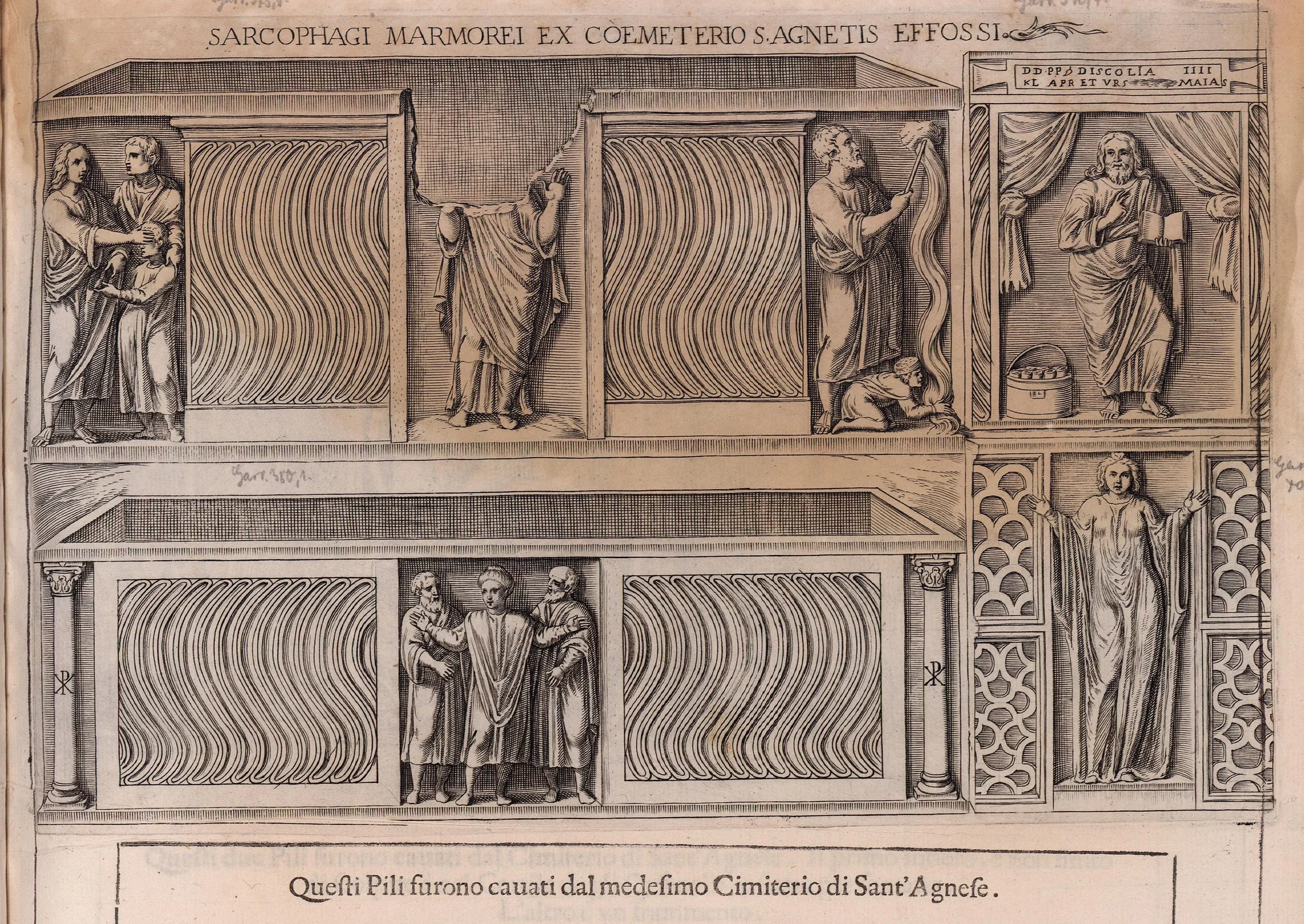
The stone is first recorded in the notes of Pompeo Ugonio (16th c.), and was first presented in print by Antonio Bosio in 1602. Ugonio reportedly saw it reused (?) in the pulpit of the church of Sant'Agnese. Bosio published a drawing together with some sarcophagi 'retrieved from the cemetery of Agnes' and together with a similar object, which, he claimed, were both 'pili' excavated form the cemetery. He, however, did not note the presence of the inscription. Since then the plaque has been re-examined by many scholars. For a list of editions up to 1983, see the lemma in ICVR, n.s., VIII, no. 20759 by Antonio Ferrua. According to the editors of the Epigraphic Database Bari the stone is now in the Capitoline Museums (aula cristiana II).
Discussion
For an inscription with a similar formula, see E05850.
Bibliography
Edition:
Epigraphic Database Bari, nos. EDB9579, see http://www.edb.uniba.it/epigraph/9579
De Rossi, G.B., Ferrua, A. (eds.) Inscriptiones Christianae Urbis Romae Septimo Saeculo Antiquiores, n.s., vol. 8: Coemeteria viarum Nomentanae et Salariae (Vatican: Pont. Institutum Archaeologiae Christianae, 1983), no. 20759 (with further bibliography).
Frutaz, A.P., Il complesso monumentale di S. Agnese (Rome: Tipografia poliglotta vaticana, 1976), 178, note 120.
Herzog, R., "Zwei griechische Gedichte des 4. Jahrhunderts aus St. Maximin in Trier: II. Gedicht auf die hl. Agnes", Trierer Zeitschrift für Geschichte und Kunst des Trierer Landes und seiner Nachbargebiete 13 (1938), 91.
Armellini, M., Gli antichi cimeteri cristiani di Roma e d'Italia (Rome: Tipografia poliglotta, 1893), 273.
Armellini, M., "Die neu entdeckte Frontseite des ursprüngl. Altars der h. Agnes", Römische Quartalschrift für christliche Altertumskunde und Kirchengeschichte (1889), 65 Taf. 1.
Armellini, M., "", Cronachetta mensuale di scienze naturali e d'archeologia (1885), 13.
Armellini, M. (ed) in: O. Marucchi, "Conferenze della società di cultori della cristiana archeologia in Roma", Bullettino di archeologia cristiana 4. Ser. 3 (1885), 128
Bosio, A., Roma sotteranea (Rome: Appresso Guglielmo Facciotti, 1632), 429.
Further reading:
Lapidge, M., The Roman Martyrs. Introduction, Translations, and Commentary (Oxford: OUP, 2018), chapter XVII.
Images
Associated saints
| Saint | Name in source | Certainty |
|---|---|---|
| Agnes, virgin and martyr of Rome (S00097) | Anneas, Agnes | Uncertain |
Cult classifications
- Cult Places
- Burial site of a saint - cemetery/catacomb; Cult building - independent (church)
- Use of Images
- Public display of an image
Record author
Paweł Nowakowski
Entry date
20/06/2018
Citation
Paweł Nowakowski, Cult of Saints, E05836 — https://csla.history.ox.ac.uk/record.php?recid=E05836